
dies academicus 2026: Training Program for Sustainable Entrepreneurship Honored with Transfer Award
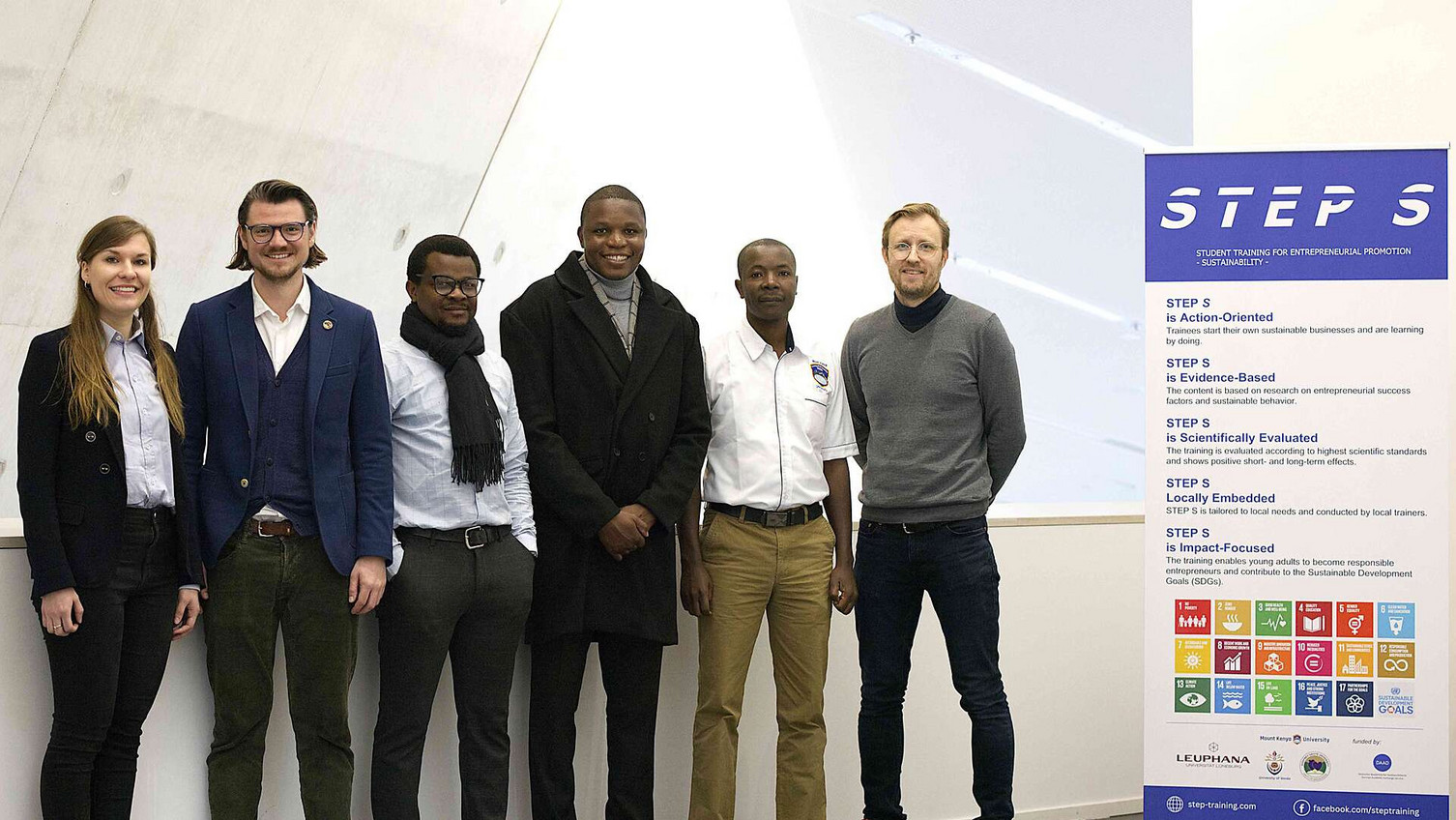
2026-08-12 How can we empower people to start their own businesses, take on responsibility, and actively shape their economic future? For many years, STEP has been successfully researched and implemented in countries of the Global South. Together with doctoral candidates Janina Peschmann and Paul Herrmann, Prof. Dr. Michael Gielnik has further developed the training program and systematically integrated sustainability aspects.
 ©Leuphana
More than 60,000 people in the Global South have already participated in STEP or STEP Sustainability (STEP S). Randomized controlled trials demonstrate the program’s impressive impact: Two years after the training, 50% of STEP participants had started their own businesses, compared to 41% in the control group. This corresponds to an increase in the probability of starting a business of approximately 22%.
The success lies in the training concept: “Fundamentally, the business idea is not as important for entrepreneurial success as the act of taking action itself,” explains Michael Gielnik, who has provided scientific support for the project for over 20 years and is one of the founding fathers of STEP. Program participants are developed not only in terms of business management but, above all, psychologically: Strengthening self-confidence and initiative, building networks, increasing perseverance, and learning to cope with personal failure are key components of the training.
Fundamental to STEP is “learning by doing” between the scheduled training sessions: During the twelve-week program, participants launch a small business to quickly gain experience in independent action. Step by step, they build a sustainable business. It is explicitly intended that participants start with a small, easily implementable business idea. Such ideas range from a beverage stand to a story-reading contest to the sale of bath mats made from trash bags.
With STEP Sustainability, the focus is no longer solely on entrepreneurial success but also on responsibility toward the environment and the community. “We want to convey that economic success and social responsibility go hand in hand,” explains the professor of psychology, specializing in entrepreneurship. Initial evaluation results show that the economic success of these young entrepreneurs is not diminished by the additional focus on sustainability.
A distinctive feature of STEP is the so-called “train-the-trainer” concept. “Our goal is for the programs to continue independently of us in the long term,” explains Michael Gielnik. The concept has proven successful: Many partner universities now continue the entrepreneurship training on their own and adapt it to the needs of their target groups.
The two doctoral candidates, Janina Peschmann and Paul Herrmann, support the project and also conduct training themselves in partner countries such as Kenya, Nigeria, and South Africa: “STEP was originally aimed at university students, but has since been successfully expanded to include many other target groups—from young women in West Africa to teacher candidates, who in turn serve as multipliers,” explains project coordinator Janina Peschmann.
Paul Herrmann oversees the Nigeria region in particular: “I’m impressed by how inspiring the entrepreneurial spirit of the young training participants is even while the entrepreneurship program is still underway.”
In addition, two spin-offs from Leuphana - MOVE Entrepreneurship Training Institute and Doorways gGmbH - now offer the training independently worldwide, thereby reaching even more people.