
Professor Florian Stamer: Economic Resilience Through Sustainability
2026-09-22 Whether it’s the Strait of Hormuz, low water levels in Europe, or the coronavirus—it’s becoming increasingly clear that industry must become more resilient to crises. Due to unstable global supply chains, companies often resort to costly measures such as maintaining larger inventories, working with more suppliers, and increasing inspection efforts. In this interview, Prof. Dr. Florian Stamer, Professor of Production Management, explains how companies can become more resilient while saving resources, the crucial role artificial intelligence can play in resilient production, and how collaboration between research and industry benefits both sides.
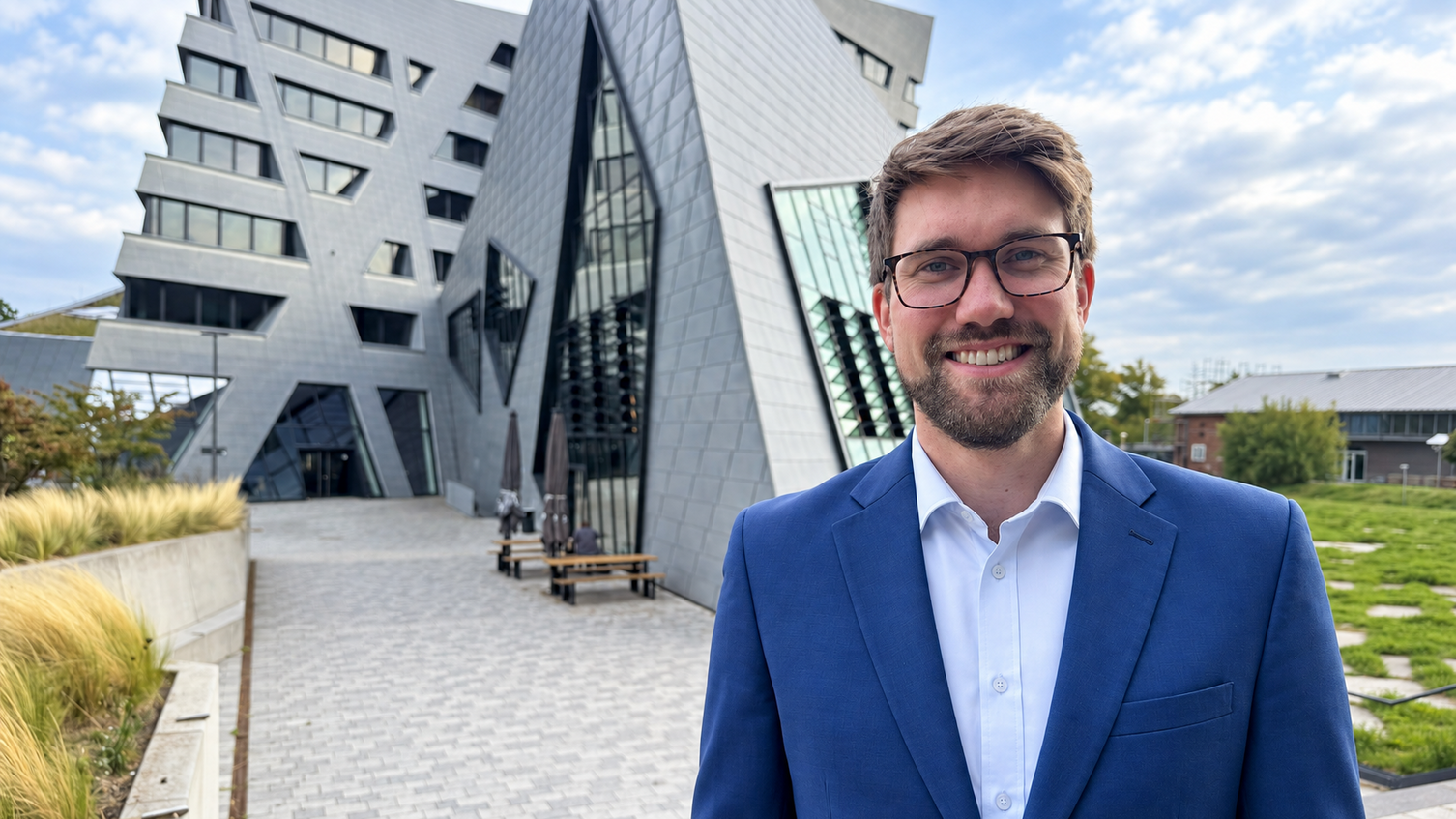
To ensure resilient production, many companies are relying on larger inventories to avoid dependence on unstable supply chains. What is your take on this?
Florian Stamer: Resilience is a very important issue. However, larger inventories aren’t ideal. One alternative is to invest more heavily in circular systems. This means transforming global, linear supply chains into local circular systems: keeping imported resources in circulation, retrieving products from the market, remanufacturing them, and reusing the raw materials. This makes a company more robust - and, almost as a side effect, protects the environment.
Artificial intelligence (AI) plays a major role in your research. How can AI help build resilience?
For me, AI is a key enabler of sustainable production. In circular production, I have to analyze the utility value of used products on a per-item basis and decide what to do with them - a complex process that usually only a very experienced person can handle. This is a bottleneck and results in high costs. This is where AI comes into play: It can process unstructured information such as photos or text and immediately determine whether a product is still usable, needs to be disassembled, or requires cleaning. This dramatically reduces costs, which is what makes the products competitive in the first place.
How can research, for example at Leuphana, contribute to this?
For one thing, we are actively involved in the Leuphana Innovation Community for Sustainable Production, through which we are organizing the upcoming Industry Colloquium (see link below) and researching how sustainable production must be organized in collaboration with industry. For another, we are investigating how companies can implement AI to solve planning tasks - using both traditional machine learning and large language models (LLMs). A machine learning model can detect in milliseconds whether 3,285 screws have been installed instead of 3,286. An LLM, on the other hand, is good at handling unstructured data - such as identifying whether a surface defect is present.
So does AI primarily make processes more efficient?
Especially in times of a skilled labor shortage, it’s a tool that companies can utilize. As is always the case with new technologies, it’s virtually impossible to do without it in a competitive environment.
What advantages can companies gain from collaborating with researchers - for example, within the Sustainable Production Innovation Community - that they cannot achieve on their own?
On the one hand, our partners gain a different perspective from the academic world, which can provide new impetus. On the other hand, small and medium-sized enterprises in particular often lack the funds for a broad-based development department. Here, we can do valuable work and show which approach can work - which minimizes the investment risk. The Leuphana Industry Colloquium brings these elements together. In addition, industrial companies can exchange ideas with one another. This allows them to network more effectively and gain inspiration for their own processes.
Thank you very much!