
DAAD Prize for International Students: Rudo Femuko – Turning Obstacles into Business Ideas
2026-11-18 The doctoral candidate from Zimbabwe is researching how people with an immigrant background build businesses in Germany. Through her own experience in startup consulting and the intercultural initiative Unity Cuisine, the 34-year-old now supports young founders herself and demonstrates how we can turn societal problems into business opportunities.
The good business opportunities are there, and so is the entrepreneurial spirit. But for people with a migration background, it’s often particularly difficult to build a business: German bureaucracy is hard to navigate, long-established networks are lacking, and accessing sustainable financing is difficult. But what strategies do people develop when they encounter such additional obstacles while starting a business? Rudo Femuko is exploring this question in her ongoing dissertation project “Venture Creation and Strategies under Adversity: The Entrepreneurship of Afro-Germans.” The project is supervised by Prof. Dr. Hannah Trittin-Ulbrich and Prof. Dr. Steffen Farny.
Rudo Femuko has firsthand experienced how difficult starting a business can be for people with an immigrant background. She grew up on a rural area - Chipinge in Zimbabwe. Her parents were subsistence farmers. When school tuition was due, her father had to sometimes sell a cow, as this was their primary source of income: “Study and help make the world a better place,” her father had urged. Rudo Femuko promised she would. After school, she went to Algeria and studied Financial and Banking Economics there.
Having grown up in a rural setting and being well aware of social issues, she decided to pursue the master’s program in Sustainability Science at Leuphana University in Lüneburg: “I really wanted to learn everything about sustainability and business because sustainable business in one promising way through which we can solve problems in our society.”
She wrote her master’s thesis on Cradle to Cradle Farming Business. Today, she teaches on how we translate and operationalize sustainability in business model designing using a live case project – Unity Cuisine that she concepted in 2023. In this seminar on
sustainable business models, students also learn about the intercultural aspect of Unity Cuisine, and how the initiative combines sustainable cooking class for companies with the economic participation of migrants. “Above all, I learned how important networking is when starting a business.” Unity Cuisine aims primarily to offer opportunities to migrant entrepreneurs. The assignment in the seminar is to examine the path from a project idea to a viable business offering. This involves, for example, sustainable supply chains, inclusive organizational structures, and sustainable revenue models. Since 2022, she became part of the founding team of Utopia Lüneburg, a startup Centre for social and sustainability business. There, she experienced just how much work lies between an idea and the moment when others can actually make use of it. She also advises young founders there. "I am not a German citizen by law, but I am a member of my city, Lüneburg. That means a lot to me, and I want to contribute to my community." she says.
For the 34-year-old mother of four, it’s a labor of love: bringing people together, empowering those from less priviledged background, and help solve problems as a resident of Lüneburg.
She kept her promise to her father.
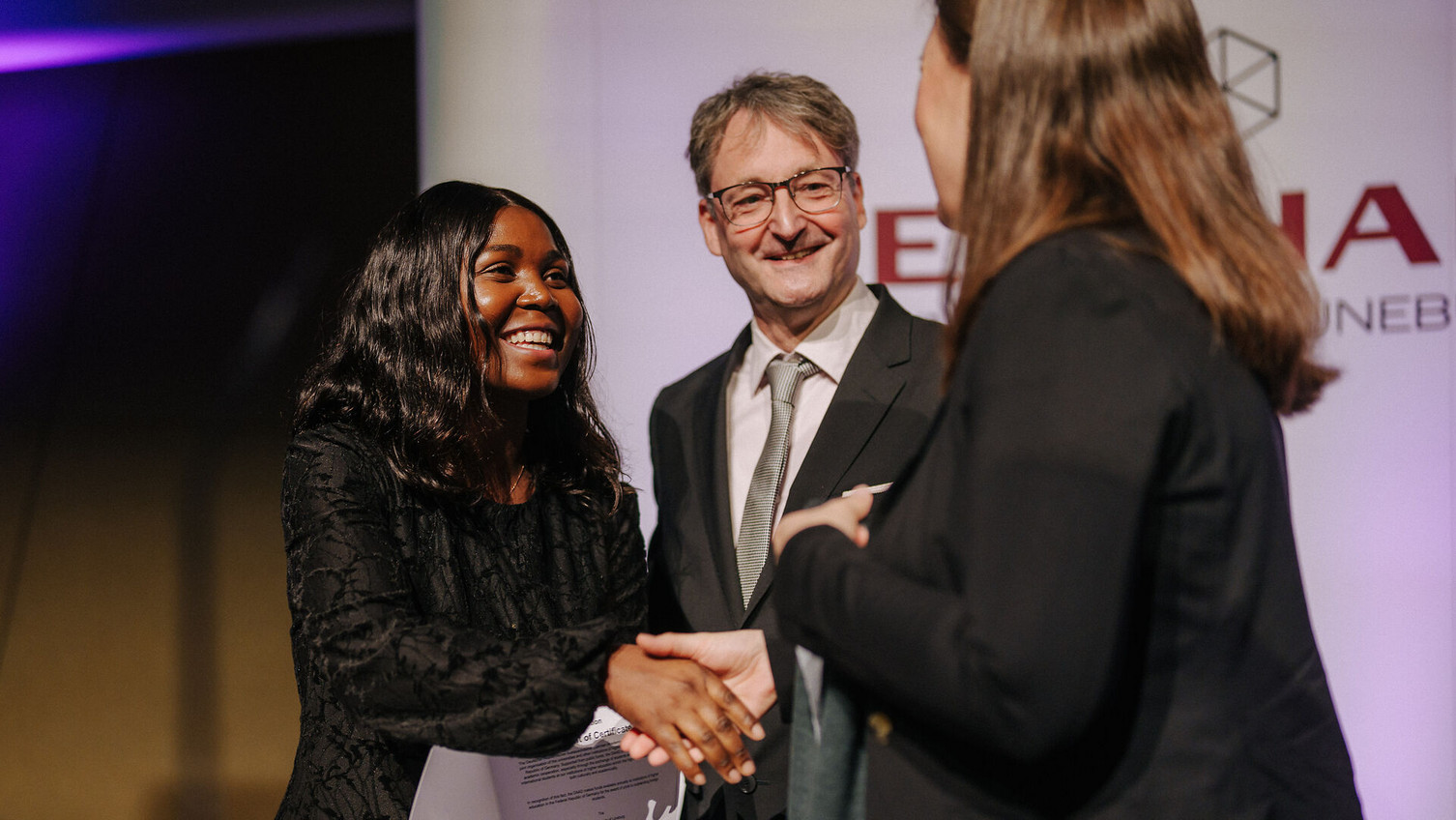
The DAAD Award for Outstanding Academic Achievement and Social/Community Engagement, which comes with a cash prize of 1,000 euros, is intended to raise public awareness of the enrichment that universities and society derive from international students. The German Academic Exchange Service (DAAD) has been awarding this prize annually at Leuphana University Lüneburg for more than ten years. The prize money is raised by the International Center, and the recipients are nominated by faculty members or other individuals.