
Grumbling through the exhibition
Leuphana Creative Space
2026-04-14 Leuphana students are exhibiting robots they have built themselves at the Long Night of Museums in Hamburg.
When the doors open for Digital Science Night at the Museum of Work on 18 April 2026, visitors will also be able to see three unusual robots from Lüneburg. They were developed by Siri Malin Weber and Julius Waschl, engineering students at Leuphana University Lüneburg. The projects were created at the Leuphana Creative Space – and they are anything but conventional technical demonstrations.
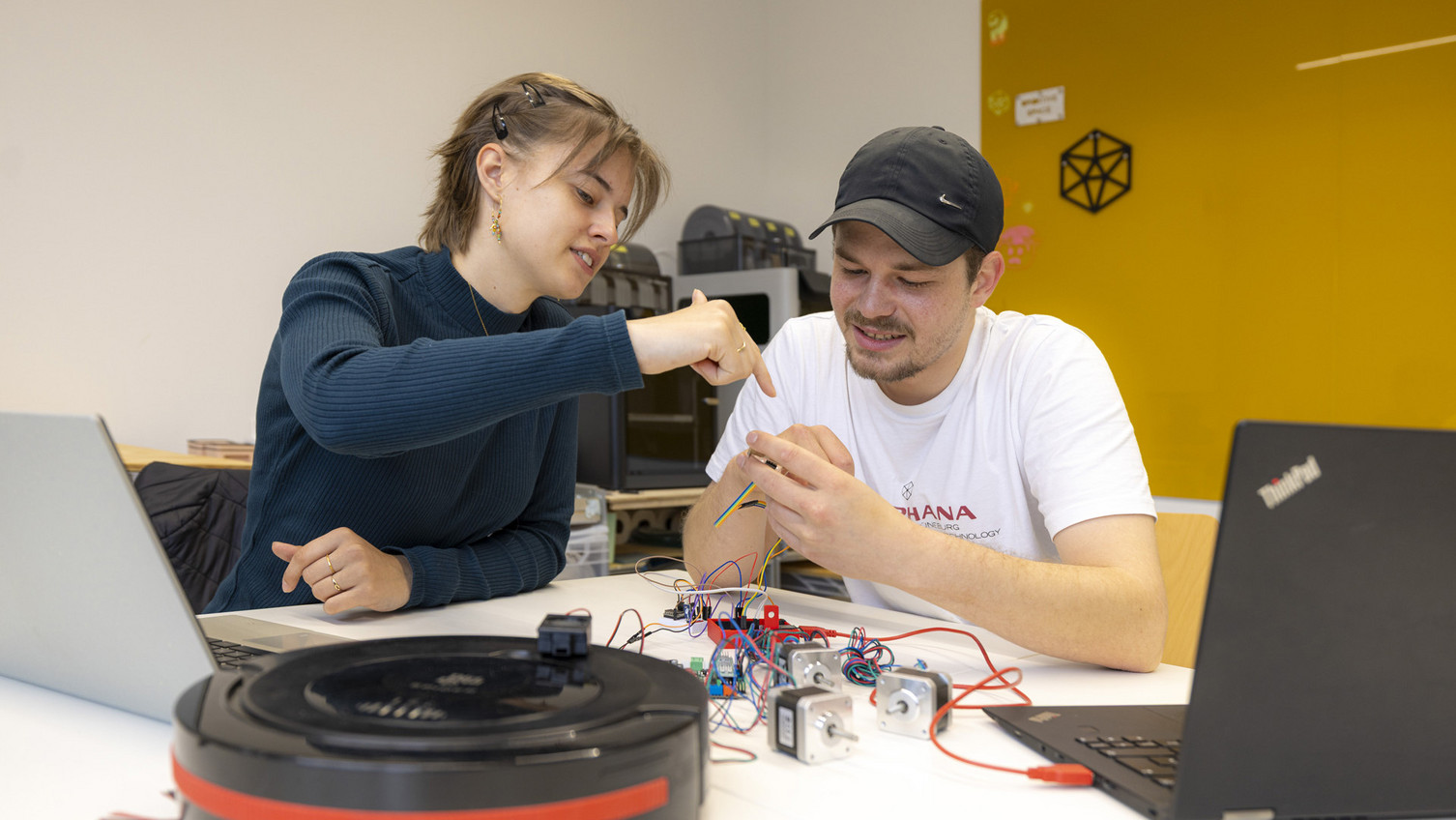
The connection to the event came about through a network of makerspaces and creative labs in Hamburg and the surrounding area. “This gave us the opportunity to contribute our own exhibits,” explains Siri. For Julius, the invitation was also a welcome opportunity to finally put long-planned ideas into practice: “Sometimes you just need a deadline.”
The result is three projects that combine technology with humour and social commentary. An “Angry Bot”, a converted robot vacuum cleaner, moves freely around the room – deliberately causing irritation. Instead of working quietly, it reacts to its surroundings and “disrupts” things on purpose. A second exhibit takes up the myth of Sisyphus: a plotter continuously draws lines, which are immediately erased by smaller robots. “Two systems that give each other work – without a result,” is how Siri describes the principle.
A third project, a reading robot, engages with texts by Karl Marx. The idea: machines could develop an awareness of their role and question existing working relationships. It remains to be seen whether this exhibit will be ready in time. The aim behind it, however, is clear: the works are intended not only to entertain, but also to spark discussion.
Both students share a passion for tinkering. They began taking devices apart, programming them and developing their own solutions at an early age. In their engineering studies, they are deepening these interests – and expanding them in the Creative Space. “Learning by doing is key,” explains Julius. New components, unexpected errors or unclear documentation are part of everyday life. “You’re constantly learning.”
At the same time, they emphasise that getting started can be very accessible. Initial successes – such as flashing LEDs or simple controls – can be achieved quickly. It only becomes more difficult as complexity increases. “But that’s exactly what the Creative Space is there for – to provide support,” says Siri.
The exhibits are deliberately designed to challenge familiar expectations of technology. Instead of functioning efficiently, they pose questions: What happens when machines are not just tools? What role does control play? And how is work changing in conjunction with AI and robotics? “You should use new technologies – but always question them critically,” says Siri.
After the exhibition in Hamburg, the projects are set to continue. The plan is to showcase them at Leuphana University and develop them further. For both of them, one thing is clear: this will not be the last experiment.
Background: Leuphana Creative Space
The Leuphana Creative Space is an open innovation lab at Leuphana University Lüneburg. Students from all disciplines can use the space to carry out their own projects in the fields of artificial intelligence, microelectronics and digital manufacturing. In addition to technical equipment such as 3D printers and electronics workstations, the space also offers methodological support and a space for experimental ideas. The aim is to promote interdisciplinary collaboration and to facilitate both application-oriented and critically reflective projects.
In addition, the Creative Space also provides a place where data-driven start-up ideas can be developed, tested and turned into initial prototypes – from the concept phase right through to fully functional demonstrators.