
(Not) Into Stem? Simone Abels on NDR Children's Radio
2026-05-07 “Children are great just the way they are. It’s the school system that needs to change.” Simone Abels, Professor of Science Education at Leuphana University, speaks her mind in an interview on NDR children’s radio programme Mikado. Under the title “No Interest in Maths & Co.”, she was invited to the studio to share her perspective on STEM subjects. The full interview airs on Sunday 10 May at 8.05 am on Mikado on NDR Info and will subsequently be available in the media library.
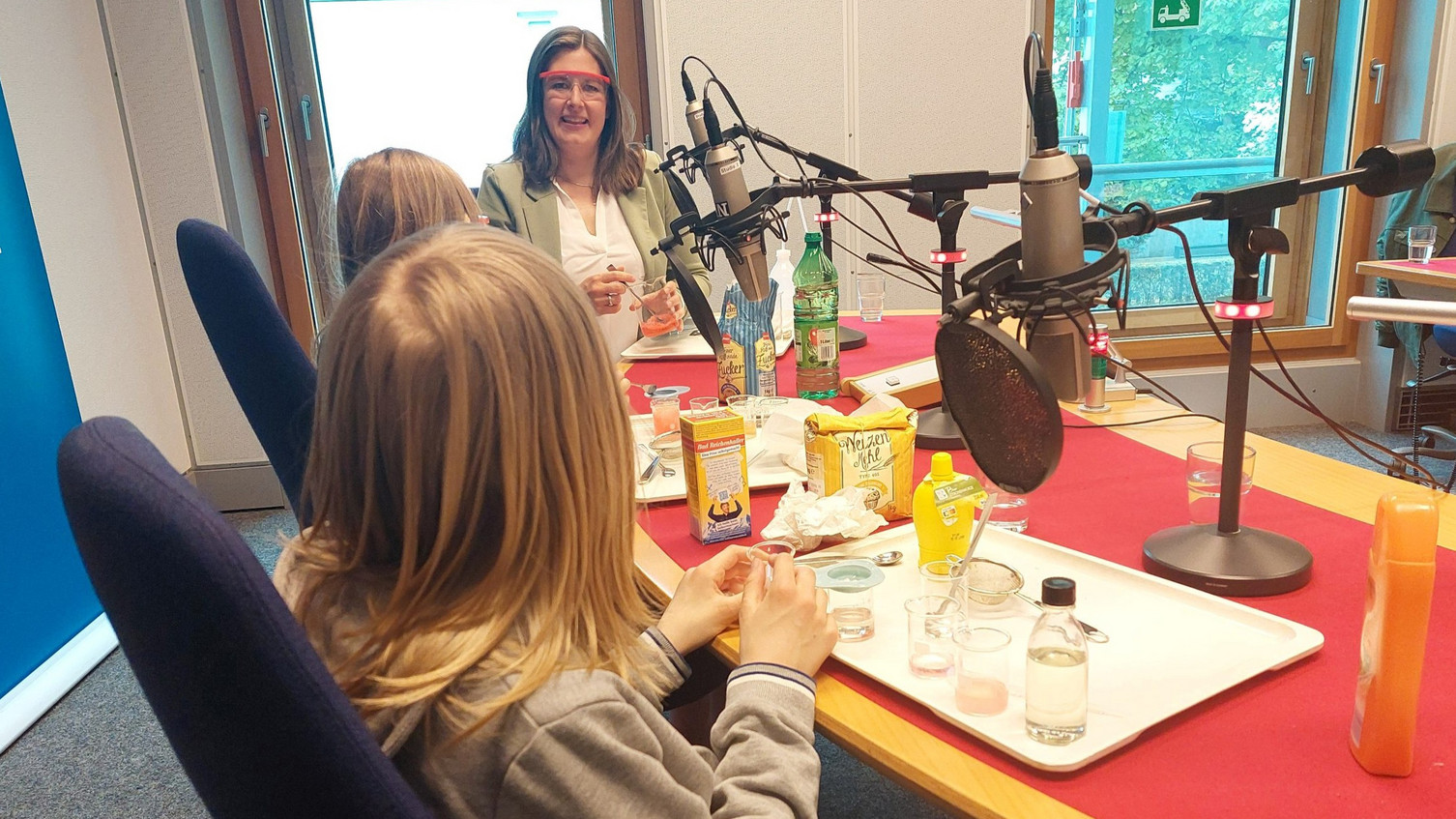
How can STEM subjects be made more enjoyable? The radio programme Mikado has tackled this question and invited Simone Abels, an expert in science education. Abels, who works closely with schools in her role as scientific director of the Leuphana Innovation Community for School Development and Leadership, says: “Good STEM education strengthens society’s capacity for innovation and ensures greater equality of opportunity. Those whose interest is sparked, who feel a sense of belonging and comfort, and who experience a sense of self-efficacy, perform significantly better.”
In STEM subjects in particular, inquiry-based learning offers children the opportunity to learn in a self-directed way, understand contexts and think in a solution-oriented manner. They put this into practice straight away in the recording studio, working with two children to investigate how a slimy bath additive (superabsorbent) turns back into a liquid so it can pass through the drain. But should this microplastic even be entering the sewage system and our environment? Abels’ message: “It is not the pupils who are to blame, or who are disinterested, unmotivated or poor learners, as is sometimes claimed. The data shows us that our education system is failing to reach all pupils. This must change urgently through inquiry-based, problem- and context-oriented learning that motivates.”
For example, Abels works alongside her team and numerous partner schools, administrative staff and politicians – such as within the Innovation Community – to develop new teaching concepts and opportunities for participation. At the 1st Lüneburg Education Conference in February, around 80 children worked together with teachers and administrative staff to design a school environment that promotes well-being. At the Community School Conference in March, school representatives from across Lower Saxony discussed open teaching and tested new methods for school development.