
Report Alina Knabbe
Research Group Empirical Educational Research
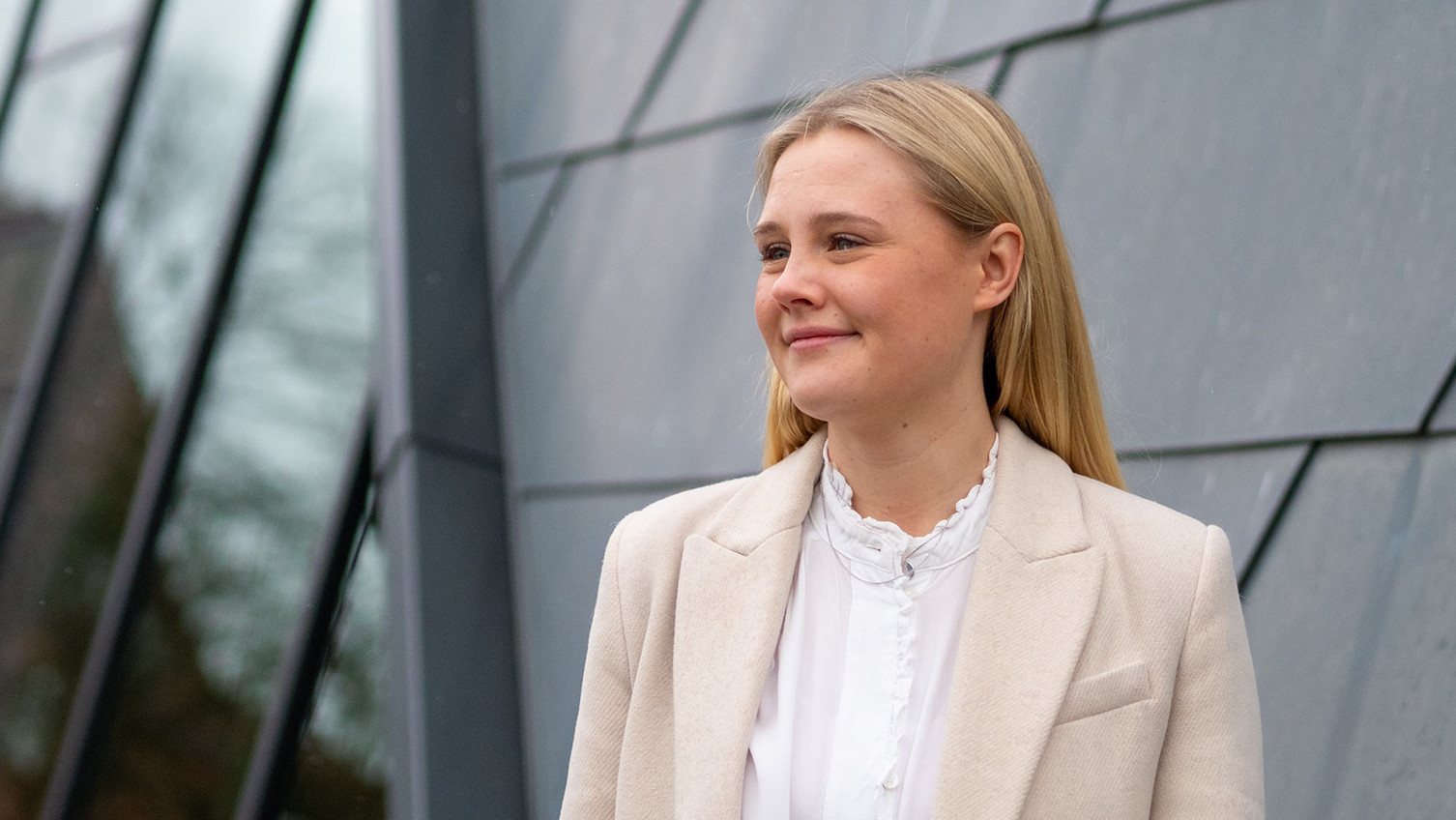
2023-05-26 Alina Knabbe is a research assistant at the Institute of Mathematics and Education. She started pursuing her Ph.D. in empirical educational research at Leuphana in 2023.
Why did you decide to do a doctorate at Leuphana?
The doctorate was a good opportunity for me to combine two things: my interest in dealing with subject areas in more depth and over a longer period of time and to get to know other professional fields besides school. I chose Leuphana because I already knew many professors through my studies and work as a student assistant (SHK) at Leuphana, and Leuphana offers good support opportunities for doctoral candidates.
When did you first think about doing a doctorate?
During my work as a student assistant, I worked closely with doctoral candidates, so my inhibitions about entering academia diminished. Since I enjoyed the SHK job and writing and researching during my studies, the idea of doing a doctorate myself came up more and more often. While writing my Master's thesis, I pursued this idea and exchanged ideas with professors and other doctoral candidates in order to better inform myself about doctoral courses.
What is different about the doctorate compared to the Master study times?
As a doctoral candidate, you have more time for your own research. However, this also requires greater independence and organisation, which is why it is important to structure your time effectively and prioritise your own tasks. Compared to the Master's, you focus much more on a specific research area, which you work on in greater depth.
What do you benefit most from during the doctoral phase?
I benefit most from the scientific discourse with my colleagues and at conferences. Getting feedback on my own work is important for me and also a reassurance that I don't lose focus. At the same time, I learn to justify my own ideas and projects to other scientists and to stand up for them.
What would you say is different at Leuphana than at other universities?
Leuphana is committed to personal and academic (further) development with various offers from the Graduate School. In addition, Leuphana supports doctoral candidates financially with conferences, stays abroad, etc. through the Qualification Fund.
What do you benefit from most as a doctoral candidate?
I have improved my time management and task prioritisation skills. The doctoral phase also offers the opportunity to exchange ideas with other doctoral candidates from different disciplines and learn from their research areas, perspectives and experiences.
To whom would you recommend a doctorate in your subject?
People who are interested in working on topics in detail and enjoy learning about new topics (e.g. statistics). In general, you should have a certain degree of self-organisation and time management.
Do you already have plans for the future after your doctorate?
At the moment, I am exploring the different options after my doctorate and weighing up what I like best. One option for me is to do the preparatory service, complete my teacher training and gain practical experience in schools. To explore other options, I am participating in the Graduate School's career coaching and development programme and continuing my education in various areas.
Thank you very much for the interview!