
"Games for Higher Education"
2026-03-01 What does playing have to do with learning? – EVERYTHING! Playing and learning go hand in hand. At the SAGSAGA community’s networking event, it became clear once again: serious games offer huge potential for education, university teaching and school development. From school management simulations and card game prototypes to escape game concepts – creative game designs open up new paths for education, exchange and shared reflection.
Rethinking play, learning and education
What does playing actually have to do with learning?
The answer is simple: a lot.
We learn through experience, by trial and error, and through interaction with others. This is precisely where serious games come in – as a method for making educational processes creative, interactive and reflective.
At the SAGSAGA community networking event, a number of exciting ideas relating to games for higher education were collected. The focus was on how game-based approaches can support learning, teaching and collaboration in educational contexts.
The potential of serious games for our community work was particularly evident. At the conference’s ‘Market of Opportunities’, Dennis Wohlfeil and Ninja Mueller presented the school management simulation Transform.Ed and exchanged ideas with many interested parties.
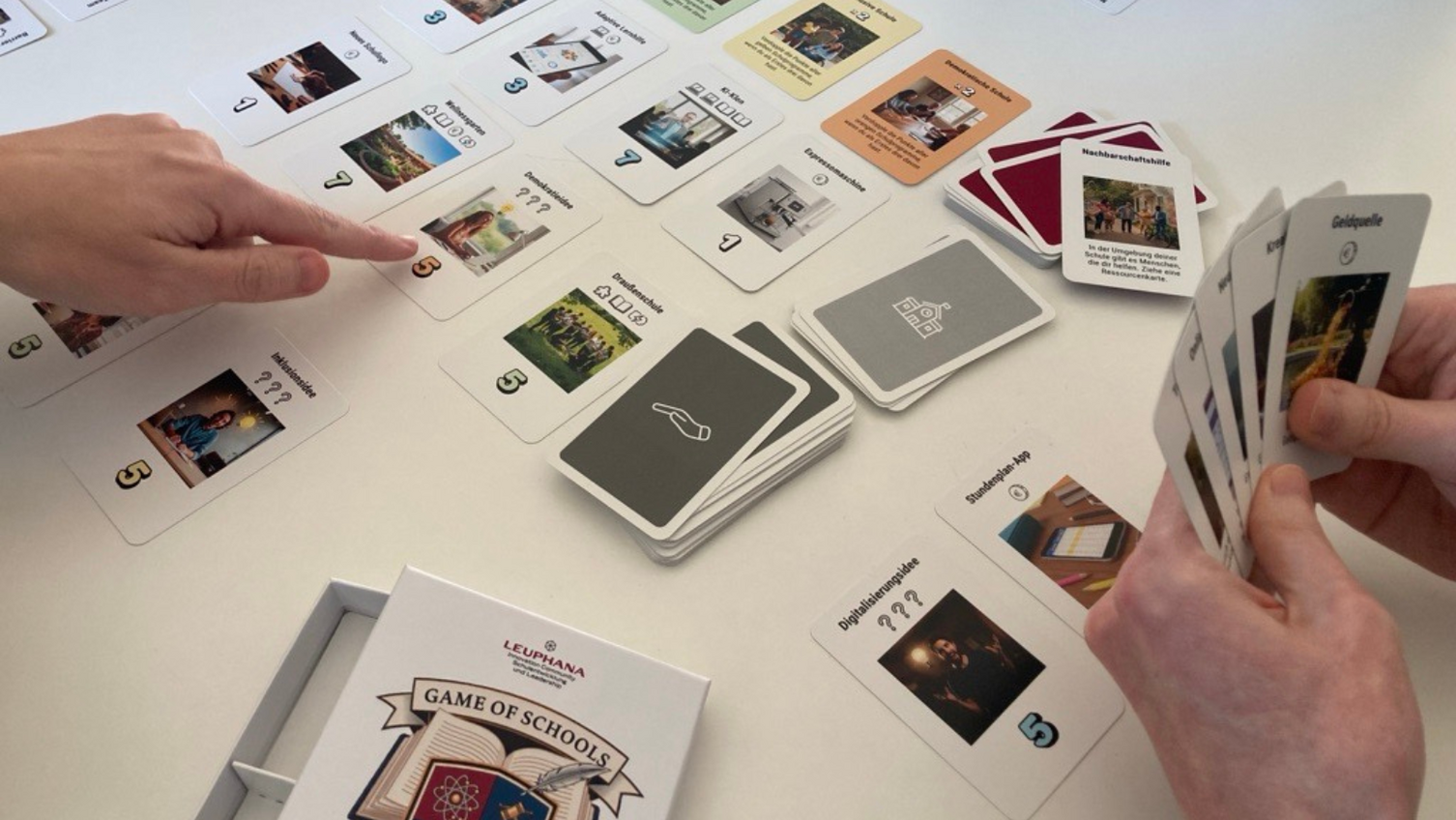
The School Development and Leadership community was also represented in a workshop format: Hariet Schellig and Dennis Wohlfeil tested the card game prototype Game of Schools together with participants. The direct feedback from a community experienced in gaming was particularly valuable and inspiring.
Overall, the network meeting thrived on its open, interactive atmosphere. Instead of traditional presentations, the focus was on exchange, experimentation and collaborative learning. At the small in-house fair, participants were able to find out about various games, tools and methods. In the pre-workshop, escape game concepts were also tested and participants developed their own game ideas using canvas methods.
The evening provided an opportunity for further discussions and playing games together in a relaxed atmosphere – for example, at the cultural centre Mosaique in Lüneburg.
A heartfelt thank you goes to the SAGSAGA community for the open and constructive exchange, and to the organising team led by Johannes Katsarov, PhD, and Saskia Sterzl for this special networking event.