
English-language Master's program in Social Work Research to start in fall 2026
2025-12-15 The innovative English-language Master of Science in Social Work Research program specifically prepares students for an academic career in a rapidly growing, socially relevant field of research. In small project cohorts, key skills ranging from empirical research and theoretical work to university teaching, research administration, and (self-)management are taught—with the opportunity to start a doctoral program early on in the doctoral track.
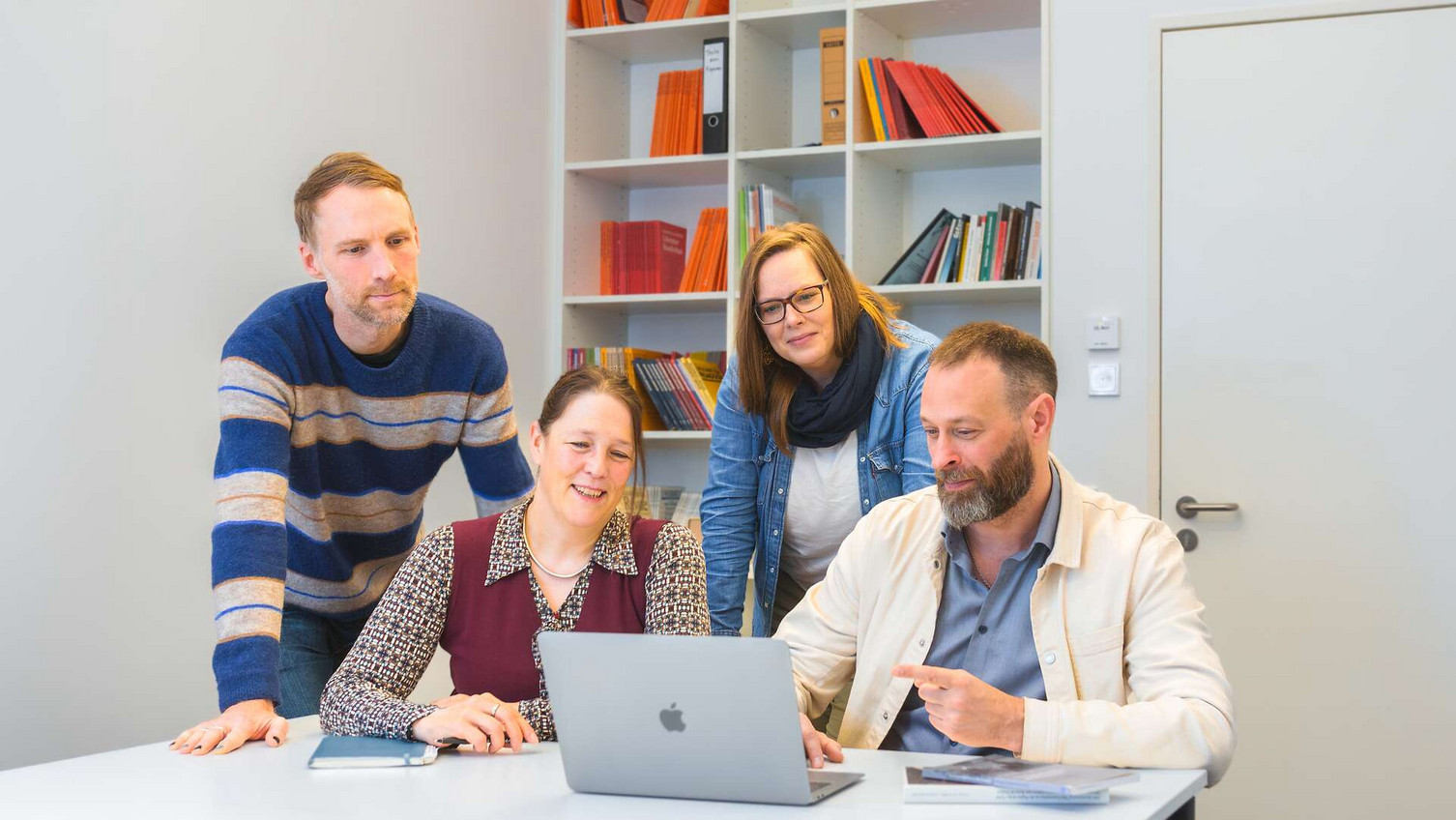
For years, there has been a shortage of personnel in the field of social work. What is less well known is that there is also a shortage of researchers, teachers, and scientific specialists at universities, government agencies, and research institutes. “Social work is one of the growing fields of science and promises good career opportunities for young scientists,” says program director Prof. Dr. Philipp Sandermann, professor of social pedagogy.
Until now, social work degree programs have increasingly focused on professional qualifications. With its new and outstanding Master's program in Social Work Research, the Leuphana Graduate School is sending a signal for more empirically oriented, interdisciplinary, and globally networked social work research.
The new master's program thus clearly distinguishes itself from traditional, practice-oriented master's programs in social work: “We train scientists—for research, university teaching, and science-related activities in social work,” explains Philipp Sandermann.
A key feature of the program is its interdisciplinary and international focus: professors from the fields of education, social pedagogy, vocational training research, psychology, and sociology teach together in the program. They all share an interest in social work and a multi-perspective scientific view of it, which they also want to convey to the students in the program. It is aimed at bachelor's degree graduates from the entire spectrum of social science subjects – from sociology and political science to psychology, social work, and education – worldwide: “Living environments may differ, but the fundamental social problems are similar globally,” explains Prof. Dr. Maren Zeller, professor of social pedagogy, specializing in diversity research. The new master's program aims to contribute to the creation of reproducible, internationally compatible knowledge – and to train the next generation of researchers in social work.
Prof. Dr. Birte Siem, professor of social and organizational psychology in social work, describes: “There will be comprehensive training in methods – in both qualitative and quantitative procedures. And everything will be immediately implemented in practical research.” Parallel to the courses, students evaluate data sets, plan studies, draw samples, or develop questionnaires. The methodological training is hands-on and prepares students for their own research projects with practical exercises.
The program addresses topics such as international welfare state comparisons, research on the living conditions of children and young people, organizational research, and interactions between professionals and clients.
Another special feature of the master's program is that it makes the functioning of the university itself the subject of study. The internship embedded in the study program can focus on research, teaching, administration, or academic self-administration. The latter also includes possible activities in quality management, the equal opportunities office, or university communications. “We also show how a university functions as a social place—with its administrative structures, negotiation processes, and power relations,” explains Prof. Dr. Lars Alberth, professor of theories and methods of childhood research. This is also framed by a corresponding course, similar to the way students complete a module on university didactics to prepare them for their future teaching of social work.
Another unique feature of the program is its dedicated module on science communication. Students learn how to present research findings in a way that has an impact on politics, administration, and the public—a skill that is increasingly in demand.
With all this, the program also sees itself as contributing to the project of an internationally networked, empirically based, and interdisciplinary scientific community in social work.