
Psychology & Sustainability
Sustainable Transformation - Human Behavior - Interdisciplinarity
As environmental and societal challenges intensify, the need for sustainable transformation has never been more urgent. Yet, transitioning towards sustainability involves more than technological solutions or policy reforms — it requires a deep understanding of human behaviour as a driver or barrier of this transition.
The Master’s programme in Psychology and Sustainability at Leuphana University is designed to empower you to explore the critical role of psychology in driving this change.
Through a mix of theory and practical application, you’ll learn to understand, predict, and influence behaviours that advance sustainability efforts.
Are you passionate about psychology and sustainability? This programme offers a unique opportunity to turn insight into impact.
Join us as we explore the human dynamics that will shape the future of our planet!
 ©Leuphana/Brinkhoff/Mögenburg
At a Glance
- Degree awarded: Master of Science (M.Sc.)
- Application deadline: EU degrees: 1 June / Non-EU degrees: 1 May
- Highlights: Unique interdisciplinary and multi-level approach to study psychological processes - enabling a thorough understanding of how individuals, communities and societies influence and are influenced by sustainable development; real-world testing of learned theories in transdisciplinary projects; Double degree track with the University of Groningen possible from the third semester onwards; option of combining Master’s and doctoral studies via the Doctoral Track
- Is aimed at: Graduates from psychology, social sciences, sustainability studies, or related fields who have earned at least 30 credits in psychology and are interested in psychological drivers and barriers in the transition to sustainability
- Type of programme: consecutive, academic prerequisites
- Start date: Every winter term, October
- Study places: 25
- Extent: 120 CP according to ECTS
- Duration: 4 semesters
- Language: English
- Location: Lüneburg
- Semester contribution: approx. 480 EUR
Psychology & Sustainability - The Programme
The Master's programme in Psychology & Sustainability is designed as a two-year programme and allows students to specialise from the second year onwards. From the third semester onwards, students pursue one of two tracks and study either psychology at the University of Lüneburg with a focus on sustainability sciences (Lüneburg Track) or at the University of Groningen with a focus on environmental psychology (Groningen Track).
Students indicate their preference for one of the two tracks in their application and are informed during the admission process whether they will be considered for their preferred option or the alternative option.
It uses a multi-level approach to study psychological processes at micro, meso and macro levels - enabling a thorough understanding of how individuals, communities and societies influence and are influenced by sustainable development.
Students will address questions such as:
- How do social norms influence sustainable behaviour?
- What motivates individuals to make environmentally responsible choices?
- How can psychological insights guide negotiation and collaboration on sustainable solutions?
- How does the perception of climate change and sustainable behaviour differ between national and cultural contexts?
- How is sustainable behaviour influenced by information and misinformation?
- How does social polarisation arise on sustainability issues and how can it be reduced?
- What are the interactions between the levels of individual behaviour and systemic structures?
Content
Sustainability science is an interdisciplinary field of research. Most disciplines in this field of research approach the topic of sustainability from a natural, social, or cultural science perspective with a focus on social-ecological systems.
Psychology, as the scientific discipline of human perception and behaviour investigates psychological processes at the level of individuals who are part of these social-ecological systems. Thus, psychology in the context of sustainability is concerned with cognitive (e.g., problem-solving), motivational (e.g., self-regulation), and emotional (e.g., fear) processes, the interplay between these processes, and how these psychological processes translate into behavioural drivers or barriers towards sustainable development.
The programme follows four guiding principles to establish an interdisciplinary exchange between psychology and sustainability science: The programme adopts a multi-level perspective, uses an interdisciplinary approach, focuses on problems and solutions, and adds a bottom-up (individual-to-system) approach to the well-established top-down (system-to-individual) perspective commonly pursued in the field of sustainability science.
By establishing this integrative approach to psychology in the context of sustainability, Leuphana University offers a unique Master’s programme in Europe and beyond, with the option of a double degree with the University of Groningen.
Students are invited to explore psychological drivers and barriers to sustainable development at different levels, such as intrapersonal (e.g. self-regulation, individual decision-making), interpersonal (e.g. persuasion), intragroup (e.g. intragroup decision-making) or intergroup (e.g. intergroup negotiations). Both sustainability science and psychology are represented on the teaching staff and collaborate closely in inter- and transdisciplinary research projects.
The Master’s programme has a strong empirical research focus and thus provides students with practical knowledge on how to address the challenges of sustainable development from a psychological perspective within the broader framework of transdisciplinary research projects.
To this end, students not only acquire knowledge of the psychological processes involved in sustainability, but also methodological skills for planning, conducting, analysing and interpreting empirical research on one of the most pressing challenges of our time.
Here you can find further information on the course content of the Master's programme Psychology & Sustainability.
Structure
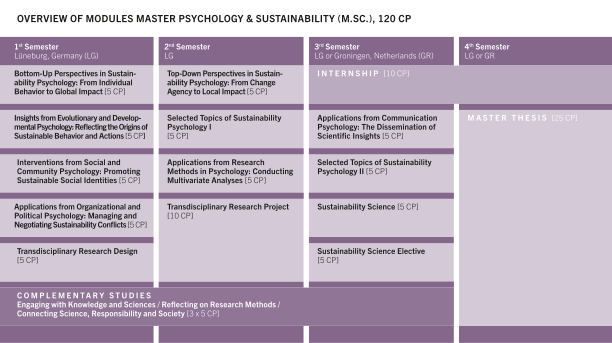
The Master’s programm in Psychology & Sustainability at Leuphana is designed as a two-year programme with the option to spend the second year at our partner institution, the University of Groningen.
The first semester at Leuphana University focuses on the key principles of the psychology of sustainable behaviour at the individual, group and societal levels. By introducing core theories and models, the programme links topics from the field of psychology with the field of sustainability science.
Accordingly, inter- and transdisciplinary work with a focus on theoretical propositions, methodological tools, and practical implications will characterise the programme in the second semester. Students have the opportunity to choose an elective course from one of the related psychology programmes at the Graduate School (Selected Topics in Psychology, e.g. International Human Resource Management). Thereby, the second semester aims to broaden students’ psychological perspective on the inter- and transdisciplinary characteristics of sustainability science.
From the third semester onwards, students of the Master's programme in Psychology & Sustainability either follow the Lüneburg Track with a focus on psychology and sustainability science or the Groningen Track with a focus on environmental psychology at the University of Groningen. Graduates of the Groningen Track receive two Master's degrees (double degree) – one in ‘Psychology & Sustainability’ and one in ‘Environmental Psychology’.
Lüneburg Track with a focus on psychology and sustainability science
In the second year of study, students sharpen their profile through further in-depth studies in sustainability science and psychology, with a distinct focus on a ‘Bottom-Up’ perspective. The second year at Leuphana not only strengthens the transdisciplinary focus through compulsory and elective courses from Sustainability Science (up to three modules can be chosen), but also prepares students for the practical and/or academic application of their knowledge.
In the module 'Applications from Communication Psychology: The Dissemination of Scientific Insights', students will learn and develop ways to communicate their knowledge of sustainability science, psychology and the intersection of the two in an effective and understandable way.
A special feature of the second year at Leuphana University is the internship module. Depending on the student's career plans and previous academic achievements, the internship will either allow the student to gain practical experience in implementing knowledge in the field of psychology and sustainability with partners at the local, national or international level, or it will allow the student to gain experience in empirical research, which could be the first step towards a future PhD position.
The fourth semester is dedicated to writing a Master’s thesis. You will complete the two-year Master's programme at Leuphana with a Master of Science in Psychology & Sustainability.
Groningen Track with a focus on environmental psychology at the University of Groningen
As part of the programme, up to fifteen motivated students have the opportunity each year to complete their second year of study at our partner university, the University of Groningen. The focus of this second year is on environmental psychology.
Graduates of the Groningen Track receive two master's degrees (double degree) – one in ‘Psychology & Sustainability’ and one in ‘Environmental Psychology’.
For more information, please visit our page on the Groningen Track: 2nd year of study at the University of Groningen.
 ©Leuphana
Study Regulations and Subject-Specific Schedule
The following link provides access to documents which set out the general conditions for examinations, an overview of the curriculum, as well as detailed and legally binding regulations.
General Assessment Regulations and the Subject-Specific Schedules
Teaching Personnel
Programme Directors
Programme Coordination
Lecturers
Interview with Prof. Dr. Astrid Kause

Studying Abroad and Double Degree
For students on the Groningen Track, the second year of study must be completed at the University of Groningen. Further information can be found on our page on the Groningen Track: 2nd year of study at the University of Groningen.
Students on the Lüneburg Track have the opportunity to spend a study-related period abroad at one of the study programme's partner universities. For that, we recommend the third semester. For any questions or to apply, please contact the International Center. The International Center will provide all further information on Erasmus+ funding, and on preparing for and organising your semester abroad.
Career Prospects
The Master’s programme trains graduates to apply their psychological knowledge and skills to the field of sustainable development.
Knowledge and skills on how to promote sustainable development have become one of the most relevant competences in various fields of practice. In the face of major societal, economic or environmental transformation challenges, such as climate change, digitalisation, globalisation, or social mobilisation not only national governments, but also businesses, political organisations, public services, or educational institutions are increasingly looking for leverage points to promote sustainable development in their respective fields of practice
Although sustainability has traditionally been addressed from a top-down perspective, such as the development of measures at the level of political, economic, or technical systems, the implementation of measures towards sustainable development must inevitably take into account the individual stakeholders and actors within these systems into consideration.
With its specific focus on the psychological processes of the individual, the Master’s programme provides students with sound theoretical knowledge, embracive methodological skills, and impactful practical tools for analysing, describing, changing and predicting sustainability-related cognitions, emotions, and motivations. As a result, graduates of the Master’s programme are highly trained in dealing with one of the most fundamental leverage points of sustainable development: the individual person as an active constituent in the process of transformation towards sustainability.
Students with an academic background in the field of sustainability science (e.g. political, natural, social sciences) will complement their disciplinary training with a new perspective on the topic of sustainability with a focus on the individual actors thus adding a psychological bottom-up perspective to their systemic perspective.
Students with an academic background in the field of psychology (e.g. work and organisational, educational, or clinical psychology) will shift their focus away from the traditional intrapersonal perspective of psychology (e.g. biological, neuropsychological, cognitive processes) to a new perspective on psychological processes as they occur in specific ecological, economic, social, or cultural environments.
Due to the international orientation of the programme, students not only acquire expertise in the field of psychology in the context of sustainability and transdisciplinary research, but will also develop their intercultural, social, and language skills.
The different foci and diverse combinations with electives provide students with the opportunity to prepare for various professional fields and areas of specialisation, such as:
- Executive in CSR and sustainability departments in companies, institutions and authorities
- Scientific consultancy for environmental or sustainability policies
- Scientific positions in research and education in sustainability sciences and/or psychology
- Advertisement agencies, market research, media, press and public work
- Environmental communication and education, adult and youth educational services, educational consultancy
- Consultancy and administration in international organisations and nongovernmental organisations or institutions
- Behavioural expert in environmental and energy organisations (such as grid operators, energy providers and water companies)
- Policy Advisor
On the Leuphana Career Service website, you will find numerous job offers for student jobs, internships, career entry, or topics for your thesis from companies, research institutions, and non-profit organizations that are specifically aimed at Leuphana students and graduates. In addition, you will find job offers and student jobs within Leuphana University.
Doctoral Track
As a student in our program, you have the opportunity to start your doctorate early via the Doctoral Track.
Thus, you to become part of the scientific community of our doctoral research groups at an early stage, giving you the unique opportunity to combine your Master's and doctoral studies and, with your doctorate in sight, to obtain your Master's degree en-route.
Admission Requirements & Application
You can find all information about the admission and requirements, the application and the selection procedure (that requires applicants to hand in a letter of motivation) on our "Admission and Requirements" page.
In order to begin the second year at the University of Groningen, all ECTS credits from the first year at Leuphana must have been completed.
All applicants for the programme, regardless of whether they intend to apply for the Groningen Track, must meet the admission criteria set by Leuphana and the University of Groningen.
Students indicate their preference for one of the two tracks when applying and will be informed during the admission process whether they will be considered for their preferred option or the alternative option.
International Students
This study program matches your interests? Then you will find further information for prospective international students on residence and social matters, such as visa, residence permit, health insurance or finding accommodation, on the following pages.
Please note that the information for incoming exchange students and international degree-seeking students differs slightly.
Contact and Counselling
First contact point
The Information Office (Infoportal) is your contact point for
- general information on the application procedure
- initial questions about the study programmes offered at Leuphana
- making an appointment with the Graduate School Student Counselling Service.
Information Office
Building 8, Ground Level
Fon +49.4131.677-2277
studierendenservice@leuphana.de
Campus opening hours
Mon - Thu 9.00 am - 4:00 pm
Fr 9.00 am - 12 noon
Student Counselling
To make an appointment with our Student Counselling Service, please use our booking tool on our website.