
Students in Studium Individuale Bachelor Programme
On this page you will find student reports about Studium Individuale at Leuphana College.
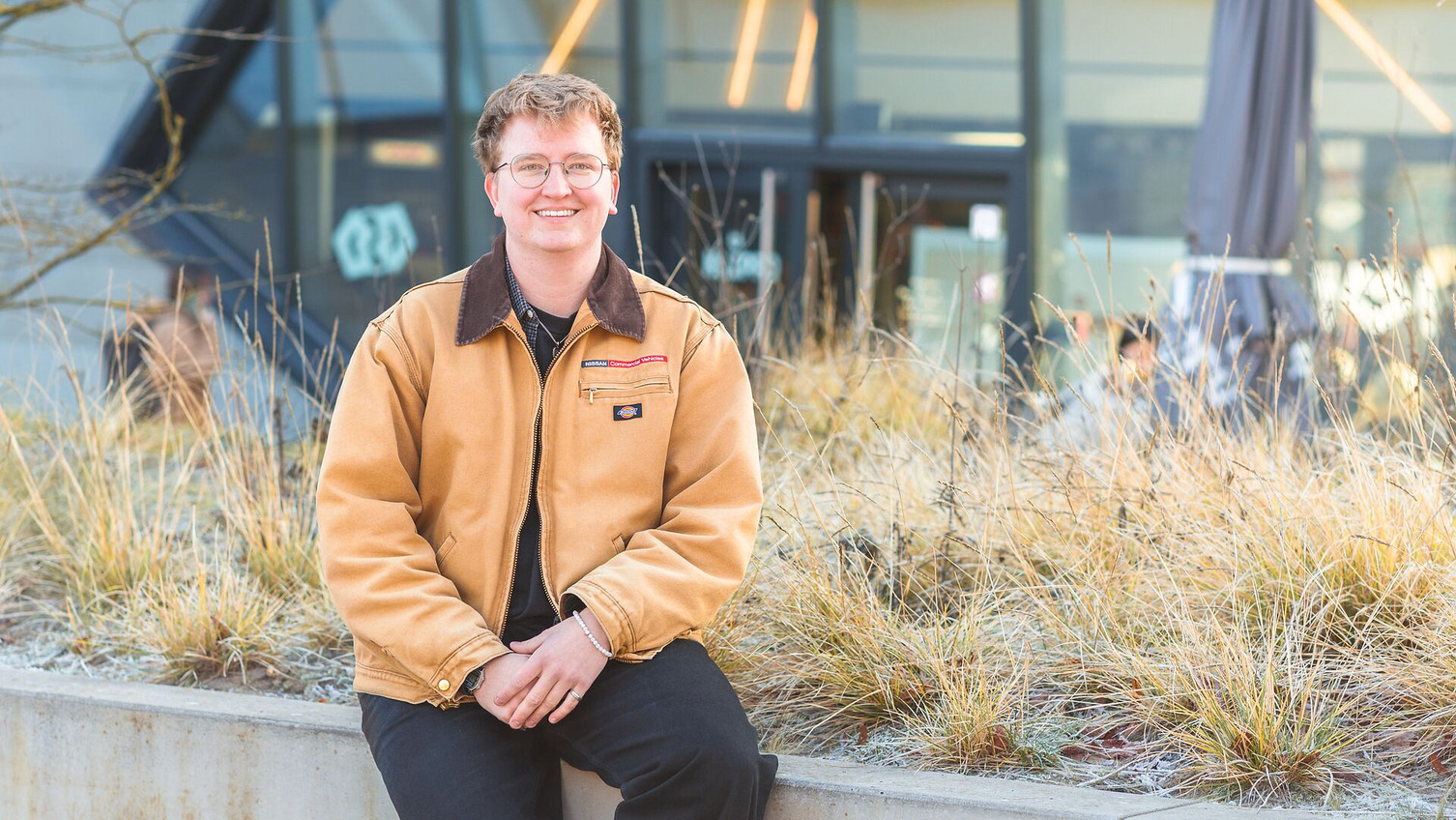
Gender studies, education, and queer perspectives: How Charlie Weißer Built His Academic Profile
 ©Leuphana/Tengo Tabatadze
Journalism or Individual Studies? After graduating from high school, Charlie Weißer received two offers for exciting university places. In the end, the choice was easy for him: "When I heard about Individual Studies, I was immediately excited because I thought: In this program, I can combine all my interests."
The Individual Studies program encourages students to design a significant portion of their curriculum freely and independently. They choose a question that they want to answer with the help of their seminars and lectures. Charlie Weißer is particularly interested in gender studies and educational sciences. After graduating from high school, he completed a federal volunteer service at Aidshilfe in Hamburg, where he worked in education and social media: "Today, HIV is medically treatable. The problem is often no longer the medication, but prejudice and a lack of knowledge. Educational work can have a big impact here."
The topics of identity, social issues, educational work, and the desire to draw attention to social issues through his work are recurring themes throughout his studies. The 23-year-old is now nearing the end of his degree. Charlie Weißer wants to bring these topics together in his bachelor's thesis: he plans to conduct qualitative interviews with transgender people from Lüneburg about their experiences with HIV education.
At the same time, he volunteered for four semesters at SCHLAU Lüneburg, an initiative that offers workshops on anti-discrimination and LGBTQIA+ issues in schools. "We went into classrooms and offered workshops. I enjoyed it immensely—and it showed me that I definitely want to work with people."
In the Individual Studies program, students learn to develop a clear plan for their studies and receive intensive guidance through reflection exercises, weekend retreats, and individual discussions. In addition, there are core modules each semester. Based on their initial question, students individually select their lectures and seminars from the entire range of bachelor's programs offered by the university. Responsibility is rewarded: "I chose every lecture and every seminar myself, so I only attended courses that really interested me," says Charlie Weißer. Courses on inclusion, queer-feminist perspectives, and digital queer culture were particularly formative for him.
A special part of his studies took Charlie Weißer to Michigan for two semesters at Kalamazoo College, a partner university of Leuphana. There, he not only studied, but also worked as a teaching assistant for German—five hours a week, including room and board.
In addition to many courses in gender studies, he also took advantage of the freedom to try new things: French, psychology, acting. At the same time, he sharpened his profile: among other things, he explored performance as a political tool in the AIDS activism movement of the 1980s and 90s. In one course, he presented a monologue from a play about AIDS, grief, and memory.
He can imagine different paths for himself after completing his bachelor's degree: educational and advisory work or working in queer media. To find out what suits him best, he plans to complete various internships first. A master's degree is also an option for him.
For Charlie Weißer, the Individuale program was one thing above all else: a space to ask questions, stay curious, and systematically pursue answers: "I feel like I really built my own degree program—from everything that's important to me."
A Deliberate Change of Direction: Johanna Hauck and the Search for Academic Freedom
 ©Leuphana/Ciara Charlotte Burgess
 ©Leuphana/Ciara Charlotte Burgess
 ©Leuphana/Ciara Charlotte Burgess
Johanna Hauck's career path seemed preordained: At the age of 15, she already worked at the ARD studio in Brussels and then completed an internship there. Later, as a graphic designer, she took care of the so-called belly bands, i.e. the inserts at the bottom of the picture. Then she changed to Discovery Communication. The company operates channels such as DMAX and Tele 5, where she was also responsible for the technology and designed episode images for the streaming platform. The German grew up in Brussels, passed her international baccalaureate there and speaks several languages. The decision to study B.A. Film and Television in Munich seemed logical: "I had already worked behind the camera so many times," says the 22-year-old.
But after just one semester, Johanna Hauck had doubts: "My fellow students had a vision, of their future in front of or behind the camera. I was missing something like that." After one year, she dropped out of her studies and first fell into a hole. "At the same time, the pandemic broke out. It wasn't easy," Johanna Hauck recalls. But she took advantage of the lockdown, attended online courses to sound out her interests and obtained information material from different study programmes and universities: "In the end, I had five folders full of material."
Leuphana and the B.A. Studium Individuale programme were also there: "At first I couldn't believe that such a study programme existed. I can fully contribute my interests and don't have to make any compromises." Studium Individuale asks students to design a considerable part of their curriculum freely and on their own responsibility and to deal with central questions and problems of the present.
But Johanna Hauck couldn't start immediately: the B.A. Studium Individuale is one of the most sought-after programmes at Leuphana College, which means that every year there are more applicants than there are places available. "My first application didn't work out," she reports. But the second attempt was successful. Johanna Hauck is now in her third semester and has no doubts about her decision: "It was worth the wait. My focus is on psychology and social issues. I would like to do something for and with people later." She is thinking about self-employment, which is why Johanna Hauck would soon like to take courses in business administration. At the beginning of each semester, the student sits in about 15 seminars and lectures. She checks which courses are the right ones for her. "What doesn't fit into my portfolio, I hand in again. So far, every decision I've made has felt right," says Johanna Hauck. But freedom also brings responsibility. That's why the student focuses and reflects on her choices: "In Studium Individuale, you learn a lot about yourself." At the same time, students on the programme are regularly accompanied and advised by teachers. In addition, every semester there is a core module on topics such as freedom, methods of culture and criticism or procrastination and motivation, in which all students of the B.A. Studium Individuale participate.
After her diversions via Munich, Johanna Hauck has fully arrived in Lüneburg. She is involved with the International Student Initiative I:SI and is, among other things, a peer advisor for first-semester students in the B.A. Studium Individuale. "I received a lot of support from Leuphana itself when I was choosing my degree programme and used the 'Ask a student' service, among other things, in which students support interested students in their choice of degree programme via Zoom. That's how I found my way and, as a student ambassador, I want to help others do the same."
Education, Climate, Participation: How Emma Steinbrück Connects Sustainability and Policy
 ©Leuphana/Tengo Tabatadze
After leaving school, Emma Steinbrück went to Northern Ireland for a year: “I did voluntary service there in a facility for people with disabilities.” After that, it seemed clear what she wanted to study: Emma Steinbrück enrolled at a university of applied sciences to study “Integrative Health Promotion”. “A lot of the content was interesting, but this type of study didn't offer me enough freedom and flexibility,” she recalls.
She was looking for a program that she could better combine with her political commitment and came across Studium Individuale at Leuphana College. The program encourages students to design a significant part of their curriculum freely and independently. They choose a question that they would like to answer with the help of their seminars and lectures. Emma Steinbrück is particularly interested in education for sustainable development and political sustainability. “I have the great opportunity to satisfy my curiosity and make connections that would otherwise not have been possible. For example, I can combine environmental sciences and education for sustainable development or deal with climate adaptation from a cultural studies perspective. At the Leuphana Law Lab, I learned more about sustainable legislation,” reports Emma Steinbrück. She never had the feeling that she was alone in her decisions: “I received good support throughout my studies and now work as a peer advisor myself.”
Born in Kassel, she attended a UNESCO project school. This led to her involvement with the German UNESCO Commission. Today, she is active in several committees and is involved in the German LCOY (Local Conference of the Youth) for climate protection and climate education and is responsible for networking with various youth organizations and the Federal Ministry of Economics and Climate Protection, among other things. “We are currently working together on a position paper for the Bundestag elections,” reports the 23-year-old.
Last year, for example, the young people discussed with Robert Habeck how climate-friendly the Heating Act is. “Socially relevant issues also need a young voice,” says Emma Steinbrück. She wants to strengthen the interests of young people through her committee and association work. “The best thing about studying and being involved is the interesting people I get to work with.”
Emma Steinbrück is now in her fifth semester and is planning her Bachelor's thesis on youth participation formats at federal ministries: “You don't learn leadership at school, you learn it in youth organizations.”
Reflecting and Connecting: How Vincent Gewert keeps track of his interdisciplinary curriculum
 ©Teresa Halbreiter
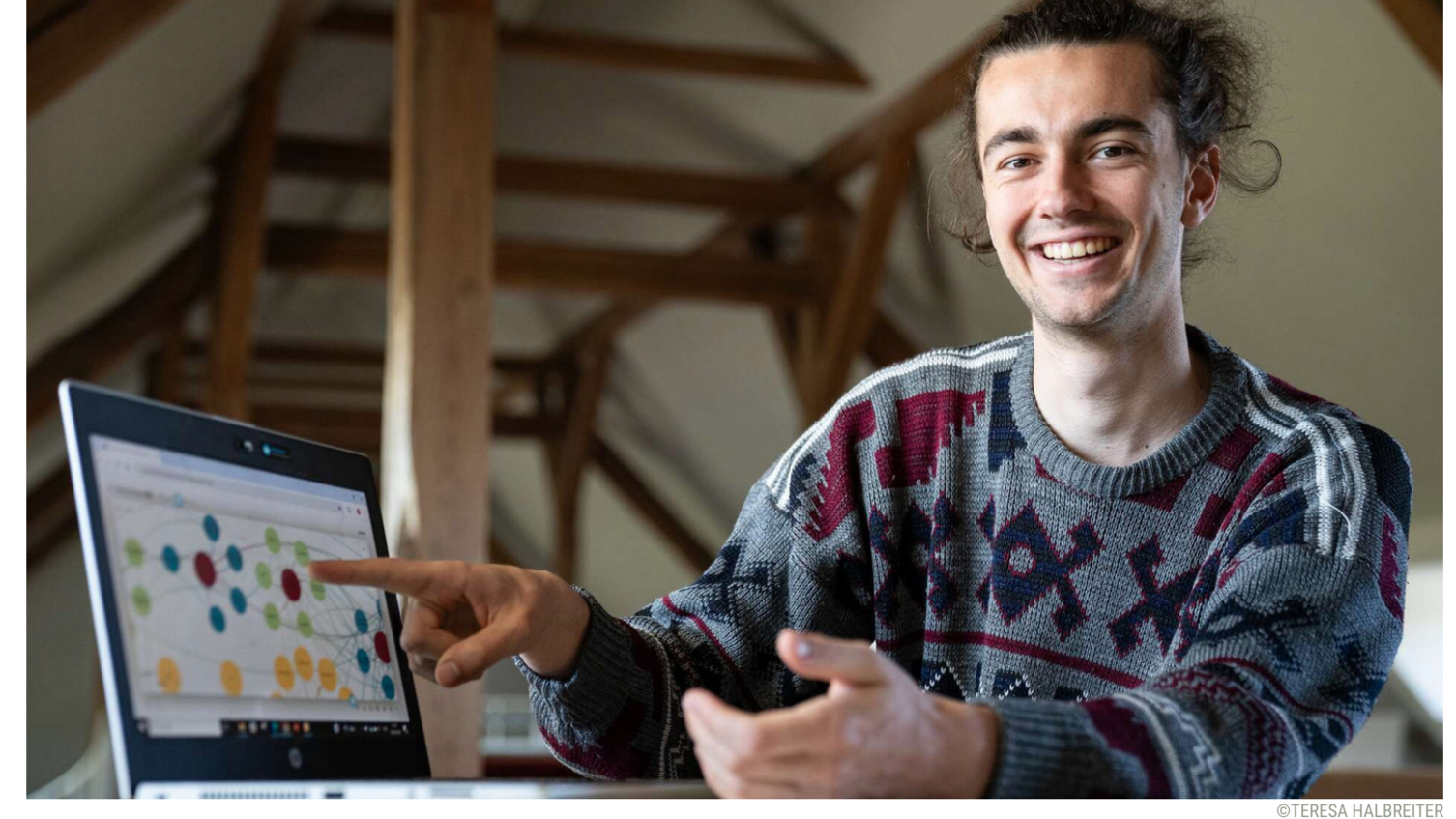
Vincent Gewert's semesters are red dots. Lines lead from them to green circles. They contain keywords such as Green New Deal or Philosophy of Nature. They represent the content of seminars. Lines lead from the green dots to yellow dots. They contain terms such as Presenting, French or Teaching. ‘These are skills that I have acquired in the respective semesters and modules,’ explains Vincent Gewert. The 23-year-old is studying Studium Individuale at Leuphana College.
The programme encourages students to design a significant part of their curriculum freely and independently. They choose a question that they would like to answer with the help of their seminars and lectures. Vincent Gewert's studies focus on the ethical and political prerequisites for fair globalisation.He documents his course of study with the help of a virtual thinking board. ‘The documentation allows me to mentally go back to past semesters, make connections and recall content that particularly interested me,’ explains the student. Vincent Gewert puts a lot of time into the preparation: ‘In Studium Individuale, we don't study according to a predetermined curriculum. For me, the documentation is a great added value.’
Studium Individuale follows the tradition of liberal education that has long been found in the USA and more recently in Europe. The aim of such a liberal education is the intellectual and personal development of each and every student. Students at Leuphana receive close support in the form of reflection discussions, retreats and core modules, which are compulsory for all participants in the programme. Vincent Gewert moved from Franconia to Lüneburg because of the Studium Individuale programme: ‘Only at Leuphana did I have the opportunity to combine philosophy, sociology, political science and sustainability science,’ explains the student. In addition to his passion for philosophical reflection, he is also interested in larger political connections, such as between global justice and the climate crisis
This is why he is involved in the ‘Oceania Dialogue’. The NGO aims to multiply the voices of Pacific civil society in the global North. Vincent Gewert represented the Oceania Dialogue at the climate conference in Dubai. ‘We can only solve the climate crisis politically and not by all of us hiding at home. The climate crisis is far too deeply rooted in our everyday social structures for that,’ says the student. In Dubai, he met cooperation partners from Pacific countries and lobbied the German delegation on their behalf. ‘At the climate conference, an internationally coordinated, globally just solution to the climate crisis can be negotiated. That's why it's important to be there to make a real difference,’ says Vincent Gewert. He recommends the Individuale degree programme to people who are capable of organising, interested in a wide range of topics and curious about different methodological approaches: ‘I benefit greatly from Studium Individuale because I actively build bridges, connect content and have the opportunity to only attend seminars that really interest me.’
Contact persons
Academic Programme Management / Academic Director for Liberal Education
Lecturer & Advisor
Arrange an appointment
College's Student Counselling Service
Building 8, ground floor
Universitätsallee 1, 21335 Lüneburg
Open Consultation Hours
Wed 11 – 13 h (on campus)
Thu 16 – 18 h (via Zoom)
Initial Information
Information Office (Infoportal)
Building 8, ground floor
Universitätsallee 1, 21335 Lüneburg
Fon +49.4131.677-2277
studierendenservice@leuphana.de
Opening hours
Term time & term break:
Mon - Thu 9 - 16 h
Fr 9 - 12 h