
Cultural Studies: Testimonials
On this page you will find student reports about Studium Individuale at Leuphana College.
David Odiase: Poetic Resistance
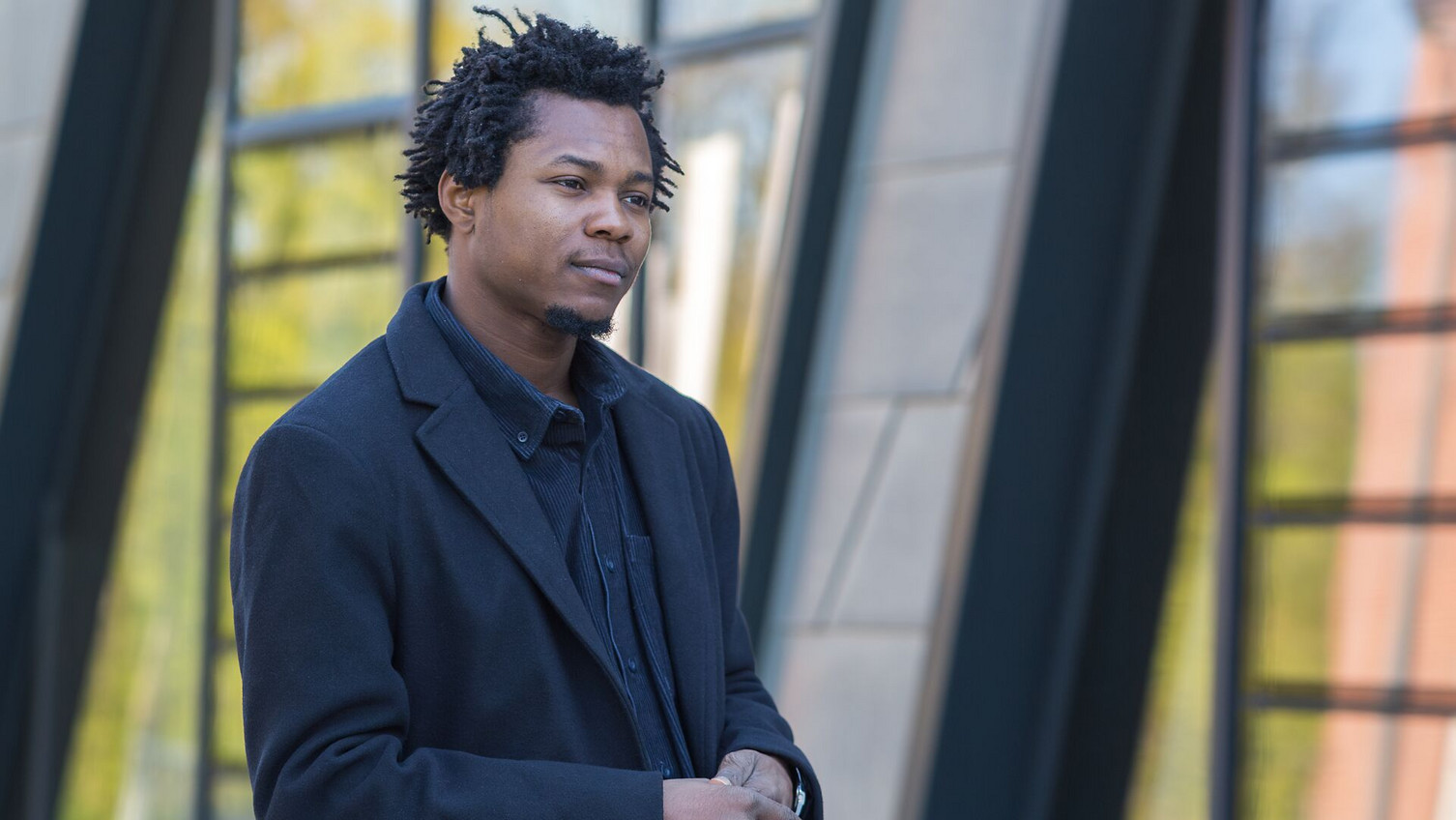 ©Leuphana/Tengo Tabatadze
You should know this poisoned river still quenches thirst,
You should know that this wounded fraction of a people has healed into whole numbers,
You should know
Benin mawu, Benin we na Tuwa.
that Benin did not die, and She sends her regards.
When David Odiase recites these lines of his own composition, they seem like a form of poetic resistance against forgetting. The undergraduate student often has to explain: “The Benin Bronzes do not come from Benin, but from Nigeria – more precisely from the city of Benin City in the south of the country.” The historic Kingdom of Benin was founded around the year 1000 and was destroyed by British invaders in 1897. Until then, Benin City was considered one of the most impressive cities in Africa.
David Odiase had already studied Media Studies in his home country of Nigeria. “Then I heard from friends about Leuphana and the opportunity to study Cultural Studies there, with a minor in Museum Studies,” he recalls. Thousands of works of art were looted from his homeland and ended up in European museums – including those in Hamburg and Berlin. Many works of art from Benin City are still in Western museums – partly on official loan, partly because their return has been refused. “It is high time for the West to come to terms with Africa’s cultural heritage and the plundering by Europeans. But it is just as much time to reach out to one another,” he says.
David Odiase is an artist himself. His work spans performance, video and poetry: his film Benin Did Not Die, She Sends Her Regards, for example, addresses the restitution of looted cultural artefacts. The film Open Line, a finalist at the 2023 Emmys’ International Young Creative Award, stages a symbolic dialogue with the British Museum and is intended as an artistic plea for justice and restitution.
He came to Leuphana particularly because of the Minor in Museum Studies: “The thinking here is modern. And I have a voice in my studies. Lecturers listen to me too, not just the other way round. But I’m also learning about important methods and academic discourses on provenance studies,” he explains.
He was already working as an artist in Nigeria, but has long been active in Germany too: at the Kunstraum, for instance, he presented an interactive media performance on Blackness, temporality and African cosmologies entitled “Ẹ̀dùmarè, When Am I?”
His project My Grandmother the Astronaut Sings to Me from Beyond the Stars, for example, explores his ancestors and their timelessness: “I stand on the shoulders of giants,” he says, thinking of numerous Nigerian freedom fighters.
David Odiase has garnered international attention through presentations at the Academy of Arts, the House of World Cultures and the ZEBRA Poetry Film Festival, amongst others. He was also an artist-in-residence in the Goethe-Institut’s Studio Quantum programme.
And he has many more creative and academic ideas in mind for bringing cultures and people together: “At Leuphana, I can study in an interdisciplinary way, network across disciplines and further develop my theoretical knowledge. Anyone who wants to get involved is given the space to do so at Leuphana,” explains David Odiase.
Silang Mera: A Super-Match
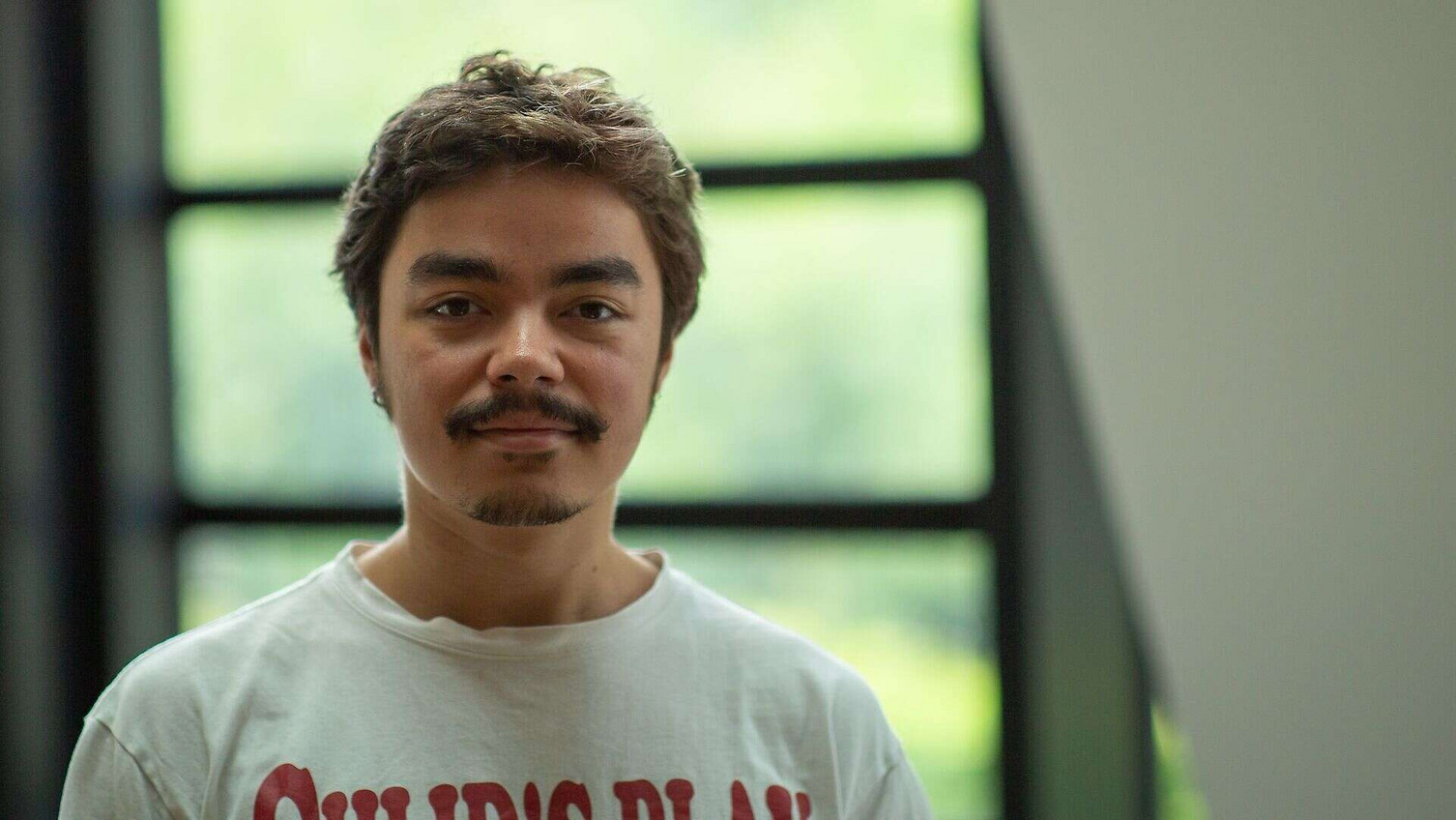 ©Leuphana/Phillip Bachmann
The story begins with a drag queen: "Not the most talented make it in the art scene. The successful ones are the ones who write the best applications," she said after her lecture in the art room at Leuphana. Silang Mera listened carefully. He understood that sound theoretical knowledge can actually be helpful. Born in Mainz, he had just completed his A-levels and has been drawing comics since his youth. That evening, he heard for the first time about the new study programme "Cultural Studies: Organisation, Society, and the Arts" at Leuphana College.
"I'm particularly impressed by the combination of culture, organisation and political aspects. For me, the programme is a super-match," says Silang Mera.The student himself works in the cultural scene and in catering: "The evening in the art space was about working conditions in art, among other things. A relevant topic," says Silang Mera. He is interested in taking a critical look at the cultural sector. In the study programme "Cultural Studies: Organisation, Society, and the Arts", students learn about research methods as early as their Bachelor's degree. Silang Mera has conducted interviews on changes in music consumption and is currently planning a visit to a festival in Hamburg, including field research. "We read and discuss a lot of texts. Combined with the research tasks, I develop a new perspective on the cultural scene and understand many processes better," says the student. He sees the fact that the programme is offered in English as an advantage: ‘I could also go abroad in my career, but being bilingual also helps me for the German business: the scene is becoming more and more international.’
Later on, Silang Mera would like to work at alternative festivals that also focus on queer life, for example. That is why he is completing the Gender Diversity Certificate as part of his complementary studies. It is a voluntary, study-integrated programme for all Bachelor's and Master's students at Leuphana. The certificate demonstrates the acquisition of gender diversity skills that enable students to reflect on and critically analyse gender relations, access opportunities, social inequality and social heterogeneity. ‘I would like to make a positive contribution to our society,’ says Silang Mera.