Utopia Conference 2026: Dancing in the Thought Space
2026-08-28 Is generosity really just a private virtue? Or have we long since needed it as a political dimension? For three days, people from all over Germany gathered at Leuphana University in Lüneburg to explore how we can reach out to one another in the face of social division, rapid technological change, and growing uncertainty.
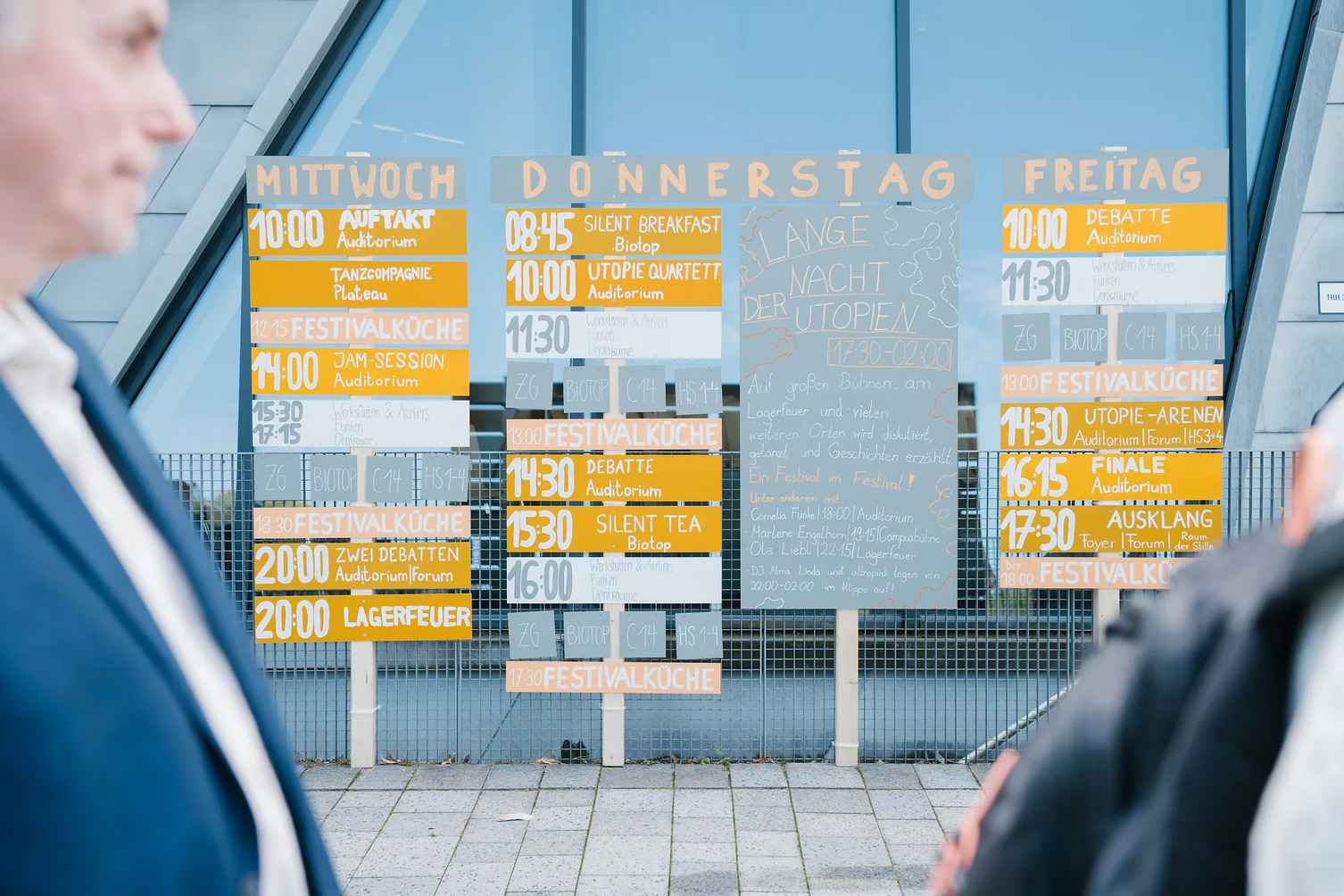
Someone steps aside to make room for another’s turn. A movement is passed on, accepted, and shared anew. Connections are formed, broken, and reestablished. In front of the main building, visitors to the Utopia Conference dance together. The Sasha Waltz Company had invited everyone to join in an improvisation. For a moment, it becomes clear what political generosity might mean: making space, tolerating differences, and engaging with one another.
With the Utopia Conference, Leuphana opens a “free space for thought” every two years, as President Sascha Spoun put it: “The search for something better, for something new, for something more just—that corresponds to our self-understanding as a university.” In closing, he urged the participants: “So by all means, tear down boundaries, challenge what is taken for granted, and open yourselves up.” Especially in times of crisis, Sascha Spoun said, we must look ahead—toward “something new that has not yet existed.”
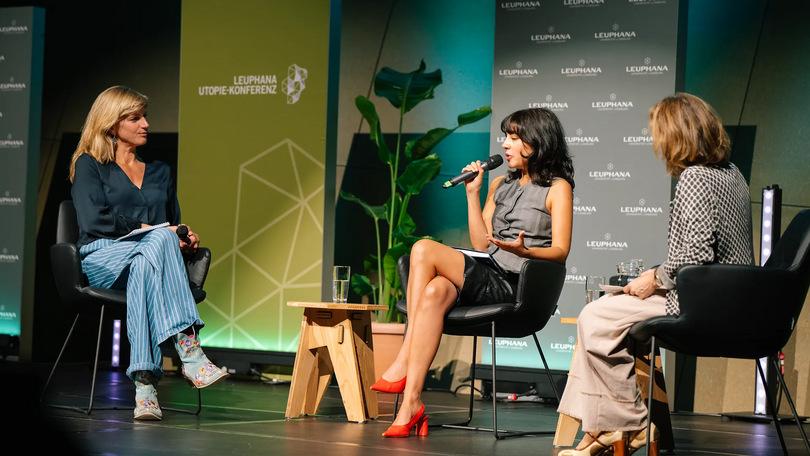
One topic that exemplified this aspiration was artificial intelligence. Author Léa Steinacker also turned her attention to the major tech companies and their promises. The prospect of enormous productivity gains and societal upheavals, she said, is “initially driven by market logic.” At the same time, it remains unclear how the benefits of the technology will be distributed. This turns the question of generosity into a debate about ownership and distribution: Who benefits from the enormous possibilities of AI—and how much of that actually benefits society?
Sustainability expert Maja Göpel spoke with journalist and philosopher Şeyda Kurt about her understanding of generosity. Both turned their attention to the issue of scarcity. Not all scarcity is a given of nature; some is socially constructed. “The capitalist economic system also functions through artificial scarcity,” explained Şeyda Kurt. At the same time, she noted, there is also “real scarcity” resulting from the consumption of natural resources. For this reason, the decisive question for her is not primarily, “What are we giving up?” but rather: “Where does the scarcity come from, and isn’t this scarcity actually a question of justice?”
The Resonance Artists at the Utopia Conference also opened up new perspectives on generosity. One of them is Leuphana Vice President and international law expert Prof. Dr. Jelena Bäumler. “In fact, generosity is not initially a category in law,” she explained. Nevertheless, she added, it can become important when the existing balance of justice is called into question. Generosity can then represent a “surplus” that contributes to “the development of a new order of justice.”
Students contributed a historical perspective. In a seminar, they explored the question of whether there are historical examples of social generosity. Among other things, they examined the 1975 women’s strike in Iceland, the CSCE détente process during the Cold War, and the invention of the polio vaccine. They presented their findings in various formats—such as a podcast, a short film, and an interactive exhibit.
One moment during the opening made it clear: human rights are not a matter of generosity. Azadeh Maghsoodi, who was an artist-in-residence at Leuphana two years ago, paid tribute to Jina Mahsa Amini, who died in 2022 after being arrested by the Iranian morality police. The violinist performed the song “Soltane Ghalbha” together with the university’s music director, Rebecca Lang. “I would like to play it in Iran once the regime has fallen,” said the musician. Many members of the audience in the auditorium stood up to pay their respects.