
Carlo Masala at Opening Week 2026: Europe in a Pinch
2026-10-07 ) Europe in the midst of geopolitical upheaval: At the first Distinguished Lecture in Security Studies hosted by the newly founded Leuphana Center for Cooperative Security, Carlo Masala, professor of security and defense policy at the University of the German Armed Forces in Munich, spoke about the implications of the current geopolitical situation for Europe’s security. Afterward, he engaged in a discussion with first-semester students. The discussion was moderated by Prof. Dr. Ferdinand Müller-Rommel.
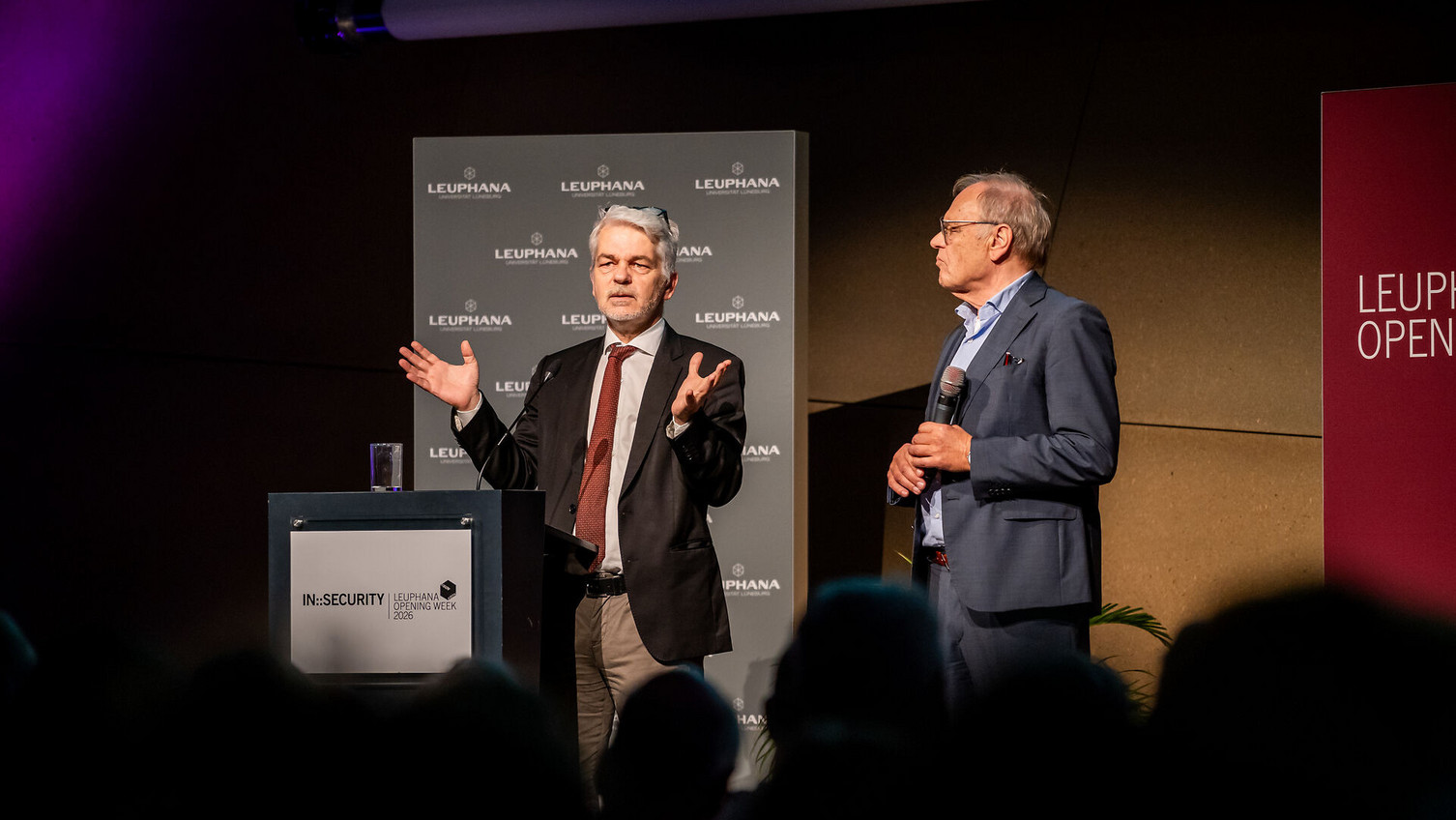
There isn’t enough time. Everywhere in the Libeskind Auditorium, hands shoot up. The new students are seizing the opportunity to engage in conversation with one of Germany’s best-known security experts. Carlo Masala can barely answer all the questions. In his lecture, he provides a comprehensive overview of the geopolitical situation and its implications for Europe. In his view, the continent is being “squeezed from three sides”: Russia is waging war against Ukraine, China is acting with greater self-confidence on the international stage and pursuing a more assertive economic strategy, while the United States is increasingly distancing itself from its traditional role as Europe’s protector. Masala describes the development as follows: “The United States wants to remain a world power, but it no longer wants to provide public goods.” The consequence for Europe: the reliability of America’s protective role is in question.
The students also address the danger of a direct conflict. “How realistic do you think it is that the Russians will actually start an open war?” asks a student. A direct attack on NATO is currently “relatively unlikely,” Masala replies. As long as the war in Ukraine ties up a significant portion of Russian forces, an open conflict with NATO is unlikely. Masala refers to academic research: “Ultimately, we know from research that wars are only started when the aggressors believe they can win a military campaign relatively quickly and keep their own losses limited.” In the event of a direct attack on NATO, however, it is unclear from Russia’s perspective whether such a conflict could be won. Smaller, hybrid operations are more likely. Their goal, he says, is “to exacerbate the discord between Europeans and Americans.”
In his lecture, Masala looks at the big picture: What international order will prevail in the coming years? “From a German or European perspective, it’s not at all about maintaining a rules-based world order; rather, it’s fundamentally about maintaining the liberal world order,” he explains.
Economically, too, Europe is in a state of flux. “We are seeing the so-called downsides of globalization,” says Masala. Global interconnectedness has brought prosperity to Europe, but at the same time has made it more vulnerable: “This extensive interdependence that we have entered into—and from which we have benefited immensely—now means that we are affected by virtually every crisis and virtually every conflict taking place in the world.”
Masala cites the conflict in Yemen as an example. Just a few years ago, the Houthis were still largely unknown in Germany. Today, things are different: “Today, everyone knows the Houthis. Today, everyone knows at least roughly where Yemen is, and most people have some idea of the basic contours of this conflict.” Among other things, this is due to the Houthis’ attacks on container shipping in the Red Sea. As a result, ships have to take longer detours, which increases transportation costs and ultimately affects European companies and consumers as well.
According to Masala, it becomes particularly problematic when economic dependencies become tools of political pressure. He cites China and the production of guncotton as an example. At the start of the war in Ukraine, Europe wanted to quickly ramp up production of artillery ammunition but was dependent on certain raw materials. “There’s only one country that has and exports guncotton. And that’s China,” says Masala. “They simply stopped supplying guncotton for three months.”
At the same time, globalization cannot simply be reversed, he replied to a student’s question. Rather, Europe must find ways to build redundancies to reduce dependencies and secure critical supply chains.
However, Europe lacks a unified response to free itself from this proverbial predicament. Masala is critical of the idea of an international “coalition of middle powers,” as advocated by Canadian Prime Minister Mark Carney, among others. The proposal calls for countries such as Germany, Italy, Canada, and Singapore to join forces more closely in order to carry more weight vis-à-vis the major power centers of the U.S. and China. But Masala warns: “The more countries you have as part of such a coalition of middle powers, the more difficult it becomes to formulate policy at all.”
Even today, European nations differ in their perception of threats, their historical experiences, their financial capabilities, and the level of public support for military action. Germany, in particular, faces a difficult transition. “We are facing a 21st-century challenge in which it is fair to say that we are witnessing tectonic shifts in the parameters under which Europe has formulated and executed its foreign policy over the past 30 years.”