
Opening Week 2026: “We challenge assumptions”
2026-10-02 Leuphana University’s unique study model requires all 1,500 first-year students to engage intensively with a socially relevant topic at the start of their studies. This year, the focus is on ‘In::Security’ – and thus on the question of how security and insecurity are in tension with one another, yet are also intrinsically linked. At the opening ceremony in the main building, the university welcomed social entrepreneur Shai Hoffmann as a guest speaker.
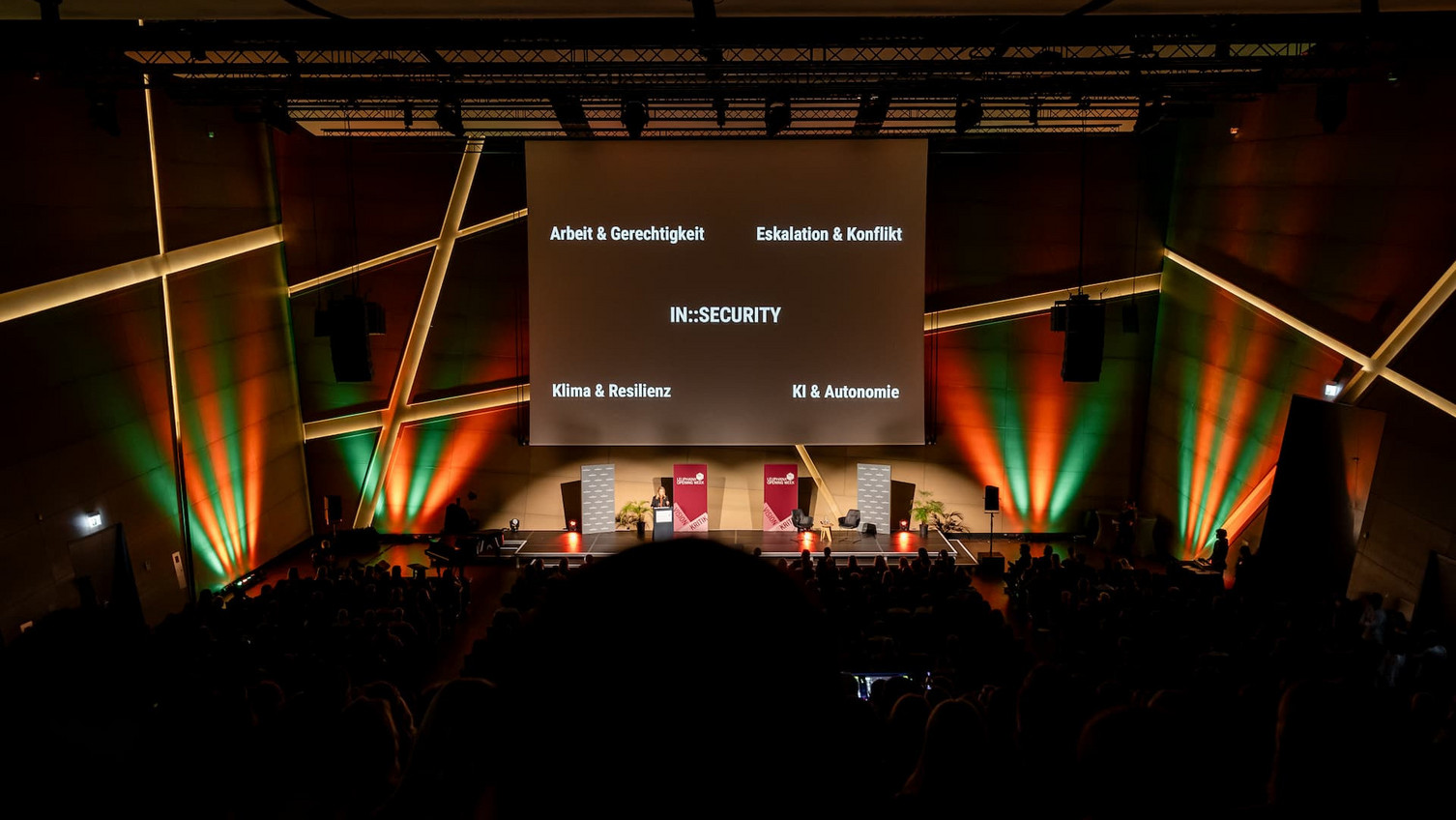
Many students initially look around, unsure of where the voice is coming from. Christian Brei stands at the very back of the Libeskind Auditorium: “The university is a place where questions can be asked. A place where we question what we think we know, where we experiment, where we challenge assumptions, where we are willing to question our own convictions,” says Leuphana’s full-time Vice-Chancellor. With these words, Brei echoes the theme of this year’s orientation week: In::Security.
Around 1,500 students are beginning their studies at Leuphana together at the opening ceremony. “The university is not only a place of ideas, but a community of people,” emphasises Brei, striking up a conversation with the students. Some of them have come to Leuphana because of its focus on sustainability, others because of the university’s support for start-ups or its unique study model. One of them is 20-year-old Carolin. She is studying psychology. She sees the opening ceremony as more than just a symbolic start: “We’re getting real substance.” That’s why she keeps taking notes throughout the ceremony. For 40-year-old Adriane, on the other hand, this isn’t her first degree. The teacher-training student leaves the ceremony with an “all-round good feeling”: “A new chapter in my life is beginning.”
A key component of the unique study model is the induction week, which goes far beyond a traditional orientation week and forms part of the interdisciplinary Leuphana Semester. From 1 to 9 October, the first-year students explore how security is created and where it becomes fragile. In around 90 project groups, they will examine what courses of action arise from the challenges of the present: escalation and cooperation, climate and resilience, work and justice, AI and autonomy.
In::Security – Prof. Dr Jelena Bäumler, Vice-President of the College, shed light on this deliberately ambivalent motto using the example of the so-called security dilemma. Institutions are meant to limit insecurity, but their actual impact also depends on trust in their reliability. Furthermore, measures intended to create security can themselves generate new insecurity. This is evident, for example, in relations between states: “Measures to increase one’s own security can be perceived as a threat by other states and thus ultimately reduce the security of all,” explains the professor of public law.
Shai Hoffmann has therefore been championing dialogue for many years, particularly when it comes to controversial issues. “The crucial moment is when two people physically come together, look each other in the eye, put their smartphones away and really listen to one another,” he says. Such encounters can reveal common ground and build trust. For Hoffmann, the initial aim is not to resolve conflicts immediately or to reach a consensus, but rather to understand one another.
A key concept in his presentation was what is known as ‘tolerance of ambiguity’. Hoffmann defines this as the ability to tolerate contradictions. ‘The world is not simple,’ he says. Academic work, in particular, must therefore engage with diverse and sometimes contradictory information and perspectives. The university must be a place of critical engagement: ‘That does not mean that every position is equally correct. It means that we examine them.”
Leuphana President Sascha Spoun also addressed the uncertainty associated with the rapid development of artificial intelligence: “Given the speed at which AI is making progress, given the uncertainty regarding the job market in ten years’ time, it is hard to say what you ought to learn.” Precisely because it is almost impossible to predict what knowledge and skills will be needed in the future, he turned his attention to personal and academic freedom: “Instead, you’d be better off asking: What do I wish to learn? What do I consider worth learning and worth knowing, looking ahead to my future? Without doubt, we have established the framework for you – a safe space for learning and understanding.”
Lüneburg’s Lord Mayor, Claudia Kalisch, is herself a Leuphana alumna. She welcomed the new students to the city: “We in Lüneburg are proud of our university.” She, too, picked up on the theme of security: “For a secure future, we need your critical thinking. We need your fresh ideas and your willingness to shape the world. And we also need your uncertainty, your insecurity, because it can be a desire for change.”
The two AStA spokeswomen, Frida Klee and Merle Horn, also addressed the importance of uncertainty and collaborative learning: “Use this time to learn how to understand complexity, how we are all part of it.” At the same time, they urged the students not to view the university merely as a place of learning: “We need the university not only as a place of study, but as a place of community.”
The opening ceremony was accompanied by music from the musical “Dear Evan Hansen”, which Leuphana students will be performing in German with a live orchestra at the Libeskind Auditorium from 21 to 23 October.