
“The Dangers of War Without Limits” – Panel Discussion on the Ethics of AI in the Military
2025-12-15 “Questions of military approaches to peacekeeping have taken on an entirely new urgency,” said Prof. Dr. Thomas Kück as he welcomed guests and audience members to a panel discussion in the ETHICS IN CONVERSATION (Ethik im Gespräch) series. Under the title “Humans – Machines – Military: On the Ethics of AI in the Military,” Gerhard Schreiber of Helmut Schmidt University / University of the Federal Armed Forces Hamburg and Tobias Lenz of Leuphana University Lüneburg discussed the topic on December 11, 2025.
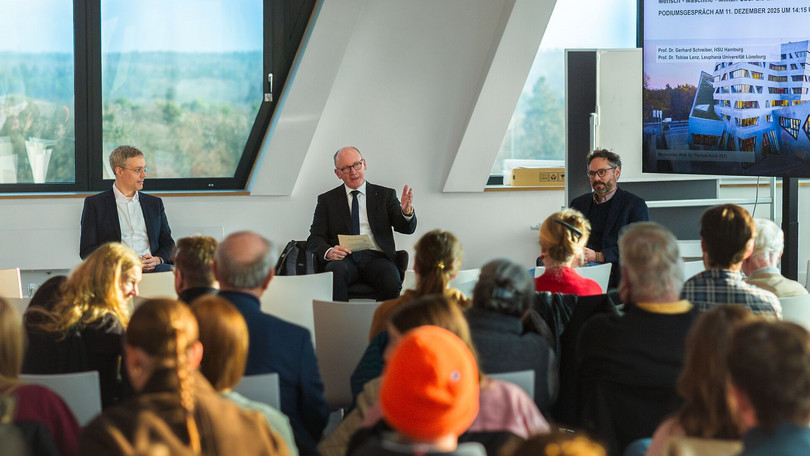

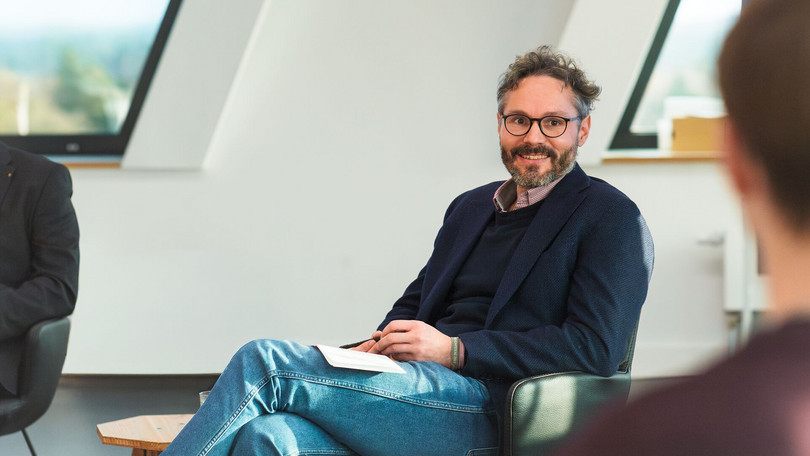
Prof. Dr. Gerhard Schreiber, Chair of Protestant Theology, Social and Technical Ethics and Director of the AI Ethics Research Hub at Helmut Schmidt University, offered insights into his research. Current technological developments are accelerating rapidly, he noted, making the need for binding ethical standards for technology increasingly apparent. Within NATO, there is a clear intention to establish binding definitions of ethical limits for the use of artificial intelligence in military contexts, according to Helmut Schmidt University’s AI commissioner.
Drawing on his expertise in international relations, Lüneburg political scientist Prof. Dr. Tobias Lenz agreed with this assessment in principle but questioned the prospects for successful international agreements in the field of ethics. Historically, there have been relatively successful treaties regulating military technologies, such as the 1970 Treaty on the Non-Proliferation of Nuclear Weapons and the 1996 Ottawa Protocol. “But if we assess the current situation realistically, we should not expect international agreements aimed at restricting new military AI technologies within the next 10 to 15 years.” Instead, he said, the present moment is marked by a significant increase in multipolar competition, in which AI is assigned an important strategic role.
“What technologies are we talking about when we refer to AI in the military?” moderator Thomas Kück asked. According to Schreiber, the German term “Künstliche Intelligenz” is only a partial translation of ‘artificial intelligence.’ In English, ‘intelligence’ can also refer to the gathering of information or situational intelligence. In this context, the term therefore primarily refers to targeted, computer-assisted information processing. In military applications, its potential lies less in the platform itself than in the prior analysis of large volumes of data – for example, as a basis for planning and deploying systems such as drones. Lenz added that this had been the case during the military escalation in Gaza, where the Israeli military had identified purported strategic targets on the basis of AI-generated information, with devastating consequences for the civilian population.
At this point, Thomas Kück turned the discussion to the ethical dimension of the issue. In his book “Menschen, Götter und Maschinen” (“Humans, Gods, and Machines”, Munich, 2022), Wolfgang Huber develops an ethics of responsibility comparable to the approach Hans Jonas had previously developed in environmental ethics. Its guiding principle is forward-looking judgment in accordance with the precautionary principle. Few would dispute this, Schreiber said. In military contexts, however, responsibility must be defined more precisely.
The English word ‘responsibility’, he explained, can literally be understood as the capacity to respond – 'response-ability.’ Looking back, it refers to accountability; looking ahead, it concerns whether an action can be responsibly justified. This, he argued, is the more difficult question. Schreiber distinguished among three categories in assessing whether military uses of AI can be responsibly justified: first, their use for self-defense; second, their use against an adversary without direct physical effects; and third, their use in kinetic attack scenarios. He noted that ‘kinetic effects’ is a euphemistic military term for the use of weapons.
The discussion with the audience that followed was lively and demonstrated just how deeply the issue currently concerns many people. “What can we do in Europe?” a student asked in closing. “Get a move on!” came a spontaneous response from the audience, which Tobias Lenz took up in his final remarks.
“To some extent, yes: get a move on and develop our own technologies if Europe wants to have a voice at the negotiating table. The history of successful negotiations shows that those who are heard are primarily those who are capable of imposing legal ‘constraints’ on themselves – not merely on others. But we are also talking about the dangers of war without limits,” the Lüneburg political scientist concluded with a warning.
In closing the event, Thomas Kück added that greater vigilance in the use of digital media was also needed. “Targeted disinformation is another form of military AI use. We must not allow external forces to destroy what we have achieved democratically,” said the Lüneburg theologian, echoing Gerhard Schreiber’s call: “We need to develop democratic resilience.”