
Leuphana Professor Jordan Troeller Receives Robert Motherwell Book Award
2026-10-07 Being an artist. Being a mother. Being both. Not despite, not either/or, not and. Leuphana Professor Jordan Troeller has written a book about motherhood as an artistic stance, centering on the artist Ruth Asawa and her community of artist-mothers. Her work has now been honored with the prestigious Robert Motherwell Book Award for outstanding publications in modern art history. Our warmest congratulations! In this interview, Prof. Jordan Troeller discusses her motivation for the topic and why, for her, art and education are intrinsically linked.
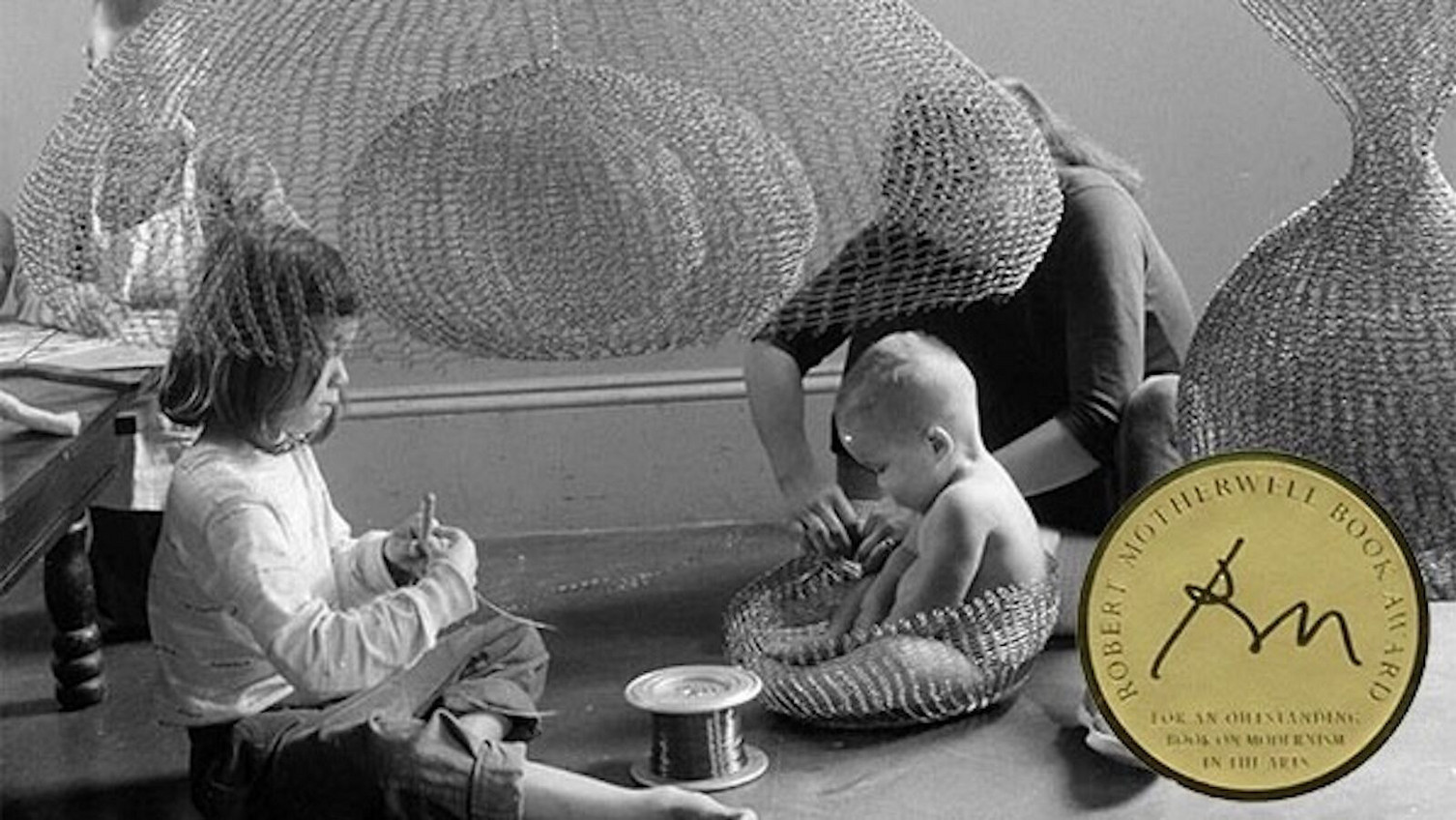
On the cover of your book, Ruth Asawa is sitting in her home with four of her six children, working on one of her famous wire sculptures. The scene exudes a profound sense of tranquility. The artist herself seems to dissolve behind her sculptures. Why did you choose this image?
My research on Ruth Asawa actually began with my encounter with this photograph. I discovered it in 2017 in an exhibition catalog on twentieth-century women artists and was captivated. My son was one year old at the time, and I thought to myself how remarkable it would be if the highest artistic achievement were entirely compatible with caregiving. To me back then, it felt like a utopian vision.
That means, the impetus for the book was personal?
It was both personal and professional. I completed my doctorate on the Bauhaus. Josef Albers, an art educator at Black Mountain College and an important mentor to Ruth Asawa, was also at the Bauhaus prior to his emigration. I found his influence on American art education highly fascinating.
Personally, I had always considered myself a feminist and was convinced that women possessed all professional opportunities. Yet as soon as you are pregnant, caring for a child, and faced with caregiving obligations, everything before feels like a mere game. I was confronted with these limitations, but also with the fact that I had grown as a person through this experience. When I subsequently saw the photograph of Ruth Asawa, I knew I had to delve deeper into this topic and engage with it from a scholarly perspective.
Did substantial research already exist on this topic?
Since the 1950s, literary studies in particular have engaged with motherhood and art, looking at figures such as Virginia Woolf, Tillie Olsen, Käthe Kollwitz, or Paula Modersohn-Becker. However, this remained somewhat marginalized and was not as prominent as the perception of the topic in contemporary art has become over the last twenty years.
With this book, I attempted to write a kind of pre-genealogy. Who was actually among the earliest to grapple with this issue? And to do so in a manner where motherhood was not merely positioned at the level of content but rather conceptualized as an artistic stance or methodology.
The jury of the Motherwell Book Award recognized precisely this contribution of your book: that you succeed in challenging the paradigm that artistic work is incompatible with raising children. What does it mean for our understanding of art when we dismantle this narrative?
It means we must operate with a far more comprehensive concept of art. That art is not exclusively found in museums and art galleries, but also in the kitchen, on the kitchen table, in the living room, or indeed in schools. This is why I dedicate a third of my book to the context of art education.
What role does such an understanding of art play in pedagogical work?
Artistic work with children is often categorized as the least valuable. Yet it is actually quite the opposite. Nurturing a personality is the ultimate artwork of all, and simultaneously a societal achievement and responsibility. Consequently, alternative pedagogical concepts have existed for at least 120 years in which artistic activity is present in every form of interaction. The Bauhaus also played a major role in this discourse. And yet, in schools, we remain stuck in outdated patterns.
In the book, you also focus on Ruth Asawa’s community of artist-mothers, as you call them. Was this an aspect of her work you were familiar with beforehand?
The significance of her community came as a great surprise to me, and at the same time, collective work makes total sense. For it is precisely through this community that an entirely new paradigm of artmaking and the artist emerges. Artistic practice happens through exchange.
What role do you assume as a scholar by writing a book on such a topic?
I see my role as that of a storyteller - rendering this important history from the past visible once again. And yes, narrating it anew. Also to demonstrate that there are alternative possibilities to what is happening today. And this gaze into the past is sometimes even more compelling than fantasies about the future.
Thank you very much for the conversation!