
Recap: Dr. Paweł Latosiński on his Research Stay at the IPTS
2026-07-28 In our new interview series, we talk with visiting scholars at our faculty about their research at Leuphana and their time in Lüneburg.
Dr. Paweł Latosiński is an assistant professor at the Institute of Automatic Control at the Technical University of Łódź in Poland. From June 1–26, 2026, he was a visiting scholar at our Institute of production technology and systems.
Dear Dr. Latosiński, we were very pleased to have you here for your four-week research visit at our faculty. What was the reason for your visit, and why did you choose our faculty in particular?
My stay was mostly aimed at establishing a firmer cooperation with prof. Paolo Mercorelli, who has been visiting Lodz University of Technology for many years. I was also asked to conduct two seminars on sliding mode control theory during my stay in Lüneburg.
What question or project was the focus of your visit?
The main focus of my work at Leuphana was centered on a combination of model predictive control with sliding mode control, with the aim of preserving advantageous properties of both of those strategies. The topic was a rather natural choice since my work at Lodz University of Technology is mostly centered on SMC, while the team at Leuphana has substantial experience in MPC design. At the moment the results are strictly in the field of control theory, but we have some experiments in mind in the near future.
Which person, group, or institution here was particularly crucial to your progress – and why?
Naturally, I wish to thank prof. Mercorelli for his invitation and guidance during my stay. I’m also grateful to his co-workers: Jannis Dethmann, Benjamin Haus, and Felix van Rossum for their warm reception and help in many aspects of my stay at Leuphana. During my stay in Lüneburg we had quite a few talks that were, in my opinion, very productive, and I am hoping to repeat that experience at some point in the future.
What surprised you during your first few days or weeks here – academically or culturally?
I actually can’t think of many academic surprises. I have not traveled very far, and I suppose the way universities work is not that different in Germany.
Culturally, I was amazed by the sheer number of bicycles in a mid-sized town like Lüneburg. Infrastructure has been progressing in that direction in Poland as well, but not on that scale.
What specific results came out of your stay?
Together with the team at Leuphana we have established three cooperative research topics that will, hopefully, result in published papers soon. Two of those topics, as mentioned before, concern a combination of MPC with SMC to increase the overall performance of the control algorithm. I have also been involved in a third topic related to fast terminal sliding mode control, which is perhaps the closest to completion at the moment.
What was your personal highlight (a moment, a place, a conversation)?
I have spent plenty of afternoons strolling through picturesque Altstadt near campus, but the fondest memory was a trip to Lüneburg Heide on one of the weekends. Thoroughly recommended to anyone who finds themselves in the area.
Thank you very much for the interview and the insight into your research stay – it was great to have you with us!
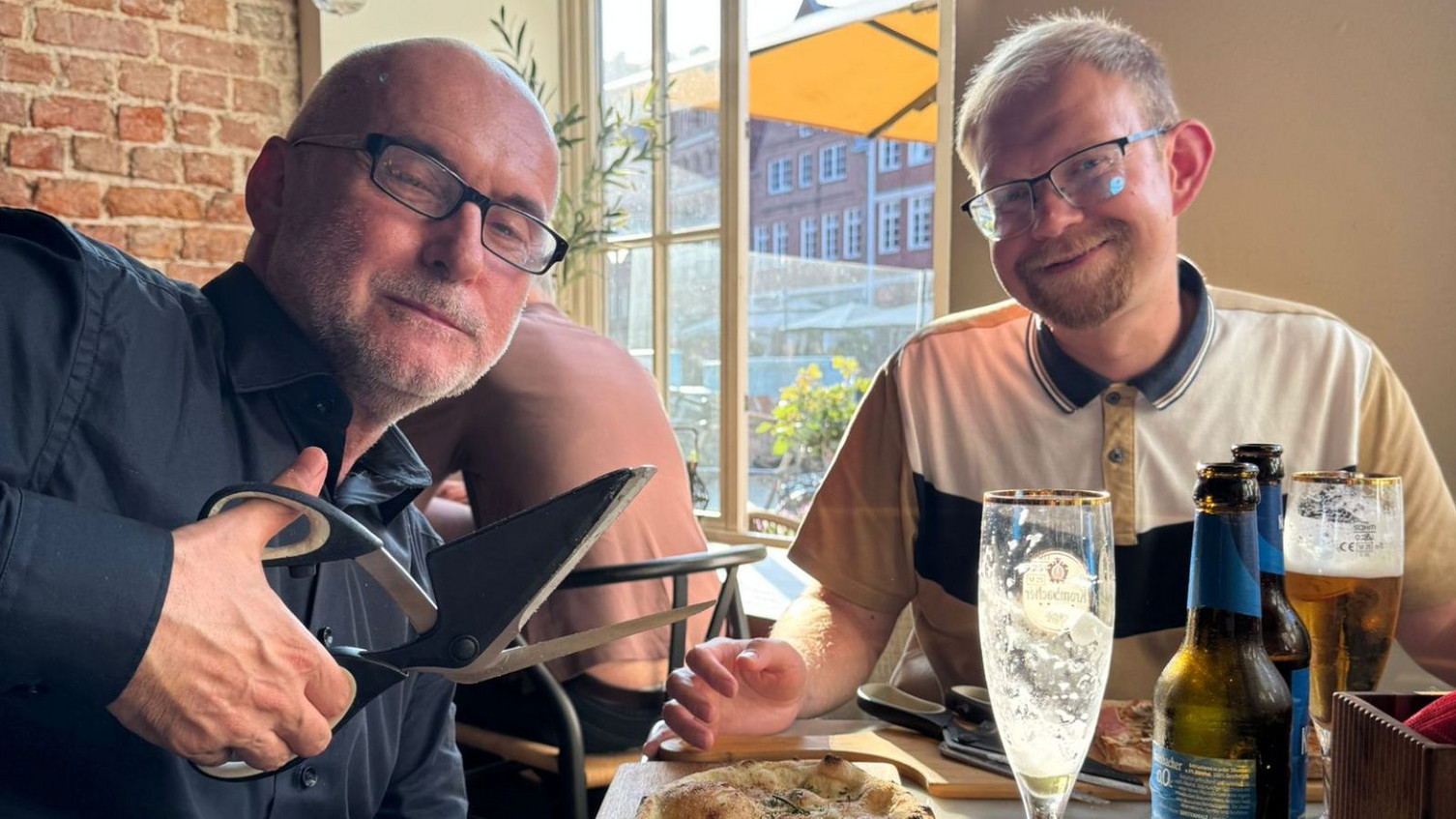
About the Researcher:
Paweł Latosiński’s (PhD) main area of expertise is control theory, particularly sliding mode control of uncertain systems. In this particular field he has published over 20 papers in JCR-indexed journals. The results of his work on reaching law based sliding mode control have also been presented on many international conferences.