
Sustainability in Mechanical Engineering: Joint Study Highlights the Need for Action and Research
2026-09-21 How far has the sustainable transformation in the German mechanical engineering sector already progressed? What challenges exist in integrating sustainability aspects into product development and production—and where do companies see a need for further research and development? Prof. Dr.-Ing. Markus Klein of Munich University of Applied Sciences and Prof. Dr.-Ing. Arthur Seibel of Leuphana University Lüneburg explored these questions in a joint study.
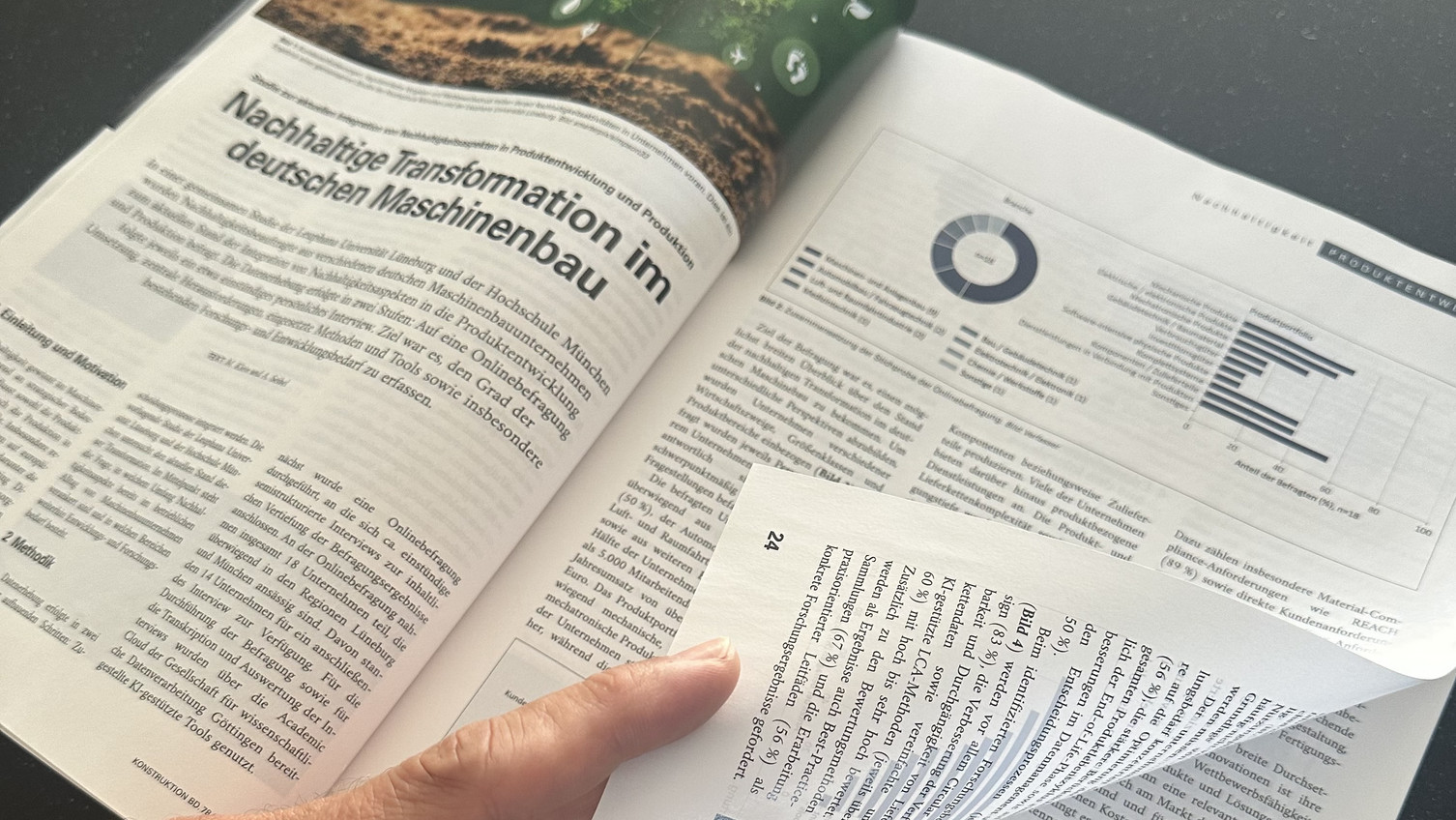
The collaboration arose during a research visit that Markus Klein undertook this summer semester as a guest at Leuphana’s Institute for Production Technology and Systems (IPTS). This visit led to a joint study on sustainable transformation in the German mechanical engineering industry, the results of which have since been published in the journal Konstruktion.
For the study, sustainability managers from companies in the mechanical engineering sector and related industries were surveyed. An online survey of 18 companies was followed by in-depth personal interviews with 14 companies. The goal was to gain insight into the current status of implementation of sustainability aspects, existing challenges, and the research and development needs relevant from a corporate perspective.
The results show that sustainability has now become a top strategic priority for many companies. However, concrete implementation is often still driven by regulatory requirements and customer demands. At the same time, significant hurdles remain, particularly due to the high cost of sustainability assessments and an often inadequate data foundation along the value chain.
At the same time, the surveys identify concrete starting points for research and development. These include, among other things, simpler and more automated evaluation methods, improved data availability and consistency, and approaches to more circular product design. The study thus makes it clear that the further integration of sustainability requires both technical and methodological solutions as well as stronger embedding within existing development and business processes.
Markus Klein’s research visit to IPTS provided an opportunity to bring together the perspectives and expertise of both universities and to collaboratively address a research question of high relevance to both academia and industrial practice. The recently published paper summarizes the results of this collaboration and also identifies potential avenues for further research.