
AgRe-Lab: Long-term strategies for Climate-Resilient Agricultural Landscapes
2026-11-10 Prof. Vicky Temperton and PhD student Mira Heßelmann of Leuphana School of Sustainability are researching the multifunctional role of plants.
How can agricultural landscapes remain productive, safeguard biodiversity, and provide important ecosystem services even under the conditions of climate change? The new collaborative project “AgRe-Lab”, led by the University of Göttingen, is dedicated to addressing this question. Leuphana University of Lüneburg is leading the subproject “Multifunctional Role of Plants”, headed by Prof. Vicky Temperton, which examines the extent to which increasing the functional diversity of plants on grassland and cropland in collaboration with farmers and other stakeholders in the landscape is possible without significant yield losses.
Four additional research institutions and ten industry partners from the fields of agriculture, nature conservation, public administration, and education are participating. The Volkswagen Foundation and the Lower Saxony Ministry of Science and Culture are funding the research consortium for six years with a total of 5.3 million euros from the “zukunft.niedersachsen” program.
The researchers are examining social science components such as socioeconomic resilience, the acceptance of measures, and the prerequisites for collective action. At the same time, they are studying key ecological functions and services of agricultural landscapes, including carbon sequestration, biodiversity, agricultural productivity, and the water cycle.
Research sites will be established in the three Lower Saxony districts of Hildesheim, Northeim, and Gifhorn, and these will be divided into twelve study areas. An additional “Twinning Lab” in Vechta will be used to assess the transferability of results and to work with regional partners to explore how successful approaches can be adapted to different conditions.
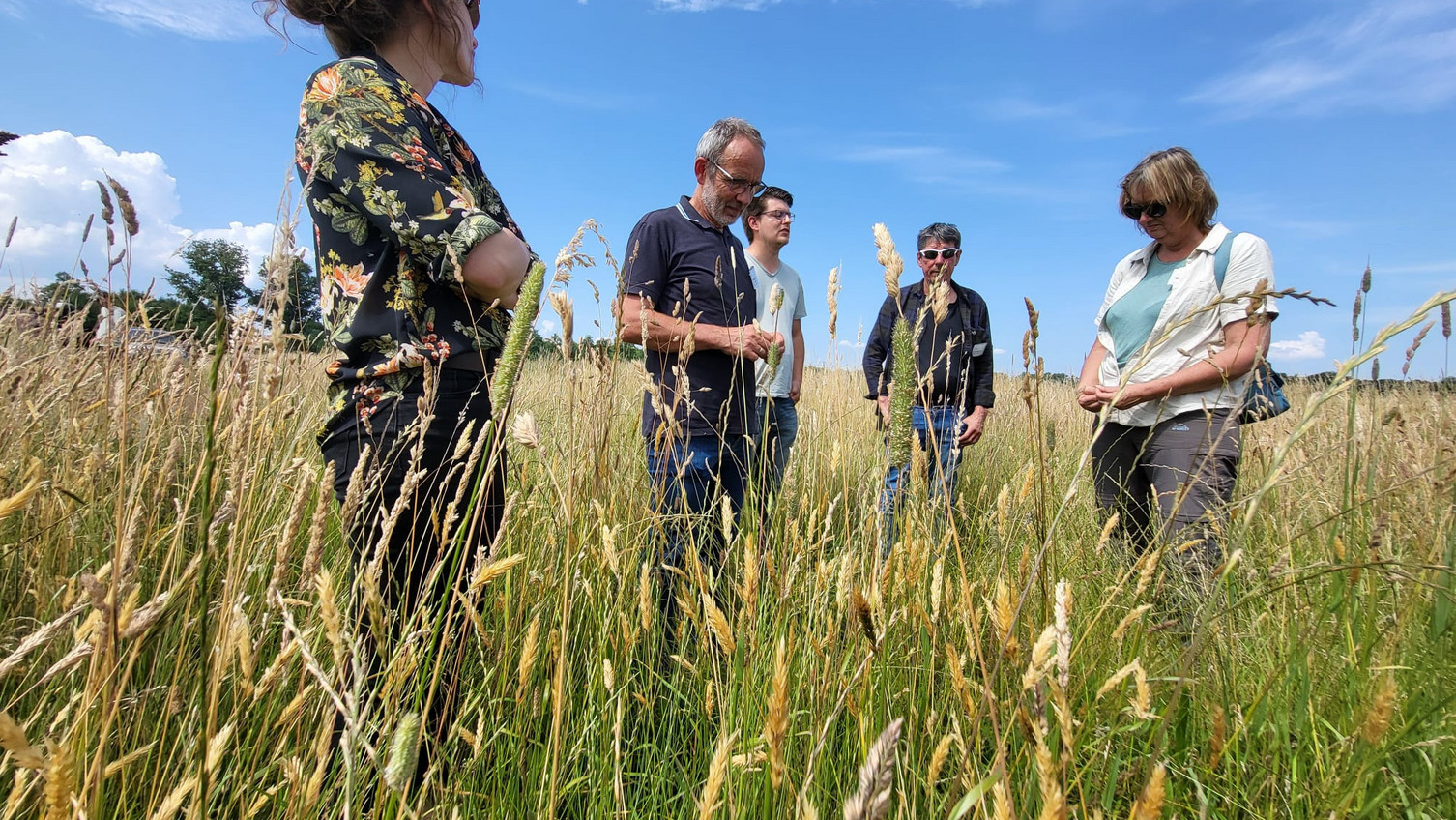
In the Leuphana subproject “Multifunctional Role of Plants”, researchers aim to better understand where synergies are possible within measures to promote biodiversity and climate protection in agricultural landscapes, and where trade-offs regarding the impacts on plant diversity and yield are unavoidable. The project involves ecological experiments conducted in the field and under controlled conditions that go beyond standard measures, in which intensively managed grasslands are converted from one or two grassland species to three to six species through extensification. Planting nitrogen-fixing legumes and other herbaceous plants creates new opportunities to increase plant and pollinator diversity in systems that would otherwise have low biodiversity, as well as to enhance carbon sequestration in the soil. This is a promising path toward multifunctional grasslands that can both provide yields and contribute to climate protection and biodiversity. A key question the research group aims to answer is to what extent nitrogen-fixing legumes can be maintained in the grassland ecosystem over the long term, since, on the one hand, their presence is essential for carbon sequestration, but, on the other hand, they are displaced over time by grasses that are more competitive under these conditions due to the accumulation of nitrogen.
During the first three-year phase, beginning in November 2026, doctoral candidate Mira Hesselmann will be working in Prof. Vicky Temperton’s research group at Leuphana University Lüneburg.
AgRe-Lab provides scientifically sound, practice-oriented solutions, strengthens regional transformation processes, and lays a solid foundation for excellent climate and sustainability research in Lower Saxony and beyond.