
From Concept to Realization: An Interview About the Exhibition “The Secret World of Moths”
2026-11-18 Interview with Senan Gardiner and student Pablo Benedikt Witterau about the process of creating the exhibition “The Secret World of Moths.”
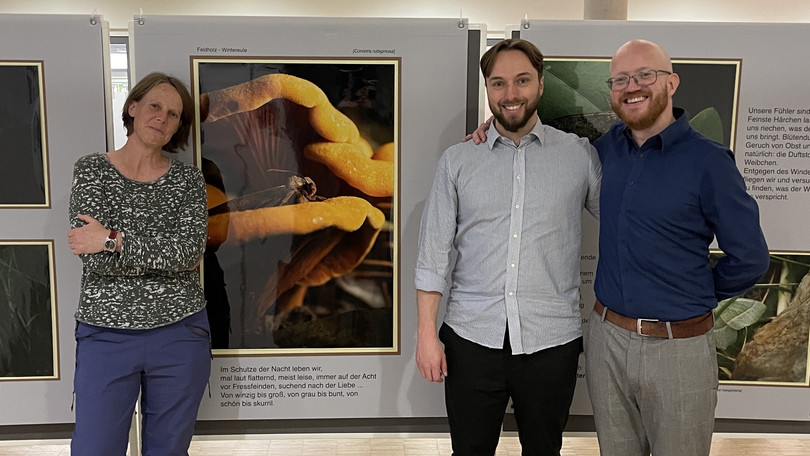
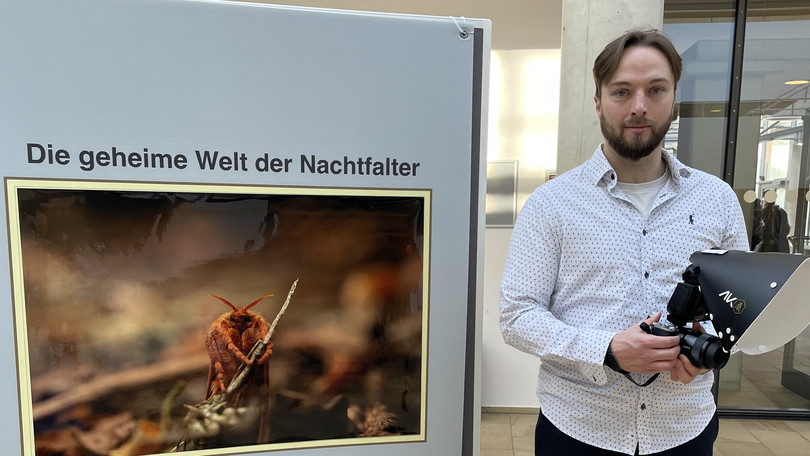
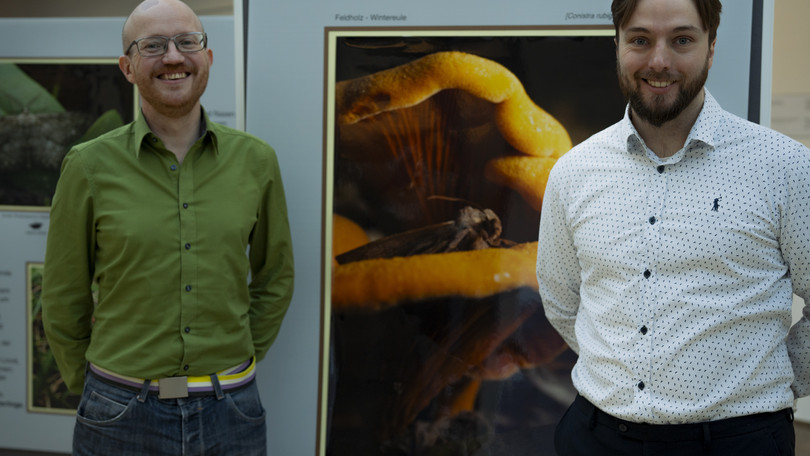
As part of his bachelor’s thesis, student Pablo Benedikt Wetterau opened an exhibition on moths in the library foyer at Leuphana University of Lüneburg. In the following interview, he and his thesis advisor, Senan Gardiner, explain how this came about and what the storytelling method has to do with it.
The interview
In what seminar context was the exhibition created?
Senan Gardiner: Bene was a student of mine in the course “Storytelling for sustainability” a few years ago and after we met again when I took over teaching the course “Ecosystem Services and Functions” for Vicky Temperton’s Sabbatical Bene asked if I would be his supervisor for his Bachelor thesis.
How did the two of you come up with the idea for the exhibition?
Pablo Benedikt Witterau: The idea of the exhibition developed through my interests in photography and ecology. Since surveying diurnal butterflies in the Grassworks Project, I found great interest in the group of Lepidoptera. After I dived into the topic, the nocturnal butterflies sparked my curiosity especially when I found out about their unproportional higher diversity compared to their diurnal companions, while being less known and studied. Following that, I thought, those animals are super crucial to our ecosystems and they need more attention. Last year then, I bought myself a UV-A lamp and started to survey my own and the neighbours garden. Because I didn't want to kill the animals in order to identify them, I had the idea of photographing each individual. I found my technique through the inspiration of the photographs of the Columbian photographer Alejo Lopez (@junglediamonds). When I had a data set and quite an amount of photographs, Senan and I discussed several ways to display them to public.
Senan Gardiner: Bene came to me with these amazing images he had taken and wanted to know how he could combine his passions for ecology and photography with a project where he could explore the visual storytelling through photography. There were many conversations about how that would look like, and eventually we arrived at the idea of the exhibition.
What did your collaboration look like?
Senan Gardiner: Bene and I met multiple times over the last year to discuss his work. As a Sustainability Education researcher, my question to him was always “How can we stir people’s interest in your topic (moths) and what are the stories we can tell about them?”
Pablo Benedikt WItterau: We discussed how we could present the photographs to people in a way, that transports a valuable message that we wanted them to convey. I imagined first of putting them into a video with animated graphics, but then we came up with the idea of doing a physical exhibition. When having the final idea of doing an exhibition, I started to make first drafts and then reflected my ideas first with a few friends of mine and then with Senan. Later we discussed details with Vicky Temperton and together we filtered the information, that we want the story to tell. Finally, after some iterations we finalized the exhibition.
What is your approach to storytelling in sustainability science?
Senan Gardiner: As a sustainability education researcher, I’ve always been fascinated by ways we can help people truly connect with the challenges of our time and make the, sometimes, difficult choices to engage in more sustainable behaviours. Storytelling is about communicating in a way that evokes emotion, that your audience and makes the message relatable. It typically involves elements such as setting a scene, a clear plot structure, clear protagonists and their point of view, a conflict that needs resolving, and stylistic choices depending on the audience. Through using storytelling for sustainability communication, we can bridge the gap between knowing and doing and deliver a clear message about sustainability and a call to action.
In Bene’s exhibition you follow the story of the moths as a character who you can empathise with, and through storytelling devices you can understand their challenges more deeply – their need to find food and mates, the ingenious ways they have evolved to protect themselves from predators and the ways they navigate a rapidly changing landscape. You connect with the current challenges that moths face that are being caused by our human impact. So, our big question is whether these elements come together to help people make a choice to make their behaviour more sustainable. It’s part of SETRI’s research and for more information on sustainable storytelling you can follow this link
https://sustainability-education.net/sustelling/stelling
What is the topic of your bachelor's thesis, and how did you find it?
Pablo Benedikt Witterau: My thesis examines whether imagery rich storytelling can convey knowledge with a low threshold at a public space. The research question for my thesis developed during the process of defining the possibilities at hand: The story we want to tell, the place of the exhibition and the shape of the display.