
On the “Smiley” Position of Watches in Advertising
Prof-Insights: Three Questions for Prof. Dr. Gerd Meier About the Research Semester
2026-08-11 During the 2025–2026 winter semester, Prof. Dr. Gerd Meier, director of LüneLab, the Institute for Experimental Industrial Psychology, focused on the so-called “smiley” position of clocks (10:10), which is considered an established standard in advertising psychology.

The study investigated whether, beyond its aesthetic impact, the position of the hands triggers a subconscious evaluation. The study compared the “V-shape” of a “smiling” clock at 10:10 with the downward-pointing hand position at 8:20, as well as the influence of the spatial orientation of an upright versus a horizontal clock face. What inspired you to explore the hand position in advertising?
I am very interested in sensory marketing. I teach a course on this topic. The depiction of clocks in advertising falls under the category of sensory marketing using visual stimuli. In fact, clock hands are always shown in the same positions in watch advertisements. For this reason, experimental research into the effects of different hand positions is of great importance.
What methodology was used?
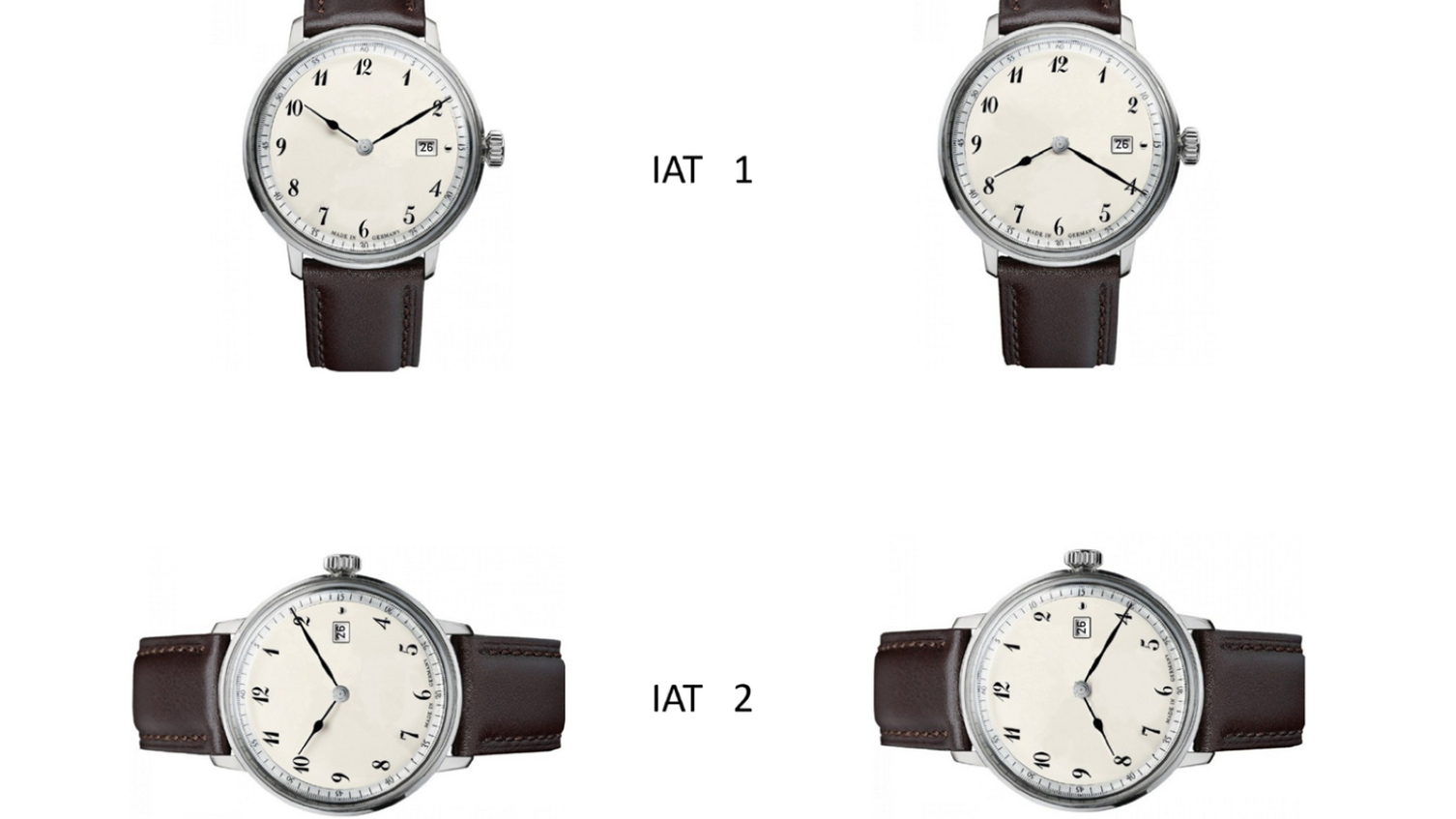
The study participants completed two so-called “implicit association tests” (IATs) in which clocks with two different hand positions (10:10 and 8:20) were displayed on a computer screen. In the first IAT, which featured upright clocks, participants had to assign the clocks to the categories “hands up” and “hands down” as quickly as possible by pressing the corresponding keys on a keyboard. In subsequent trial runs, participants were asked to assign words that imply high quality (e.g., high-quality, excellent, great) and words that imply low quality (e.g., low-quality, defective, poor) to the correct categories—“High Quality” and “Low Quality”—as quickly as possible. The IAT then analyzes the reaction time to determine which hand positions are associated with high quality and which with low quality. In the second IAT, the clocks were displayed lying flat, and the categories were now “hands pointing to the right” and “hands pointing to the left.” The trials with the words were identical to those in the first IAT.
The goal of this experiment was therefore to investigate whether clock designs with a “smiley” hand position (10:10) evoke more positive implicit associations than those with a ‘grumpy’ hand position (8:20), and whether the “smiley” design can enhance the positive advertising effect.
What conclusion did you reach, and was it surprising?
In the first IAT, the clocks were depicted upright. Here, the “smiley” and “grumpy” representations were clearly recognizable. My hypothesis was that a clear IAT effect would be evident here.
In the second IAT, the clocks were depicted lying flat. So in this case, there was neither a smiley face nor a grumpy face, even though the same times were shown. My hypothesis in this case was that there is no IAT effect. Since the participants completed both IATs, I was able to use this repeated-measure design to test the general hypothesis that the IAT effect is greater in the IAT with upright clocks than in the IAT with horizontal clocks.
All hypotheses were confirmed. We can therefore only recommend that the advertising industry use upright clocks featuring a smiley face to evoke positive associations. If anything, the effect size was surprising. The results were highly significant.
Thank you very much for this interesting insight into the psychology of advertising.