
AI & Autonomy: AIX Research Group participates at Leuphana Opening Week
2026-10-27 In early October 2026, the College of Leuphana University Lüneburg welcomed 1,500 first-year students during Opening Week. This year’s program was themed “IN::SECURITY.” Within this framework, students were able to explore the uncertainties that shape our world and how to address them. The “Artificial Intelligence and Explainability Group (AIX),” led by Prof. Dr. Ricardo Usbeck, supported the focus on AI and autonomy.
 ©Adrian Hirt
 ©Adrian Hirt
 ©Adrian Hirt
 ©Adrian Hirt
 ©Adrian Hirt
Opening Week IN::SECURITY
Every year, Opening Week marks the exciting start of the academic year at Leuphana. Students get to know the university and the campus and gain their first impression of academic work. In keeping with Leuphana’s interdisciplinary focus, they engage with the societal challenges of our time across all degree programs and collaborate on creative solutions in the form of critical commentaries and visionary short films.
This year’s central theme, IN::SECURITY, focused on societal challenges such as war, climate, work, and technology—issues that create uncertainty about the future, particularly among young people. Through talks, interviews, and collaborative project work, participants explored four thematic areas: Escalation & Conflict, Climate & Resilience, Work & Justice, and AI & Autonomy.
The fourth thematic area, centered on AI & Autonomy, was led by Ricardo Usbeck, professor of business informatics specializing in artificial intelligence and explainability, and supervised by members of the research group “Artificial Intelligence and Explainability Group (AIX)” at the Institute of Information Systems (IIS).
AIX: AI & Autonomy
In its daily work, the AIX research group also encounters the interface between AI and humans—and thus the tension between machine and human autonomy. In pursuit of the most comprehensive automation possible, many providers today forgo controllability as a design principle, thereby granting systems semi-autonomous capabilities. Meanwhile, human decisions are increasingly based on algorithmically predefined sets of possibilities, which seems to erode the autonomy imagined by humans.
The disruptive potential of AI is forcing us to rethink work, education, and society. At the same time, increasingly powerful AI tools are being developed and made available to the public.
“Progress needs uncertainty as a driving force,” stated Ricardo Usbeck in an expert presentation during Opening Week, “but AI breaks with traditional patterns of thought, so we as humanity must now figure out how we want to, can, and must control the pace of AI’s development.” In an interview led by Prof. Usbeck with Colonel Sönke Marahrens, an expert on hybrid warfare, students were given insight into the influence of digital media on war and its perception—followed by a critical discussion.
From a Loss of Control to Self-Determination and a Better Future: Academic Project Groups
In the academic project groups focusing on AI and autonomy, students received thematic guidance and technical advice from experts at AIX. In keynote presentations, H. Marlene Schulz, Debayan Banerjee, and Jannis Gries introduced the fundamentals of their research:
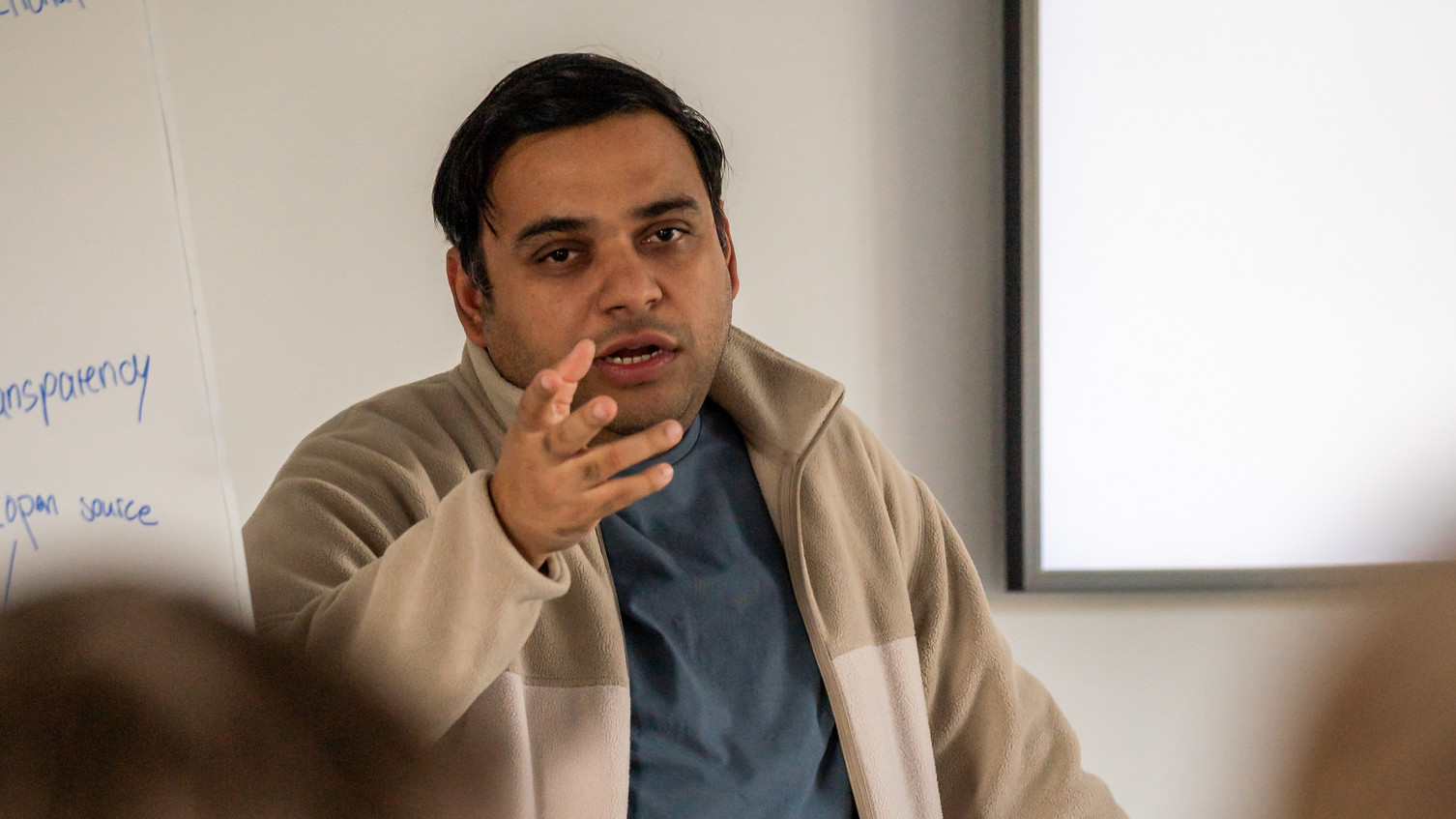
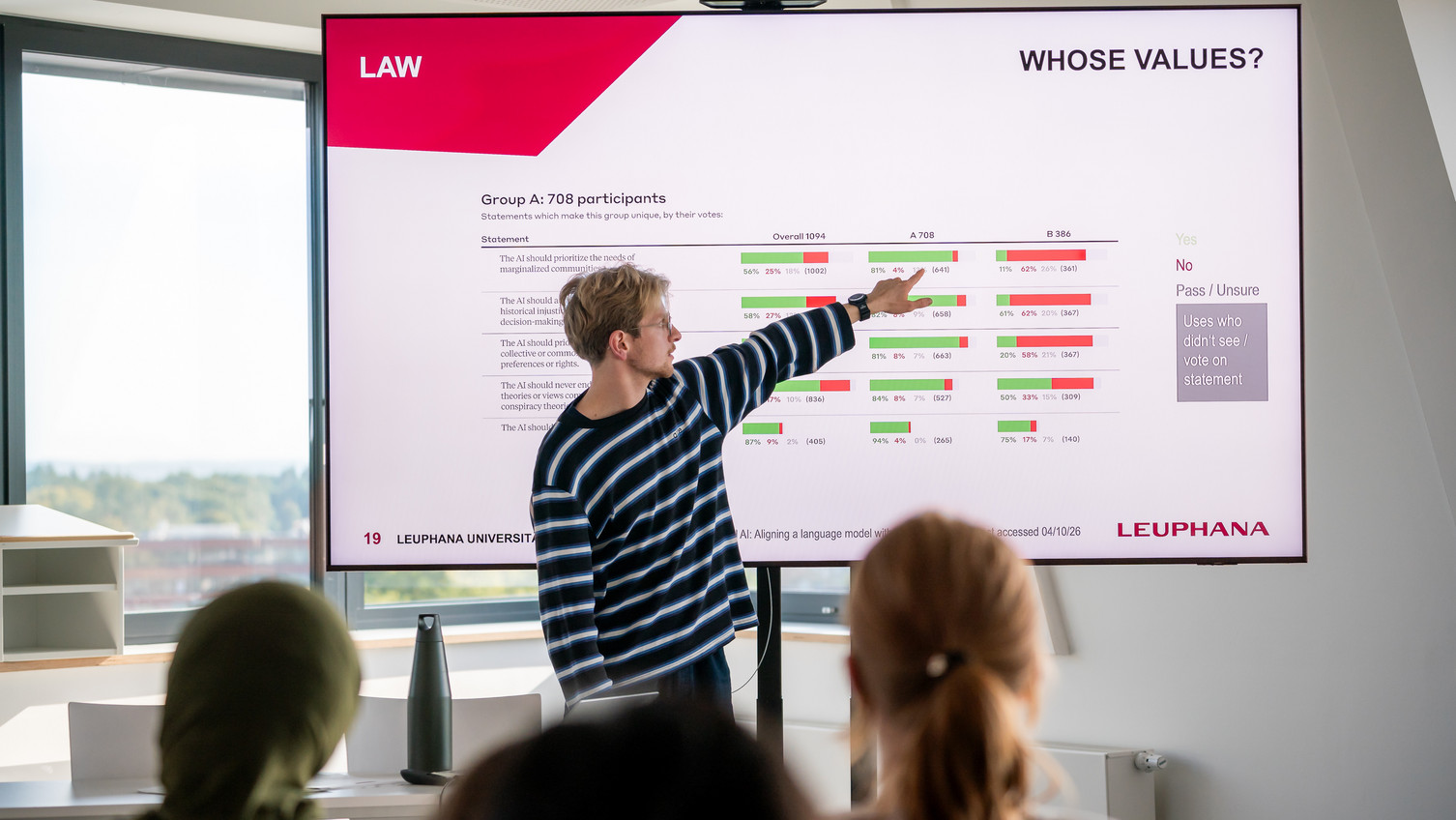
H. Marlene Schulz introduced her groups to the topic “Breaking Bad: AI Agents and the Problem of Autonomy” by examining recent security incidents involving agent-based AI, with the aim of addressing the philosophical question of the distinction between human and machine autonomy and the associated responsibilities. Debayan Banerjee, working with his project groups on “AI and Autonomy: An Opportunity for a Better Future for Germany,” Debayan Banerjee and his project groups examined the potential of AI and autonomy for Germany as a business location and discussed the risks and opportunities for society with the participants. Jannis Gries’s groups (“Whose Choices? How AI Architectures Shape Human Autonomy”) explored decision-making architectures in AI systems and discussed the democratic legitimacy of current AI constitutions.
Award-winning: “The Alignment Problem”
After an intensive week of guided discussion on the topics mentioned above, each project group submitted a critical commentary and a short visionary film. Particularly outstanding results were honored with awards at the closing event of Opening Week.
Here, the AIX group’s dedication paid off: In the AI & Autonomy category, a project group led by H. Marlene Schulz was recognized for its short film project “The Alignment Problem” and presented it in the auditorium during the finals. The film humorously portrayed an AI robot that was not aligned with human values and intentions, reacting to human instructions with actions that seemed dystopian. The film concluded with the message that even agent-based AI systems do not pursue their own intentions, but merely operate within parameters set by humans, and that it is the developers’ responsibility to adjust these parameters.