Empathy as a Key Competency: Risk-Free Training in the “Soft Skills Lab” Virtual Courtroom
2026-11-04 How the Soft Skills Lab Aims to Optimize Communication Skills in the Judiciary and Law Enforcement Using VR and AI
Imagine the following scenarios: A child who is clearly under stress is questioned in family court about why they refuse contact with one parent. A traumatized witness describes an assault in court. An aggressive defendant becomes increasingly hostile during cross-examination. Even though such situations are part of everyday work for employees in the justice system and law enforcement, they require a high level of communication skill that must be tailored individually to each case and the person being questioned. This demands not only communication skills but also tact, emotional self-regulation, and resilience. Empathy is a key competency in this context—and this is precisely where the recently launched research project “Soft Skills Lab—VR and AI for Conversational Skills in the Justice System and Law Enforcement” comes in.
VR Training in the Soft Skills Lab
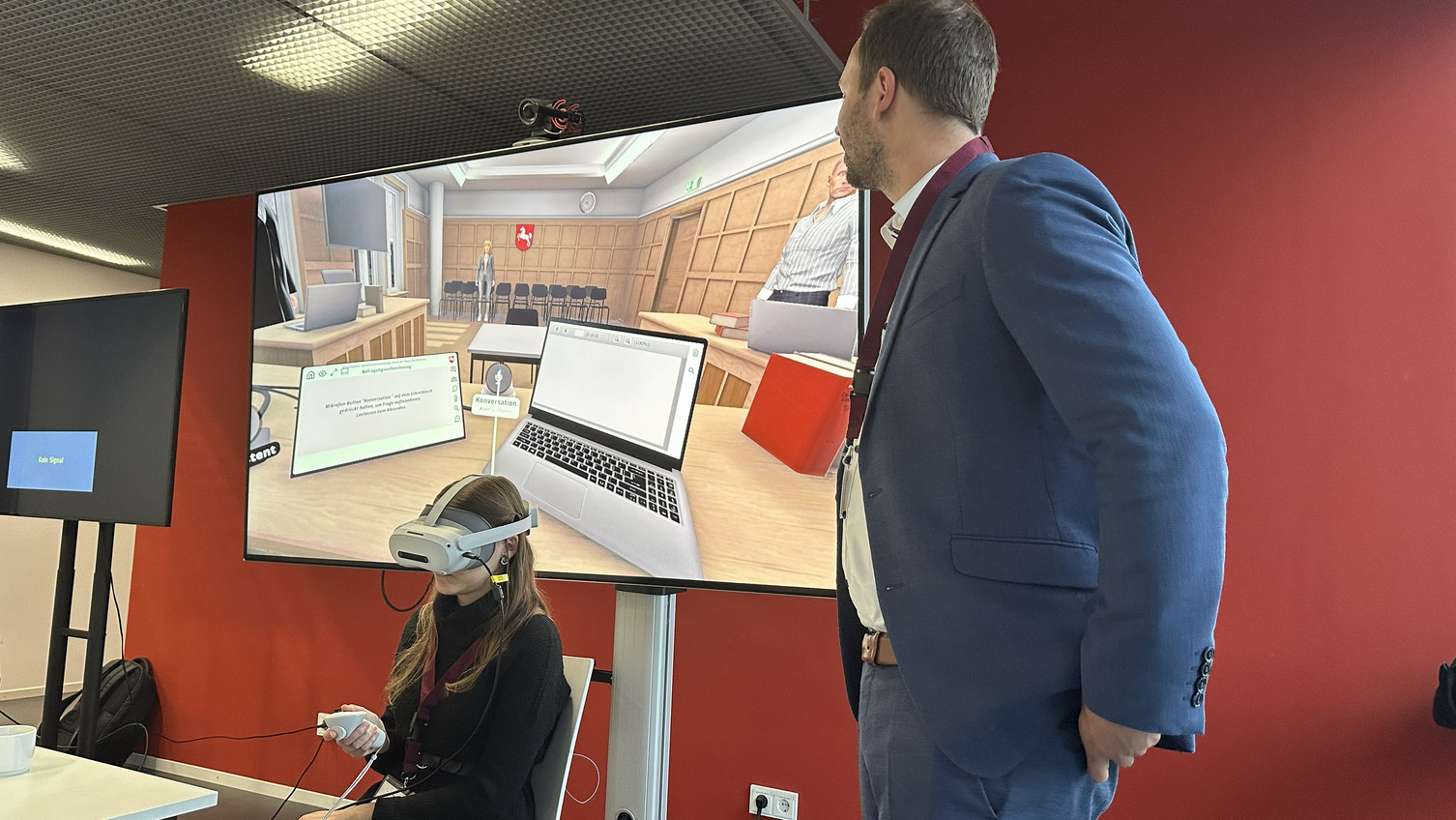
How can the key competencies described for interviewing vulnerable groups be developed? Especially when there has been a lack of digital and practical tools to foster these skills? To address the need for realistic questioning scenarios in a risk-free environment, the Soft Skills Lab, in cooperation with the Lower Saxony Ministry of Justice, aims to utilize the training tool “CourtnAI,” which has been tested in Lower Saxony since 2025. With the help of CourtnAI, judges, prosecutors, and law clerks can practice witness examinations in virtual reality while interacting with various characters. A feedback feature provides an assessment of how the examination and questioning techniques went.
With CourtnAI, we aim to innovatively advance training and continuing education in the judiciary and enable users to practice realistic conversation scenarios in a safe environment. The pilot program is already showing a high level of acceptance and tangible added value among users. Together with Leuphana University, we aim to make this added value scientifically measurable and determine how we can make the training even more effective.
– Dr. Daniel Stüve, Judge, Project Manager for CourtnAI—Virtual Courtroom for Training and Continuing Education
The Soft Skills Lab is specifically refining the VR training format from a psychological perspective, integrating it with personalized, AI-powered feedback, and evaluating it scientifically. This allows participants to practice realistic VR courtroom scenarios risk-free within technology-enabled, immersive learning environments. A question coach, eye-tracking, and a multi-user courtroom with perspective-switching capabilities support the training. Artificial intelligence can assist in this process by efficiently structuring large volumes of responses, reducing human bias, and recognizing psychological and linguistic nuances, such as speaking time, pace, and tone of voice.
Our goal is to pay closer attention to vulnerable groups in particular. For example, how can we improve the quality of the questioning process in court when children are involved?
– Prof. Dr. Sabine Remdisch, Project Director of “Soft-Skills-Lab
In Dialogue with Industry Partners
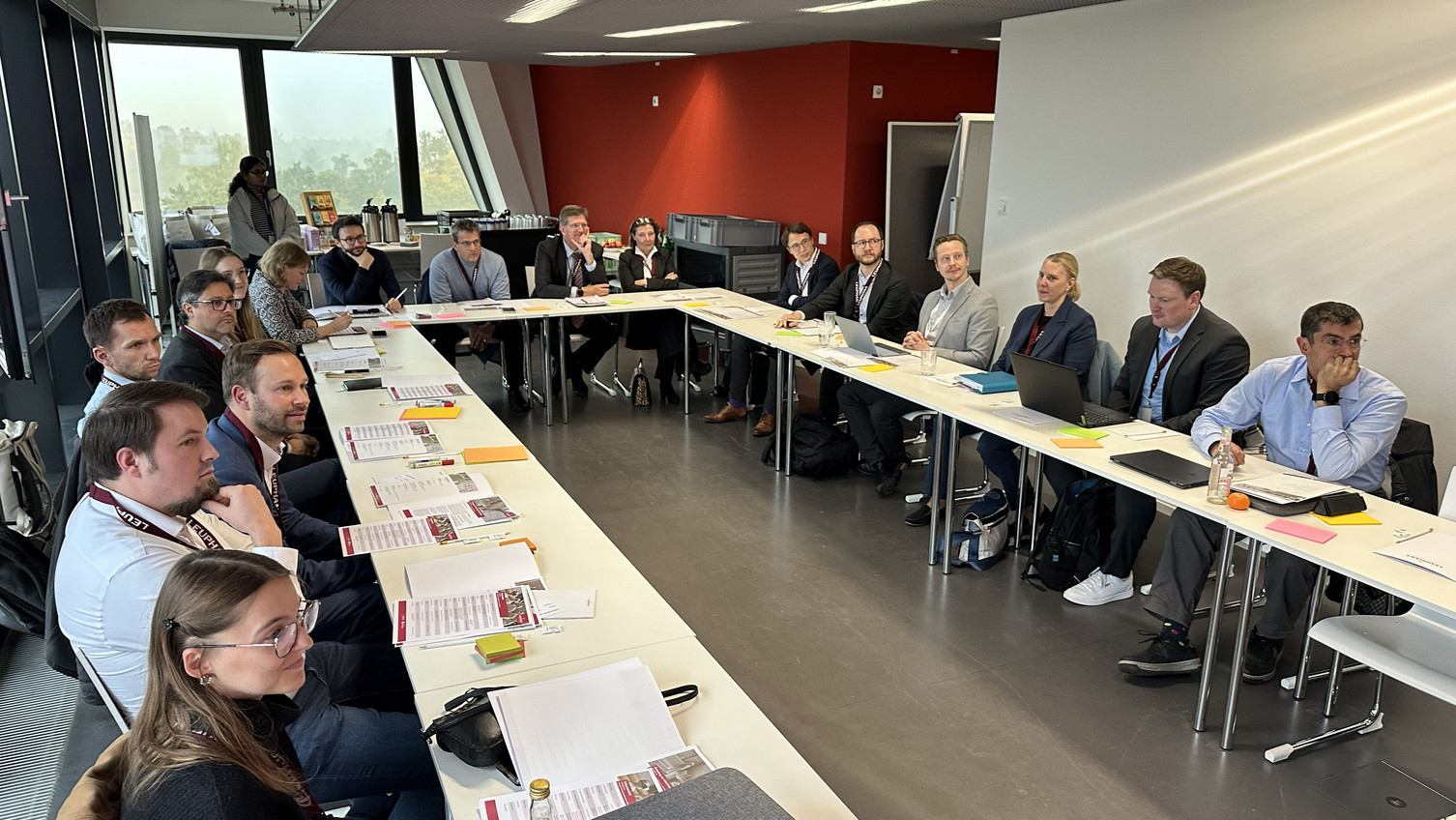
The involvement of external experts from the fields of justice, virtual reality, and AI, as well as those directly affected by the project, is of particular importance to the Soft Skills Lab. On October 21, following an invitation from the project leadership, numerous members of the external project advisory board gathered for their inaugural meeting to get to know one another over lunch and in discussion groups, to gain an overview of the research questions and the project plan, and to try out various technologies, such as 3D screens, VR headsets, and the CourtnAI tool. The advisory board members—who include representatives from the Lower Saxony Ministry of Justice, judges, AI developers, executives, psychologists, and researchers—will in the future be able to directly contribute their expertise to the project, critically reflect on research questions, and participate in the development of practical applications. Looking ahead, the advisory board members will be able to apply the project’s findings to their own professional practice, thereby strengthening the social skills, confidence in decision-making, and resilience of employees in the justice system and law enforcement.