
Professor Dr. Klaus Kümmerer Appointed to New UNEP Panel
2026-08-04 The new advisory body of the United Nations Environment Programme (UNEP), which includes representatives from the WHO and the FAO, aims to promote sustainable supply chains - particularly in the fashion and construction sectors - while reducing hazardous chemicals and environmental pollution. In an article recently published in the highly respected journal Angewandte Chemie, the professor of Sustainable Chemistry and Material Resources also reflects on nearly three decades of research into green and sustainable chemistry, resource scarcity, and chemicals management.
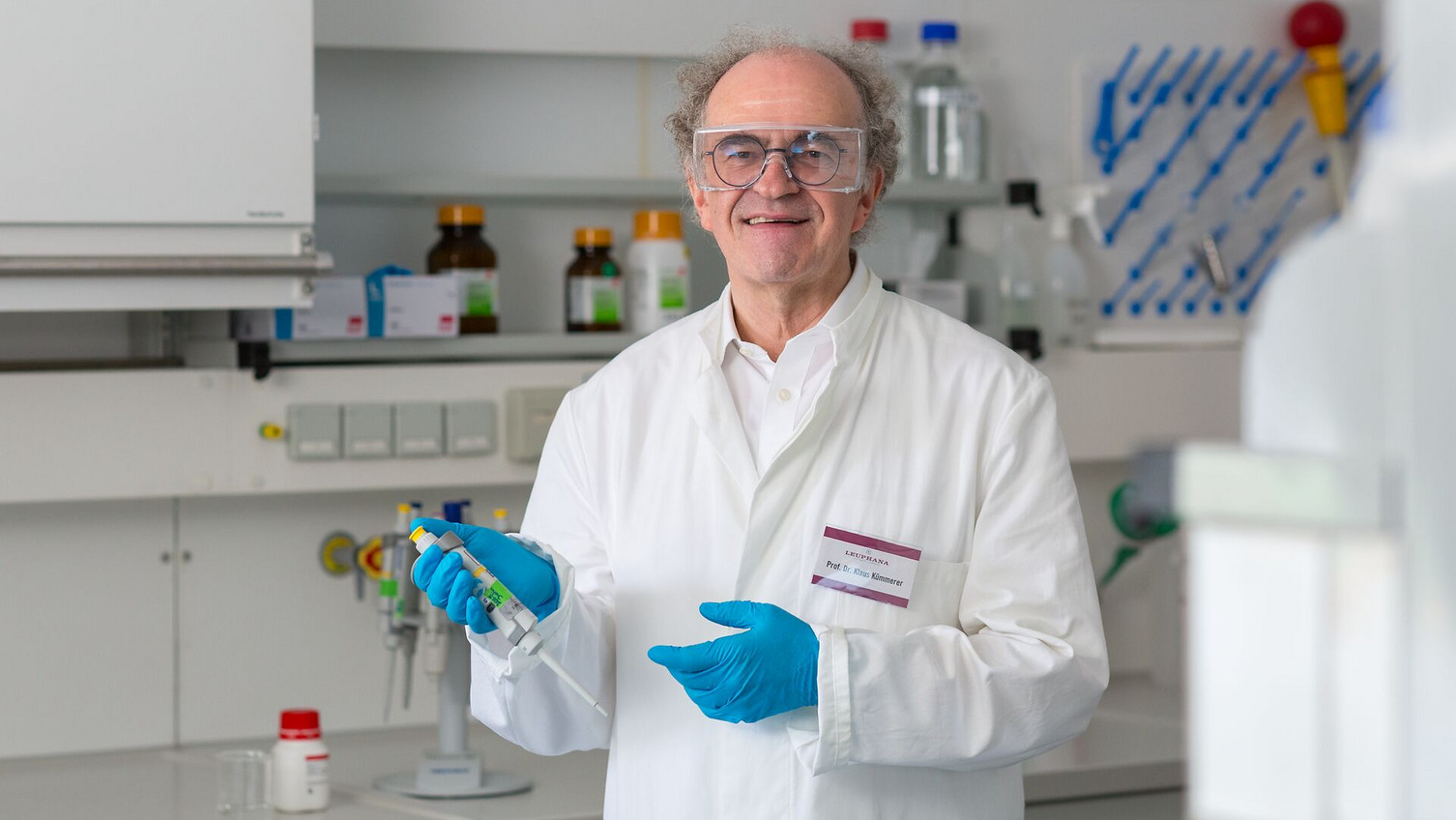
Professor Kümmerer, your appointment to this new panel places an even greater emphasis on supply chains. How relevant is this topic?
Chemistry and pharmaceuticals are indispensable. They not only secure the basic needs of modern life but also underpin our prosperity. At the same time, however, many technologies and transport routes create environmental and resource pressures. Sustainable supply chains help ensure that chemical products and their raw materials are produced in ways that conserve resources, protect the climate, and uphold social responsibility. As such, they are a central component of sustainable chemistry and sustainable economic activity as a whole.
Your recent article in Angewandte Chemie is intended as a foundational paper. Why was it important to clarify fundamental concepts such as Green Chemistry, Sustainable Chemistry, and Circular Chemistry?
Sustainability is the overarching framework. Chemistry must be embedded within that framework - not the other way around. Many of these terms are often used interchangeably. In reality, however, these concepts pursue different objectives and apply in different contexts. Not everything that is greener is necessarily more sustainable. In fact, the two can even be at odds. In such cases, Green Chemistry alone does not provide a soulution - it may actually move us further away from sustainability. We therefore need to consider not only the entire value chain but also the complete life cycle of products - starting with determining what function is actually needed, continuing through synthesiss and use, and extending to supply chains and recycling. Each stage requires energy and generates waste.
Is “Benign by Design” the solution when developing new products?
Let me avoid answering with a simple yes or no. Of course, products should be designed from the outset to cause as little harm as possible - both during manufacturing and at the end of their life, once they have served their intended purpose. But Sustainable Chemistry does not begin in the laboratory. Synthesis cannot be the starting point; rather, it is the final step. The process begins with the question of function or service. Sometimes, a new material isn’t even needed to achieve a desired function. Perhaps a different design, an alternative business model, changed user behavior, or more effective use of existing products may be sufficient. Only when a product is needed do we have to think about where it will end up at the end of its life and then design it accordingly: for rapid and complete degradation in the environment, if that’s where it ends up, or for recycling, if it can remain within a circular system.
With that in mind, do we need a comprehensive sustainability strategy instead?
Yes, exactly. We need to prevent problems from arising in the first place, rather than solving them once a product has reached the end of its life. Especially in times of increasing resource scarcity, we need to understand where the strengths - but also the limitations - of individual concepts lie.
Where, then, are the limits?
For example, in the laws of physics. Sometimes there is the impression that a circular economy can solve all problems. But that’s not the case. Recycling is undoubtedly important, but it also requires energy and additional resources, and in turn it generates waste. For thermodynamic reasons, it will never function completely loss-free. That is why I consider concepts such as zero waste or completely closed material cycles to be problematic. We should certainly strive to minimize waste as much as possible, but we need to remain realistic and recognize the limits imposed by natural science. For the same reason, I would argue that true upcycling does not exist - not even in an economic sense, by the way. While it is possible to recover value from individual components of discarded products or waste, we must not overlook the effort and resources required to do so. Renewable energies require raw materials and manufactured products. Cement production, for instance, is associated with high CO₂emissions, while large-scale dams lead to soil salinization and the displacement of local communities. Metals are finite resources, and are both resource-intensive to extract and highly complex to recycle. We cannot continue to gain indefinitely; we can only try to lose as little as possible.
You write that the principles of Green Chemistry did not originate in the 1990s. When did their precursors take shape?
I was surprised by how many ideas had already been developed decades earlier. As early as the 1970s and 1980s, there were intense discussions about preventing pollution from chemicals and chemical waste, and efforts were made to conserve resources and develop sustainable production processes. Many ideas that we associate with Green Chemistry today were already being implemented in industry back then, generating revenue or saving costs. Europe has had relevant legislation in place since 1996 - not just for the chemical industry; Germany has introduced the Circular Economy Act in 1994. The twelve principles of Green Chemistry are merely a belated summary of these efforts and, moreover, are not binding but only voluntary. As a result, they often lead to greenwashing.
Why is Green Chemistry no longer sufficient on its own?
Because sustainability is much more than environmental compatibility or greener chemical synthesis. Take lithium, for example - we need it for batteries. However, extracting this alkali metal requires enormous amounts of water. The main mining areas are located in water-scarce regions, such as South America. We need to ask broader questions: Who bears the environmental consequences? What impact does this have on local people? And who ultimately benefits economically? The same applies, however, to products from the fashion and construction industries, whose progress we are tracking in the newly established UNEP panel. Chemistry doesn’t just take place in the lab.
Thank you for the interview!
Angewandte Chemie is one of the most internationally respected journals in chemistry. It was founded in 1887 by the German Chemical Society. Today, it is published both as an international English-language edition and continues to appear in German, thus upholding the tradition of one of the most renowned chemistry journals worldwide.