
The Polar Bear Fallacy: Home Coming Days Debunk Sustainability Myths
2026-10-13 Polar bears as a symbol of species extinction? A fallacy, says Prof. Dr. Matthias Glaubrecht. The renowned evolutionary biologist and biodiversity researcher was one of several experts from academia, business, and civil society who debunked persistent sustainability myths during the Home Coming Days of the part-time MBA in Sustainability Management.
When we think of endangered species, we often picture large mammals like polar bears and tigers. What fewer people realize is that the truly massive species extinction is occurring among other animal groups. Insects and mollusks are disappearing at a rapid pace, Glaubrecht explained. These are species we pay far less attention to, even though they play a major role in our ecosystem and, among other things, form the basis of our food security. Here’s a concrete example: No mosquitoes, no chocolate. The cacao plant is pollinated by two tropical mosquitoes. If these mosquitoes were to go extinct, there would be no more cacao—and thus no more chocolate.
Glaubrecht also debunked another myth: Their disappearance often has little to do with climate change. Humans’ expansion into more and more space is responsible for the dramatic loss of biodiversity: “Climate is not the driver of species loss; rather, it is changes in land use. How can we manage land and resources more intelligently?”
Unraveling Myths Together—with a Live Podcast Premiere
His presentation was part of the conference “Our New Reality – The Myth of Sustainability” during the Home Coming Days, which also examined narratives surrounding regulation, reporting, and the circular economy. At the traditional networking event for the part-time MBA in Sustainability Management, over 150 students and alumni from 23 graduating classes gathered on the Leuphana campus for two days.
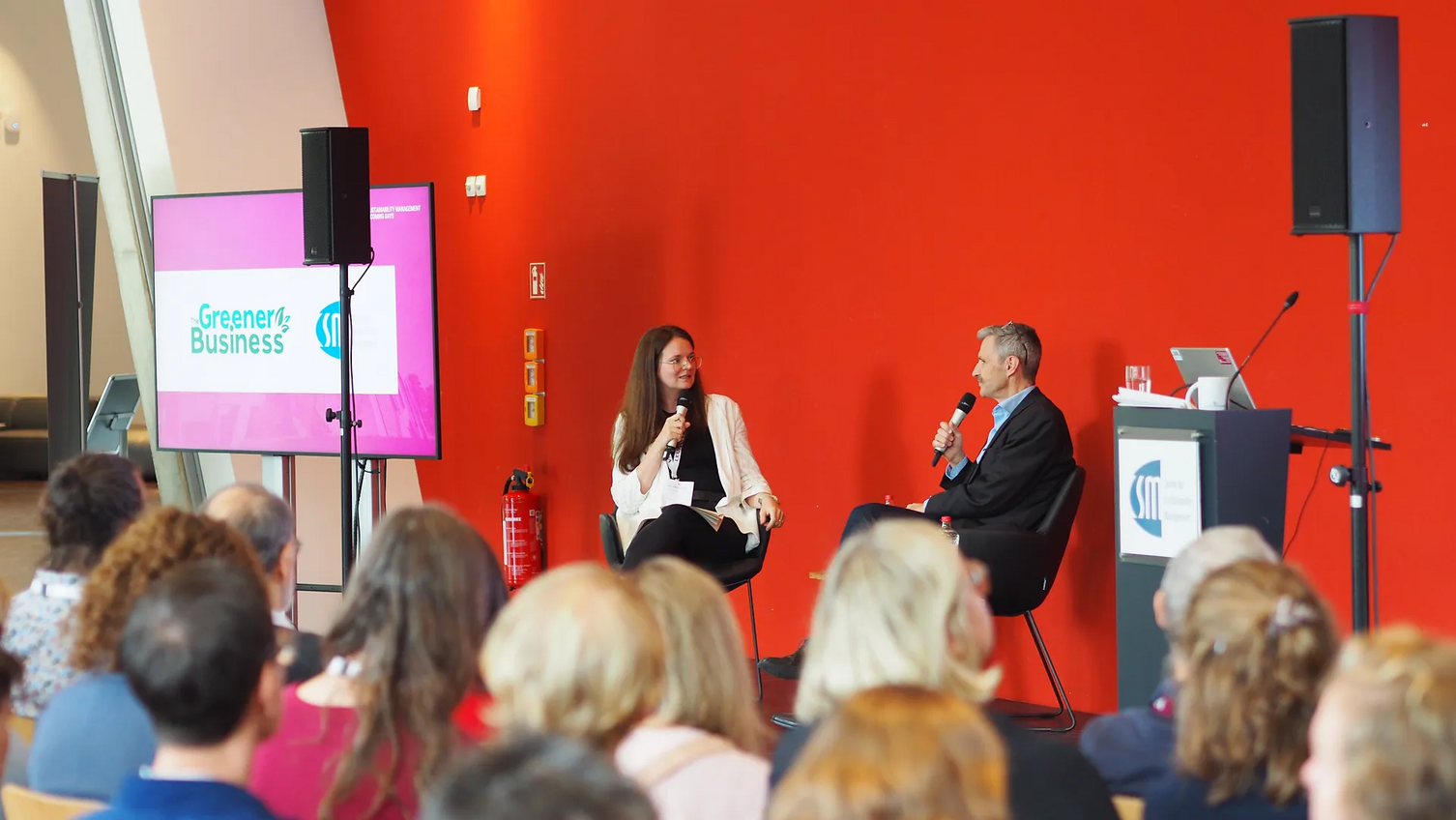
What myths shape our thinking about sustainability, and who actually benefits from them? Instead of a traditional keynote address, there was a premiere featuring two microphones: program founder Prof. Dr. Stefan Schaltegger and Marie-Sophie Wilde, an alumna and host of the podcast *The Greener Business*, recorded a podcast episode in front of the guests. The focus was on
“The crucial question isn’t simply: How do we get rid of all these destructive myths? Rather: What kind of narratives do we want to tell, and how can we create positive narratives that support sustainable development?” said Schaltegger.
After all, myths shape how we understand the world, what developments we consider possible, and what decisions we make.
You can listen to the conversation on Spotify and Apple Podcasts.
Cap-Tossing Ceremony and 42 New Graduates
Another highlight of the Homecoming Days: the graduation ceremony for 42 graduates of the part-time MBA program in Sustainability Management, traditionally capped off with a group hat toss in front of the main building.
Martin Vogl of AUDI AG highlighted just how difficult it often is to put sustainability into practice today in his welcoming remarks: “To remain capable of taking action in this reality marked by uncertainty and challenges, at least two things are needed: personal resilience and tenacious optimism.”
In their joint graduation speech, Andrea Dahm and Annette Malmann offered words of encouragement and called for action: “A better tomorrow isn’t created by intentions alone. It’s created by people who courageously take the first step.”
Managing Today for Tomorrow
Since 2003, the MBA in Sustainability Management at the Center for Sustainability Management (CSM) has been training professionals and executives who integrate sustainability and economic success. With approximately 1,000 alumni, students, faculty, and industry partners, it is now the largest university network for sustainability management. The next cohort begins in spring 2027; applications can be submitted online.