
Bachelor Teaching and Learning: Growing Vegetables, Harvesting Knowledge
2026-07-08 Kohlrabi, carrots, and Colorado potato beetles: Since spring 2026, student teachers majoring in general studies and biology have been using the newly established CampusAcker as a learning space. Here, they gain practical knowledge that will enable them to later set up school gardens at schools and daycare centers and cultivate them together with students. Prospective students can apply for this and other degree programs at Leuphana College until July 15, 2026.
Laima Franke takes a close look. Is there a Colorado potato beetle hiding among the leaves? When she spots one, she carefully picks it off with her hand. At the new CampusAcker, everything is cultivated according to the principles of sustainability. The students consciously avoid using pesticides. Instead, they rely on biological pest control—for example, with a nettle brew they’ve made themselves.
The aspiring elementary school teacher is one of about 40 students who, since the start of the summer semester, have been tending the new CampusAcker between the main building and the former Vamos. Palm kale, potatoes, Swiss chard, kohlrabi, zucchini, and beets are now growing there. What at first glance looks like an ordinary vegetable garden is, in reality, a special learning environment for the teachers of tomorrow.
“It’s fantastic that in our seminar we don’t just talk about school gardens in theory, but can actually grow vegetables ourselves,” says Lea Lietz. Together with biology students, the aspiring elementary school teachers tend to the plants through sun, rain, and wind—from sowing to weeding to harvesting.
This hands-on work is part of the CampusAckerdemie, which was established in March 2026 on an area of about 50 square meters between the former Vamos building and the main campus building. In their seminars on general studies and biology, students learn how sustainable nutrition, environmental education, and vegetable gardening can later be taught in schools and daycare centers—in line with Education for Sustainable Development (ESD). The theoretical foundation is laid in the seminar, after which students head out to the field.
“You become a student again yourself,” explains Marie Görsmann, who is studying to become an elementary school teacher specializing in German and general studies. It’s a different kind of learning than in the lecture hall: “We literally reap the fruits of our labor,” describes Emily Schomburg. The student teacher appreciates the balance between theory and practice: “Everyone pitches in and gets their hands dirty together,” adds Ann Kathrin Palm.
The seminars are led by farm coach Katja Frielinghaus. She shows the students which seeds are suitable, how far apart the plants should be spaced, and how to control pests naturally. “Children often know very few types of vegetables these days,” she says. This makes it all the more important to train teachers who can pass on their enthusiasm for nature and food.
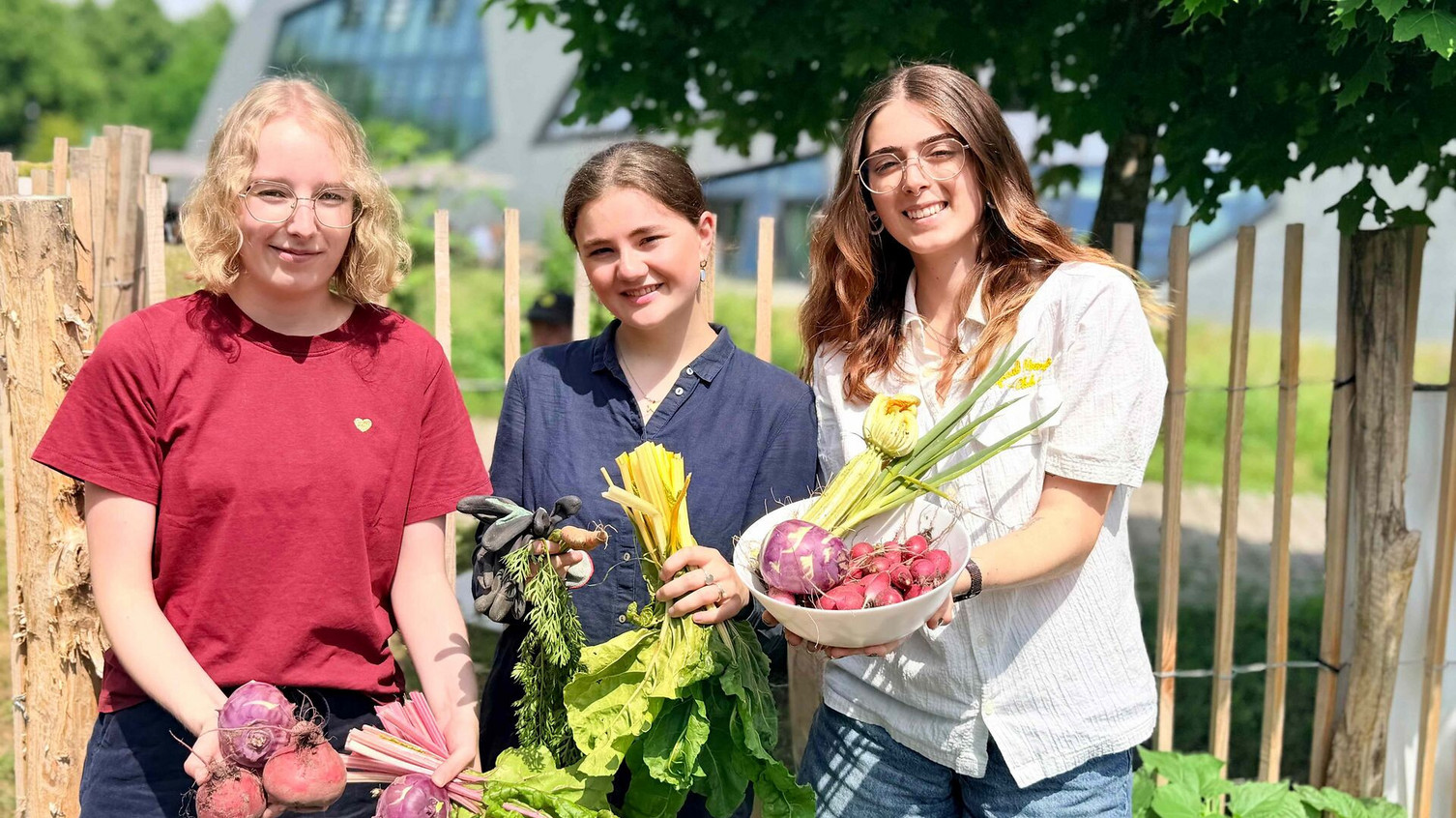
Part of the concept is also learning about the entire journey of food. After the harvest, everyone cooks, processes, and tastes the produce together. “The yields are so bountiful that we often even take vegetables home with us,” reports Emily Glaßer. In her hands, she holds Swiss chard, palm kale, and kohlrabi that the students have just freshly harvested.
The CampusAckerdemie is implemented nationwide at 14 university locations by Acker eV. The association provides support in organizing the CampusAcker and assists with site selection and field setup. In addition, supporting materials such as a seminar plan with sequential modules and learning journals are provided. The project is funded by the IKK as part of its prevention and health promotion initiatives, as well as by the Bingo Environmental Foundation.
The School of Sustainability secured the project: Staff members of the CampusAckerdemie university program, run by the Acker e.V. association, reached out to the School of Sustainability on their own initiative because they want to establish this program specifically at universities that offer teacher training.