
Profile of Junior Professor Michael Staab
2026-08-03 A Researcher at the Crossroads of Insects, Innovation, and Sustainability – Michael Staab has been a junior professor of animal ecology and trophic interactions at Leuphana University of Lüneburg since 2025.
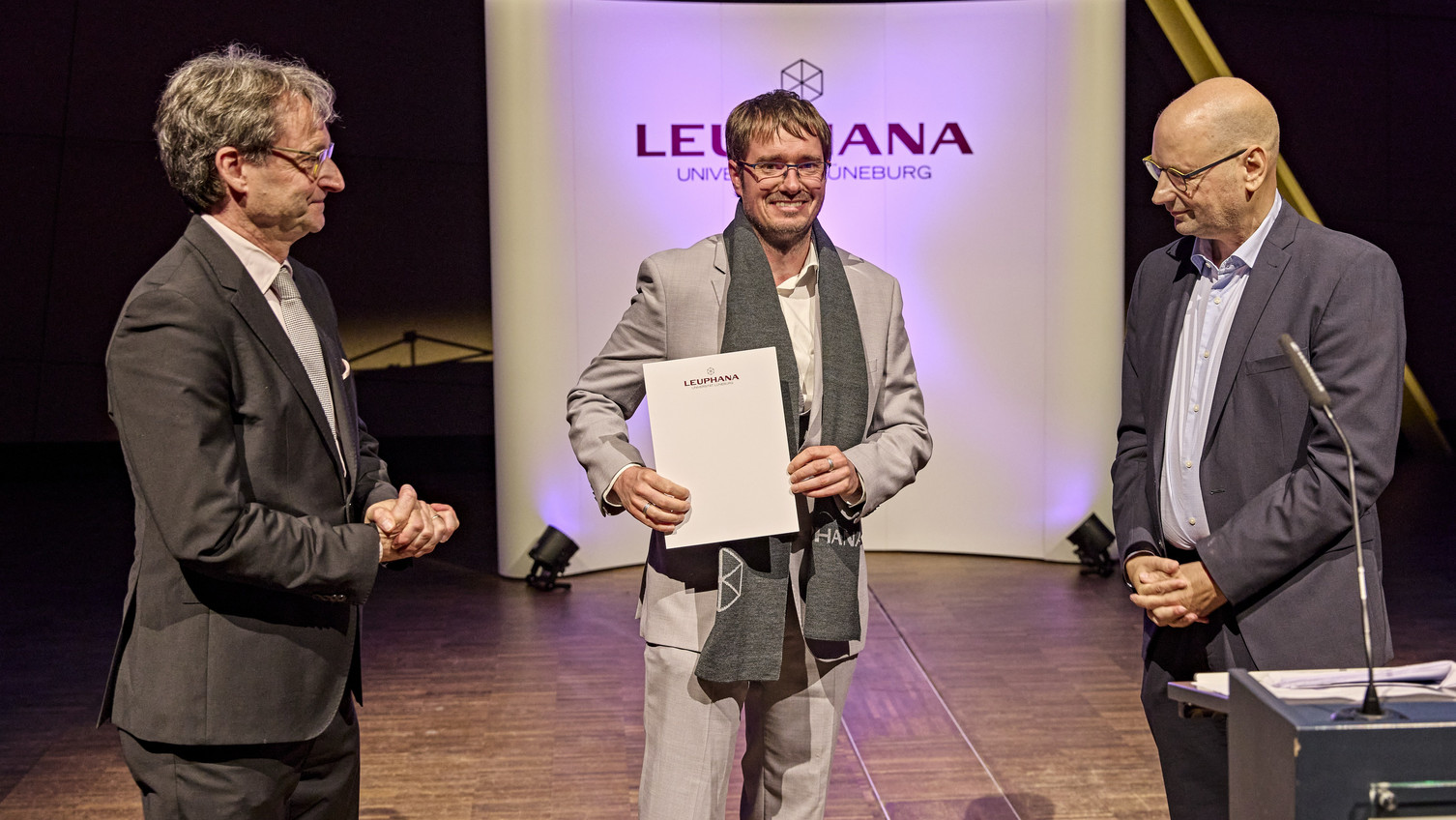
His scientific career is shaped by a deep fascination with the world of insects – which is invisible at first glance – and by the realization that these tiny creatures play a crucial role in the conservation and restoration of ecosystems. As the recipient of the Leuphana Early Career Research Award, he was honored for his outstanding achievements, his extensive list of publications, and his empirically innovative research approaches.
Ecosystem Functions at the Community Level: Innovative Research on Ants
His research focuses on the ecology of insects, particularly their diversity, interactions, and functions in natural and human-shaped landscapes. He is especially fascinated by ants – not just individual species, but the entire community they form. “I’m interested in the community level, not just individual species,” he emphasizes. “Because the functions that insects perform only emerge through their interactions.” His work is characterized by an interdisciplinary approach that combines methods from field research, statistics, and other technologies – ranging from drone-based measurements to thermal signatures and microclimate analyses.
The recognition for his “empirically innovative research approaches” stems from his ability to combine different methods in ways that have rarely been done before. “In my projects, it’s important to me not just to work on a specific, geographically limited question, but to conduct representative research – for example, across landscape types or regions,” he says. “Because that’s the only way to gain genuine insights.” In doing so, he emphasizes that the methods should not be primarily technically sophisticated, but also meaningful: “Every data collection method has advantages and disadvantages. Large-scale methods lose accuracy, while small-scale methods often lose representativeness – that’s a challenge.”
Current Research Focuses
Two projects funded by the German Research Foundation (DFG) are currently shaping his work: As part of a DFG research group, the effects of tree diversity on forest ecosystems are being studied in China – a kind of “large-scale experiment” designed to understand what is lost in terms of biodiversity and ecosystem services, such as insect populations, when tree species disappear from a forest area.
The second project is a DFG Infrastructure Priority Program, the so-called „Biodiversity Exploratories“, which focuses on the influence of land use in grasslands and forests in Germany on biodiversity and ecosystem services. One of its subprojects focuses on baseline monitoring of insects, while another examines microclimate effects – specifically, how land-use practices such as mowing, fertilization, and grazing influence the respective microclimates. The researchers rely on modern technologies: Drones are used to record thermal signatures, analyze microclimate effects, and measure radiation reflections – all in real time and on a larger scale. “A local increase of 20 degrees in ground temperature after mowing can kill animals – the survivors are forced to migrate. These are indirect effects of land use that we need to understand.” Using modeling and long-term monitoring, Staab and his colleagues aim to unravel the complex interactions between climate, soil, and ecosystems over a three-year period.
On the Path to a Junior Professorship
His path to becoming a researcher was a fairly straightforward one. After studying biology with a major in tropical biology in Würzburg and completing his master’s thesis in Würzburg and Konstanz, he earned his PhD at Leuphana University under the supervision of Prof. Alexandra Klein. He then worked for seven years as a research assistant at the University of Freiburg and five years in Darmstadt with Nico Blüthgen before returning to Leuphana in 2025.
“A decisive turning point was my research stay in Borneo during my studies,” he recalls. “The complexity and diversity of the tropical forests fascinated me – and led me to ants. I originally wanted to study fish or amphibians, but ants have stayed with me to this day.” Today, he prefers to work in biologically “more mundane” regions like Central Europe – because the conditions there are often more predictable. In the medium term, however, he also plans to conduct research in the tropics again.
For Staab, research is more than just a career – it’s a passion. “I never doubted that I would give it a try,” he says. “Ever since my thesis, I knew: This is my path.” He sees science as an endurance race – with setbacks, but above all with successes that bring joy. His strong background in mathematics and the natural sciences has helped him understand – and make use of – even complex data.
Integration into the School of Sustainability
The issue of climate change is central to his work. “The effects are local – to understand the consequences of climate change, you need a small-scale perspective,” he emphasizes. “On a centimeter scale, it’s about fitness advantages and disadvantages, about niches, and about temporal activity patterns.” The topic of climate change is also ever-present in his teaching. Staab teaches in the master’s program, among other places, and during his own time as a student, he learned a great deal about good – and not-so-good – teaching, which he tries to incorporate into his own teaching practice. But: “Teaching is always fun with interested and motivated students.”
Staab’s work fits perfectly into the faculty’s focus on sustainability. In Rwanda, where – if funding is secured – he will work on the project “A Socio-Ecological Systems Approach to Ecosystem Restoration in Rural Regions of Africa” led by Prof. Jörn Fischer, he plans to investigate how insects – especially ants – help restore degraded landscapes: through seed dispersal, pest control, and as indicators of ecological health. Insects are not only indicators of healthy ecosystems – they are also agents of regeneration. “Agroforestry systems in particular offer opportunities – and Rwanda is an ideal place to conduct research in this area, not least because the landscape is significantly degraded.”
A Look into the Future
In the distant future, Staab would like to focus more heavily again on alpha taxonomy – the systematic classification and description of species. “Hopefully, in 20 years, we’ll have a more complete understanding of species; there are simply still far too many insects that remain unknown,” he says. “And with image recognition, micro-CT, and other technologies, this could be a quantum leap.” He dreams of a world in which insects are not only counted but also understood. With transmitters attached to bees, micro-radar in meadows, or the analysis of dung beetle activity patterns, which are influenced by temperature, humidity, or light. “Some like it warm, others cold – and that explains why their activity patterns are so narrow. That’s a niche dimension we don’t yet fully understand.”
For Michael Staab, research is more than just gathering knowledge – it’s a contribution to the world. “I just want to contribute a small piece of the puzzle.” And if it’s fun, too, then that’s the best part. Because: “When you do something that fascinates you, it’s not a job – it’s a way of life.”