
Sustainability Studies: Dr. Milena Groß – Knowledge That Brings People Together
2026-09-21 The sustainability scientist studied environmental sciences in college, completed a dual-degree master’s program in Global Sustainability Science at the Graduate School and Arizona State University, and earned her doctorate at Leuphana. Today, the postdoctoral researcher is studying sustainability transformations in Tanzania. She was actually supposed to study business administration.
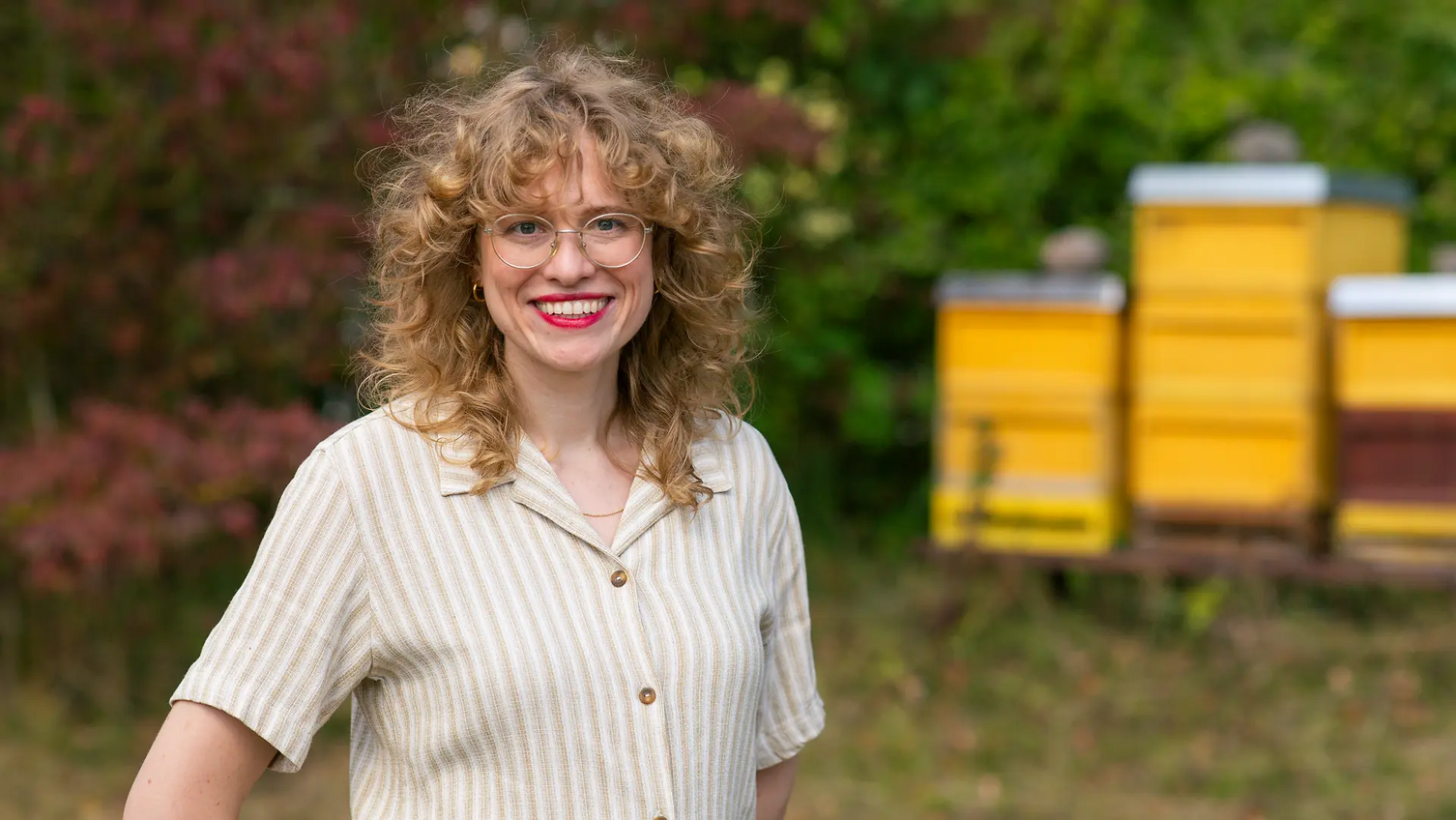
After graduating from high school, Milena Groß found herself in the same situation as many young people: she had diverse interests and a keen curiosity, yet she was overwhelmed by the wide range of degree programs available in Germany. The Berlin native decided to visit a college counseling center. “There, they recommended that I study business administration with a focus on the environment.” The suggestion didn’t quite feel right: “I then looked for universities that offered environmental sciences with the opportunity to also explore economic issues. Leuphana won me over with its interdisciplinary breadth and its academic model.” Milena Groß chose business psychology as her minor: “At Leuphana, I learned above all to understand the approaches of different schools of thought and to build bridges between them.”
She was also able to pursue her passion for ecology during her bachelor’s program: “I spent my semester abroad in Kristianstad, Sweden, where I went on some excellent ecological field trips.” Toward the end of her bachelor’s program, Milena Groß deliberately sought out an experience that was both practical and research-oriented. For several months, she gained insight into basic research at the Helmholtz Centre for Environmental Research in Halle. There, she studied grassland ecosystems and examined, among other things, the relationship between mowing frequency, nitrogen balance, and plant productivity. She then wrote her bachelor’s thesis on the results of her ecological experiment.
Her interest in ecology continued into her master’s program: Milena Groß was part of the first cohort to complete the dual-degree master’s program in “Global Sustainability Science” at Leuphana University and Arizona State University. Her master’s thesis explored how trees in subtropical regions regenerate after fires. During this time, however, she didn’t just learn from a purely academic perspective: “After my master’s, I had a better understanding of different academic systems and how they can be harmonized within a degree program.”
After graduating, she first worked at an international climate protection initiative and an applied research institute to understand how sustainability issues are addressed in practice. She brought this knowledge with her to her doctoral studies at Leuphana: In Tanzania, she investigated the contributions nature makes to the quality of life of various population groups and why people consider nature important. To that end, she and her colleagues interviewed various groups of social actor groups — including those from the fields of nature conservation, agriculture, and tourism. “Mount Kilimanjaro is a unique research site. The tropical mountain, with its glacial crown, rises from the dry savanna landscape; it possesses enormous water resources and, due to its varying altitudes, boasts impressive landscape and ,consequently, biological diversity. For the people in the region, nature is not just an abstract resource to be protected, but the foundation of their cultural identity, agriculture, and livelihood—in short: a good life,” explains Milena Groß. A central concept in her work is “Nature’s Contributions to People” (NCP)—that is, the various benefits people receive from nature, such as drinking water, food, and recreational opportunities.
Today, Milena Groß is in the postdoctoral phase and continues to work with the research consortium to maintain the valuable relationships she has built with social actor groups active in nature conservation on Mount Kilimanjaro. The second phase of the project focuses more strongly on transformations. The emphasis is on initiatives that drive social change from the grassroots level while giving equal consideration to natural resources. “Methodological decisions must be constantly questioned in this research, because they influence more than just the research findings. Ultimately, they always have implications for practice and policy,” she explains.
Especially in international research activities in Tanzania, colonial history must not be ignored. For Milena Groß, the question arises of how research can be conducted without non-local researchers imposing their own ideas and solutions. Doctoral candidates and senior researchers from Tanzania, for example, are permanent members of the project team. “Collaborating with them is an important part of our joint research and offers everyone a valuable intercultural exchange,” explains Milena Groß.
Part of her current work focuses on so-called storymaps, which are paired with spatial information, and social network analyses. The researcher aims to understand which initiatives around Mount Kilimanjaro and beyond are interconnected, how they collaborate, and how they foster processes of transformation. She is also committed to making the diverse efforts of these initiatives visible to both the academic community and the general public.
For her, this is based on a holistic view of the human being. Milena Groß has completed training in bodywork. As a result, she offers body-mind workshops and university-wide movement breaks in her working group. Likewise, her expertise outside the university is compatible with her day-to-day academic work—it shapes her ethical reflection, her engagement with responsibility in academia, and the development of team agreements in research and teaching. Various programs at Leuphana, such as the ProViae and ProScience mentoring programs for female researchers (FLINTA*), also support her personal development. “I’ve already participated once. The various modules helped me reflect on my career prospects and make informed decisions about my life path. Now that I’m in the postdoc phase, I’m facing new crossroads and would therefore like to complete the program a second time.”
She also takes advantage of resources offered by the Qualification Hub. Through this initiative, the Leuphana Graduate School brings together key support services for master’s students and doctoral candidates. They can apply for funding from the Qualification Fund to, for example, attend academic conferences or undertake research stays. Milena Groß has also used this opportunity to expand her international network and broaden her academic expertise. Most recently, she took a course on artificial intelligence as part of a professional development program for academic staff on campus. “It’s important to me to develop AI skills so I can make informed decisions about whether and how I want to apply AI in my research,” she says.
Her motivation comes from within: “I want my work to bring together different perspectives, and I find it particularly meaningful to make a concrete contribution to the further development of sustainability sciences through my work.”