
A North-South Connection: Leuphana Students travel to Nuremberg
2026-06-05 Insights into a transdisciplinary study project at the Leuphana School of Sustainability.
Every summer semester, the Leuphana School of Sustainability offers TransDisciplinary (TD) seminars. In the seminar “Communicating Sustainability in Cities”, supervised by Viola Hakkarainen and Jennifer Fandrich, fourth-semester students in the Bachelor's degree program “Global Environmental and Sustainability Studies” collaborate with practitioners from the City of Nuremberg to develop their own research projects.
This transdisciplinary project course explores how communication can drive the transition toward greater sustainability in urban environments. Cities play a crucial role in shaping a sustainable future, and effective communication through campaigns, public events, digital tools, and place-based interventions can significantly influence public engagement, awareness, and behavior.
As part of the seminar, an excursion to Nuremberg took place at the end of April 2026, allowing students to work directly with their practice partners from the City of Nuremberg on site.
The objective of these transdisciplinary projects is to engage students in research projects that they help design and implement under academic supervision. The projects address sustainability-related challenges for which a transdisciplinary research approach appears particularly suitable.
Excursion to Nuremberg
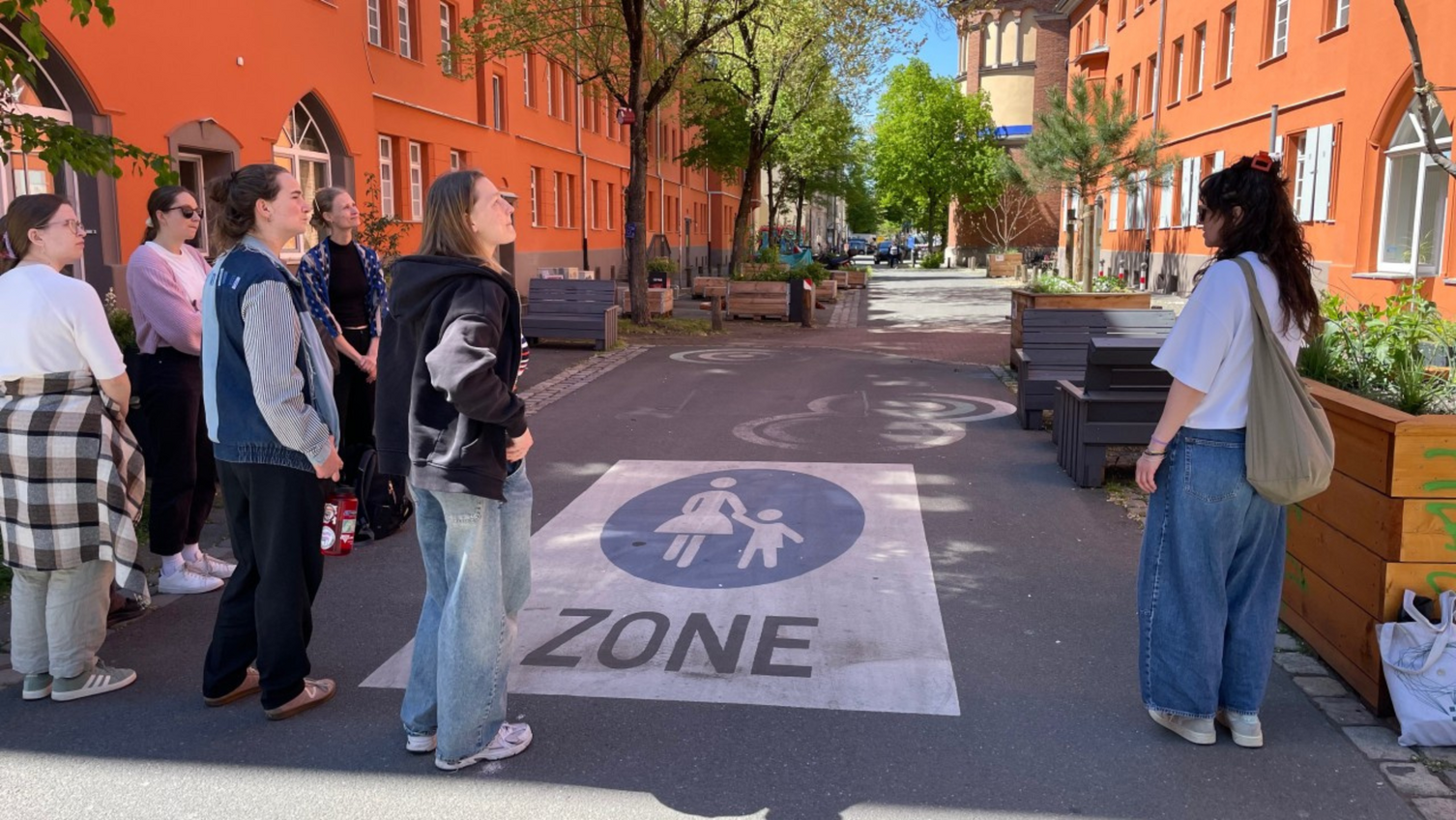
First stop in Nuremberg: Superblocks Gostenhof
Departure from Lüneburg, destination Nuremberg – after just over five hours on the ICE train, we arrived in the city where our project partners from the City of Nuremberg are based. The first item on our agenda was a guided tour of the Superblocks, an urban development district in Nuremberg that was launched in August 2025 and is partially funded by the City of Nuremberg. Elisa Schleider from the Gostenhof Association explained: “The concept of ‘Superblocks’ was developed in Barcelona. The idea involves a traffic management system within a neighborhood that prevents through traffic by non-local motor vehicles.” This is exactly what we observed here: raised planting beds, table tennis tables, seating areas, and even an old sailing dinghy (without a sail) located within the neighborhood. The goal is to allow children to move freely again within pedestrian zones and to play safely in the streets. However, the project has not yet fully achieved this vision. Elisa explained that cars still regularly drive through the area because drivers do not always read the signage correctly. The association also encounters resistance within the development area itself. We witnessed this firsthand when a resident described how difficult it had become to find parking. His wife depends on a car because she works in the southern part of the city, and using public transportation would take too much time. Given the increasing urban heat, limited shade in densely populated areas, and air pollution caused by automobiles, initiatives such as the Superblocks in Gostenhof serve as exemplary projects demonstrating how specific urban areas can be made greener and more sustainable in times of climate change while simultaneously fostering a stronger sense of community. Elisa shared the example of watering the plants and trees in the raised beds throughout the neighborhood. To do so, everyone involved first had to learn how to use the city’s hydrants, and during the initial attempts, there were one or two accidental floods. Soon, many people volunteered to help, and she was impressed by how willing community members were to offer support. According to Elisa, the Superblocks contribute to stronger social connections within the neighborhood, even though not everyone supports the changes taking place in Gostenhof.
Next stop: City council meeting
Afterward, the group hurried toward City Hall, where the Environmental Committee was meeting to decide on one of the projects that the Circular Economy group would be studying: ZIRKA, a second-hand department store planned for Nuremberg’s city center. The initiative aims to reduce illegal bulky waste disposal on public streets by encouraging residents to donate clothing, household items, and furniture. In addition, it will provide incentives for sustainable services such as a repair café and workshops on sustainable consumption. It was fascinating to observe a council meeting and witness the democratic process firsthand. A project that had been prepared over several months was presented briefly by the responsible department representative. Committee members were then invited to comment before a final vote was held. The proposal was approved with only one dissenting vote, enabling the ZIRKA project to move forward in Nuremberg.
The first day of the excursion concluded with an ice cream or a pretzel near the Schöner Brunnen fountain and a brief reflection on the day’s experiences in the marketplace.
Day 2: Project Meeting at City Hall
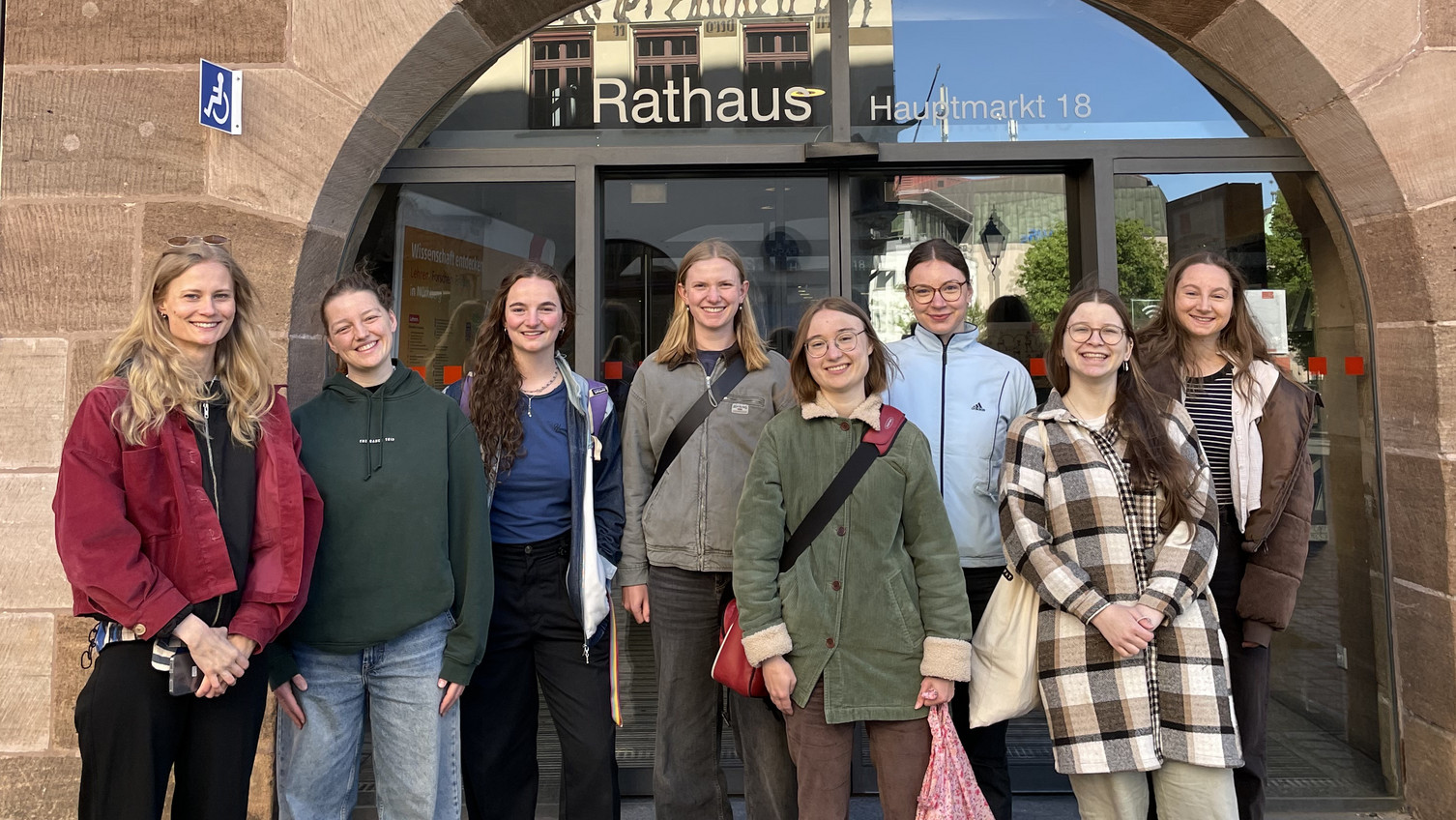
The second day began at 9:00 a.m. at City Hall with the practice partners of the three project groups: Circular Economy, Climate Adaptation, and Climate Protection. The students presented their prepared questions to the City of Nuremberg representatives, leading to a stimulating discussion about administrative processes, decision-making procedures, and the implementation of various initiatives. The questions focused on communication strategies, including data on the effectiveness of different communication channels and approaches. Discussions also explored whether opportunities for change or improvement had already been identified for future communication efforts, as well as existing experiences with sustainability strategies.
Afterward, the students split into their respective subgroups to discuss further ideas regarding communication strategies and research questions related to their specific topics. To conclude a highly productive morning, Professor Beatrice Dernbach from Ohm University joined the group. As a member of the Climate Advisory Council, an external advisory body to the City of Nuremberg, she shared insights from her work with the municipal administration. Professor Dernbach holds the Professorship for Sustainability and Science Communication at Ohm University of Applied Sciences Nuremberg and brings decades of experience in sustainability communication.
Over the course of the semester, the students will continue working in small groups alongside their practice partners from the City of Nuremberg to develop communication strategies and research questions tailored to their respective projects. This project clearly demonstrates why transdisciplinarity is so important: it fosters the ability to understand and address complex challenges from multiple perspectives and to develop solutions collaboratively across the boundaries of individual disciplines.