
What is “South-South” Capacity Building? Interview with Dr. Dula Wakassa Duguma
2026-04-01
How can local stakeholders co-create solutions that truly work?
In this insightful interview, Dr. Dula Duguma from the Social-Ecological Systems Institute (SESI) shares how “South-South” knowledge exchange is driving transformative change. By connecting researchers, practitioners, and local experts from Rwanda and Ethiopia, SESI fosters mutual learning, strengthens local capacities, and co-develops context-specific solutions for sustainable development. It’s not about top-down expertise — it’s about equitable collaboration, shared experience, and empowering communities to lead. Discover how peer-to-peer learning across borders can inspire more resilient, inclusive, and locally grounded approaches.
![[Translate to Englisch:] Dr. Dula Duguma](/fileadmin/_processed_/7/a/csm_Dr._Duguma_2_0f93f09fd2.jpg)
![[Translate to Englisch:] Feldforschung](/fileadmin/_processed_/4/2/csm_Design_ohne_Titel-3_f5edf815a9.png)
Interview with Dr. Dula Duguma
What is your field of research at Leuphana?
I work at the Social-Ecological Systems Institute (SESI) in the Faculty of Sustainability. My research looks at how people and nature interact, especially how changes in land use affect biodiversity, the services ecosystems provide (like fuelwood, food production, erosion control, soil fertility, climate mitigation, etc), and human wellbeing. I also study how degraded ecosystems can be restored in ways that benefit both nature and local communities.
What was the recent fieldwork about?
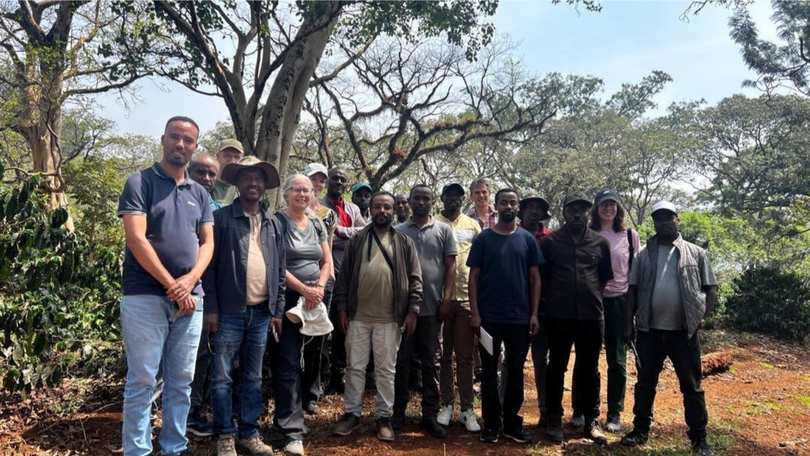
Our recent fieldwork was focused on capacity building to support local stakeholders activities on ground directly. Prof. Joern Fischer and I organized a “south-south” knowledge exchange event titled “South-south knowledge exchange on ecosystem restoration: the potential of coffee-agroforestry for social-ecological restoration” between researchers, experts and practitioners from Rwanda and Ethiopia. We targeted stakeholders who are active in the coffee-growing landscapes of both countries where we've been conducting research on both social and ecological aspects. The event brought together decision makers, researchers, and practitioners to share experiences and learn from each other about biodiversity conservation and sustainable coffee production.
What was your task?
- Communication with stakeholders – I reached out to stakeholders working in coffee landscapes, invited them to join, and followed up to ensure they were ready to share their experiences.
- Planning and organizing logistics – I coordinated flights, transportation for fieldwork, accommodation, workshop venues, and VISA arrangements. This was challenging, but with support from Leuphana University, the University of Rwanda, and Jimma University, we managed successfully.
- Designing the thematic content of the event – I structured the event to make sure it achieved its goal of meaningful knowledge exchange. We started with a one-day workshop where participants presented their work and discussed in small groups. This was followed by three days of field visits in each country, and finally a synthesis workshop to bring together the lessons learned.
What was the idea behind the "south-south capacity building event”?
The idea came from our research experience in these landscapes. Rwanda and Ethiopia both have Afromontane forest landscapes, but they use different practices for coffee cultivation, (e.g., less managed coffee forest, intensively managed coffee forest, coffee agroforest, coffee plantation), ecosystem restoration, and biodiversity conservation. Instead of just publishing our observations, we wanted to create direct impact by connecting local actors from both countries. By sharing best practices face-to-face, they could learn from each other and apply new ideas immediately - for example, in coffee agroforestry and restoration efforts.
What impact/long-term effects you would hope for after the event?
We hope participants will apply what they learned in their own landscapes. For example, using native shade trees in coffee farms, improving waste management from coffee processing, and adopting sustainable cultivation methods. These practices can strengthen biodiversity corridors and improve farmers' income.
In the long term, we also aim for:
- Future collaborative research that benefits both local and global communities.
- Co-produced knowledge that advances transdisciplinary science.
- Outreach materials, such as policy briefs that support the activities of decision makers in both countries.
What are the next steps after the field trip ended?
The next steps are:
- Strengthening collaboration with local stakeholders, including government institutions, NGOs, and universities in the landscapes of both countries
- Sharing the outcomes through brochures, policy briefs, and scientific articles.
- Possibly, applying for joint research funding to continue and expand this work.
What did you take on a personal level from this collaboration? What was special about this trip?
On a personal level, it was inspiring to see how participants came together with openness and curiosity, sharing diverse practices including their challenges and successes in ecosystem restoration and coffee production that can inform one another strengthening both scientific understanding and practical application.
The genuine dialogue between participants during the workshops and field visits to create a productive environment for knowledge exchange and mutual learning was special. Visiting the landscapes, meeting and discussing with farmers and cooperatives, and seeing restoration practices firsthand made the event tangible and meaningful.
Collaboration partners:
- The participants are from University of Rwanda (https://coebiodiversity.ur.ac.rw/ ),
- CIFOR-ICRAF Rwanda (https://www.cifor-icraf.org/locations/africa/rwanda/ ),
- National Agricultural Export Development Board (https://www.naeb.gov.rw/ ),
- Kopakama coffee (https://kopakama.yourwebsitespace.com/ ),
- Jimma University (https://ju.edu.et/agri/about-the-department/ ),
- Environment and Coffee Forest Forum (https://www.ecff.org.et/),
- Oromia Coffee Farmers Cooperatives Union (OCFCU) (https://www.oromiacoffeeunion.com/ ),
- Rainforest Alliance Ethiopia (https://www.rainforest-alliance.org/regions/ethiopia/ )
- Leibniz-Centre for Agricultural Landscape Research (ZALF),
- Hochschule für nachhaltige Entwicklung Eberswalde (HNEE) and
- Stockholm University.