
New at Leuphana: Prof. Dr. Maren Zeller – Thinking Through Power Relations
2026-04-20 The professor of social pedagogy, specializing in diversity research, examines the often invisible transitions and starting conditions for so-called care leavers, recipients of early childhood support, and people with refugee backgrounds. In her research, she relies on a broad spectrum of qualitative methods.
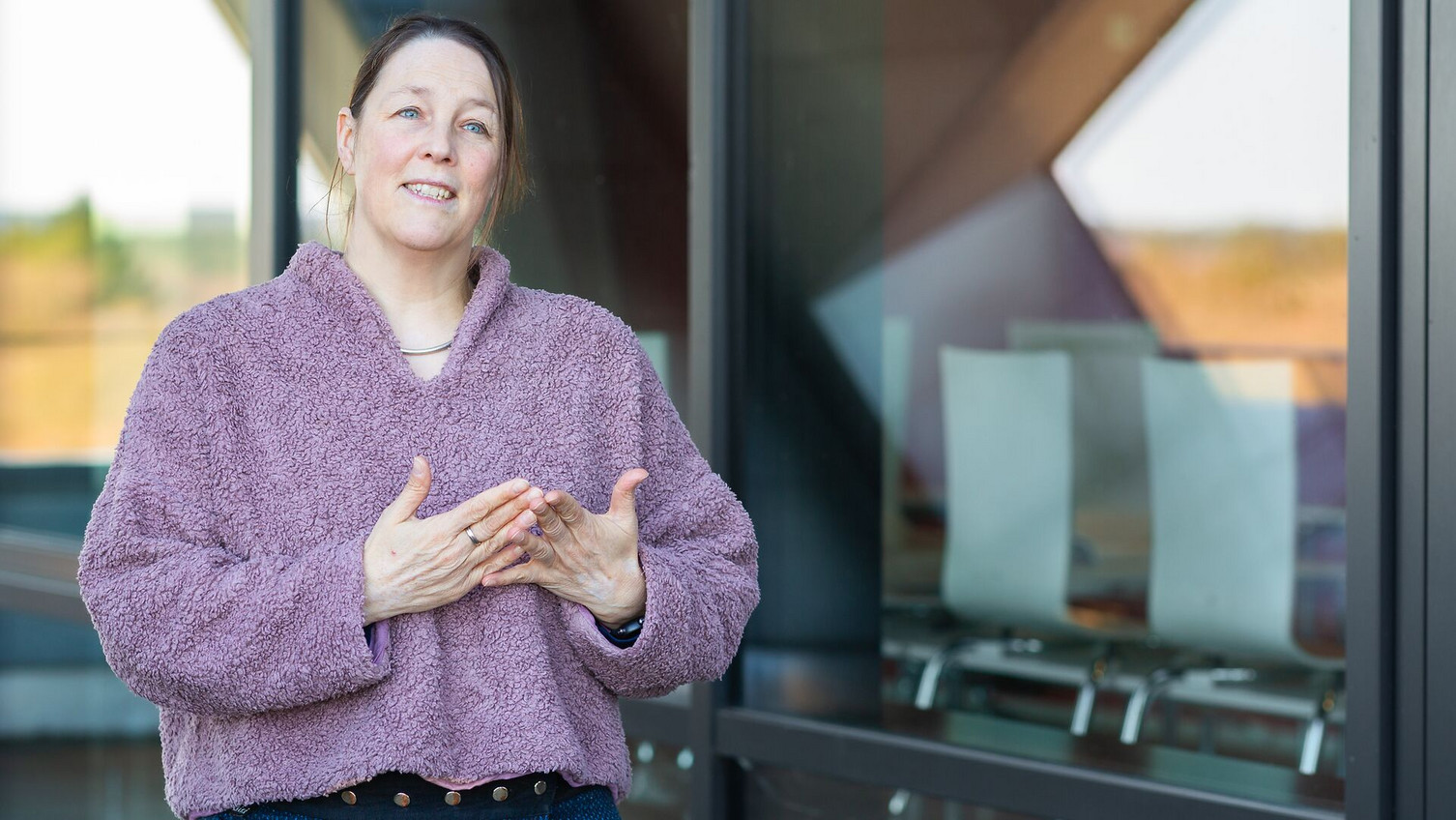
In Germany alone, around 200,000 children and adolescents live in residential homes or supervised living arrangements. Another 100,000 are placed in foster families. What becomes of these young people when they reach adulthood and stand on their own two feet? This question lies at the heart of the research field “Leaving Care.” Prof. Dr. Maren Zeller focuses on the period after support ends: on transitions, disruptions, and unequal starting points in adult life.
“Life trajectories vary greatly, which is what makes this field so fascinating,” she says. While many of their peers can rely on family support for a long time, so-called care leavers often have to stand on their own two feet early on. Maren Zeller therefore has a particular interest in self-organization. In various countries, care leavers come together, form networks, and engage in political activism. “I’m interested in how such groups function and what they actually achieve,” she explains. In doing so, she deliberately looks beyond national borders and is part of a global network of researchers: “New perspectives can help break down Eurocentric viewpoints,” she explains.
For Maren Zeller, diversity is not only a research topic but also relevant to the methods used. How can one even research what people experience without distorting their perspectives? At its core, diversity-sensitive research is about taking differences seriously—that is, categories such as gender, origin, or social status. At the same time, it is important to reflect on power dynamics within the research process: “The question is: How can we work as respectfully as possible and on equal footing with the people whose life situations we are researching?” asks Maren Zeller.
Here, she relies on a broad spectrum of qualitative methods: In narrative analysis, she examines how people tell their life stories. In ethnographic research, she looks at social situations and everyday practices. Objective hermeneutics, a method from sociology, is also part of her repertoire. All these methods assume that there are hidden structures of meaning in language and actions that can be gradually reconstructed: “Qualitative analysis enables deep insights, especially in our field of research,” explains the researcher.
Closely linked to a broad understanding of methodology is the idea of participatory research: “The goal is not just to study people, but to involve them in the process.” But participatory research is considered challenging: “Data collection often works well, but participatory data analysis, at the very least, usually poses a major challenge, and there are almost no successful examples of this,” explains Maren Zeller.
Fully “equitable” research free of bias is therefore an ideal that is virtually impossible to achieve.
In addition to her focus on “Leaving Care,” she also works on early support for families. This involves support services surrounding birth and early childhood—that is, the beginnings of care, but also of state intervention in family life. Here, too, she addresses issues of diversity and inequality: “Often, support services are labeled ‘for parents.’ But in practice, it’s mainly mothers who are addressed,” she says. Fathers are often left out, as are other family constellations. For her, this is an example of how societal notions are perpetuated in professional structures.
In her teaching, too, she places questions of diversity at the center—for example, in the Gender and Diversity Certificate program: “Diversity means looking beyond one’s own experience and understanding structural contexts. On the one hand, we examine social issues: What forms of inequality actually exist? On the other hand, we focus specifically on the research process. For example: How do I conduct an interview on equal terms? How do I design a setting so that different perspectives become visible?”
At Leuphana, she finds a suitable environment for her research and teaching: “Internationality, interdisciplinary work, and the importance of topics like diversity are much more firmly established here than in many other places. That’s what convinced me.”
Maren Zeller began her career as a research assistant in the federal model project INTEGRA at the Institute of Education at the University of Tübingen (2001–2003) and subsequently worked at the Institute for Social and Organizational Pedagogy at the University of Hildesheim (2006–2014). She gained international research experience as a visiting scholar at the Center for Refugee Studies at York University and at the School of Child and Youth Care at Ryerson University in Toronto. From 2014 to 2018, she was an assistant professor of social pedagogy at the University of Trier, and subsequently a professor in the Department of Social Work at OST – University of Applied Sciences of Eastern Switzerland (2018–2025). Since August 2025, she has been a professor of social pedagogy with a focus on diversity research at Leuphana University Lüneburg