Leadership skills for the future
The part-time MBA iPerformance Leadership shows how organisations develop performance.
2026-01-26 Many companies are currently discussing a new performance culture as a response to volatile markets, increased competition and dwindling resources. But how does a company become a high-performance organisation? How can performance be measured and how can employees and teams be developed to become as productive as possible? The MBA Performance Leadership programme at Leuphana Professional School combines science and practice to answer these questions. A highlight of this part-time continuing education programme, which combines management knowledge with sound business psychology and personality development, is the block week in the second semester, which gives students deep insights into the personnel and organisational development of well-known companies. Applications for the MBA will be accepted until 31 January 2026.
![[Translate to Englisch:] MBA Performance Leadership students with HR expert Heinrichs](/fileadmin/_processed_/5/c/csm_PeL_Blockwoche_Heinrichs_979d599560.jpg)
Performance management as a management task
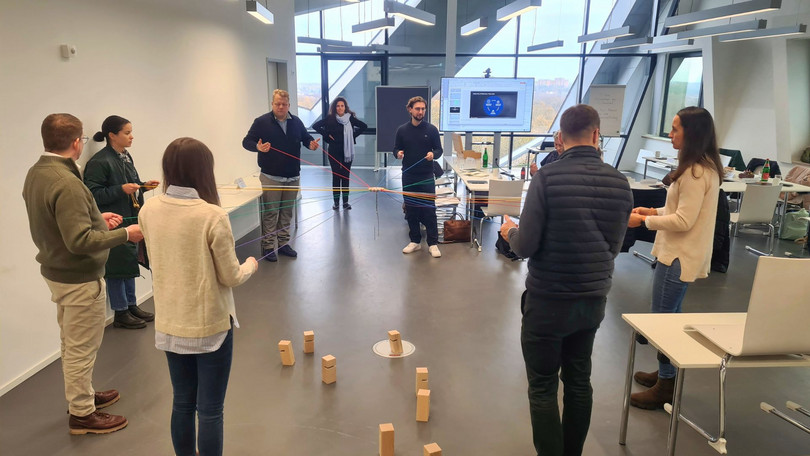
‘Effective performance management is a combination of strategy, structure and culture,’ explains HR expert Alexandra Heinrichs right at the start, opening the week together with course director Prof. Sabine Remdisch. This places high demands on managers in terms of communication and feedback skills, but also self-management. In dialogue with employees, performance management ideally sets the framework from the definition of clear, measurable goals to implementation and transparent evaluation.
For a better economy and society
At granola producer HEYHO, personnel development is approached in a new way. The Lüneburg-based social impact business employs people who would otherwise have difficulty finding work on the labour market, giving them not only a second chance, but also social and financial security.
HEYHO wants to contribute to a better and fairer economy and society – an issue that also concerns many of the students. Between the office and production, muesli and freeze-dried fruit, roasting machines and packaging equipment, there is no end to the questions for the HEYHO team, whose model is also being researched scientifically at Leuphana University.
Learning and growing together
But how do you transform a company whose structures have developed over many decades? Two very different organisations that the group visited this week have found a similar answer: learning together.
In a rapidly developing service industry, the hotel company Seminaris would probably have had little chance of survival without a willingness to change. Seminaris decided to undergo a transformation process from a classic top-down company to an agile matrix organisation and actively involved its employees in the change process.
The results include creative conference formats, proven new target groups and a cultural change within the company. In his daily work, General Manager Stefan Floret sees how the new culture empowers employees to be courageous and make their own decisions.
Support during the change process
Signal Iduna, on the other hand, operates on a different scale. Around 6,000 employees work for the insurance group at its two locations in Hamburg and Dortmund. In 2018, the company embarked on a large-scale transformation process. The goal: to develop the originally classic hierarchical company into an adaptable organisation in order to be able to respond quickly to customer needs. To this end, Signal Iduna has brought comprehensive support on board.
85 Agile Masters and a further 90 HR developers accompany the employees through the individual phases of the change process. The goal: cross-functional, interdisciplinary and more self-determined teams. Students can also see this development for themselves during their excursion by looking at the premises. In Hamburg's City Nord district, among other places, a new corporate headquarters with agile working environments has been built next to the old company building in recent years.
Cross-innovation in retail
In order to bring new concepts to market more quickly, REWE digital relies on its own innovation department, which tests and develops new products and features for the retail sector in short iterative cycles. It cooperates with various start-ups in Germany and abroad to bring together the best of both cultures and different industries: cross-innovation.
This is how the Pick&Go store concept came about, which the students test directly during their study week. The first REWE stores, such as the one in Hamburg's Schanzenviertel district, are equipped with cameras and sensors that do not collect personal data, but do record the contents of customers' shopping baskets. This means that customers no longer have to queue at the checkout. The technology directly records products taken from the shelves – the receipt is then sent by email.
The meeting room of the future
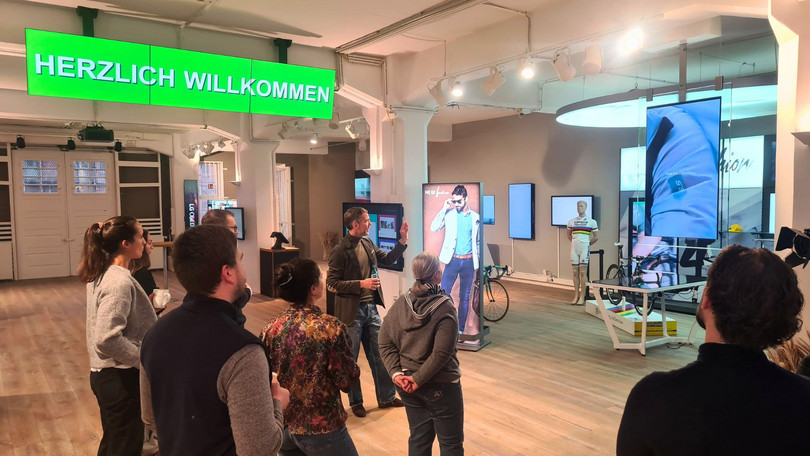
The study group also takes a look into the future during a visit to the Innovation Centre of komma,tec redaction in Hamburg's Speicherstadt, which offers digital signage solutions for organisations. These are digital information systems such as electronic posters or door signs that can be used with targeted content to communicate with customers or employees.
The company is a supplier to DEKOM Germany GmbH, which specialises in hybrid working environments. On this day, personal AI agents are naturally one of the top topics of conversation with the students. But even in the conference room of the future, a large number of cameras will be crucial, according to Simon Härke, CEO of DEKOM Germany: ‘We need flexible spaces that promote creativity and can be individually adapted to requirements. No one can afford to have empty space anymore.’ More cameras would ensure that hybrid settings can be reproduced almost realistically, as in a film. ‘However, these tools will hardly be visible anymore; the technology will fade into the background,’ predicts Härke.
High demands on managers
It is clear that high performance in a corporate context requires the interaction of a wide variety of factors, which can be positively influenced by personnel, team and organisational development tools. Managers today must keep all of this in mind.
In the MBA Performance Leadership programme, programme director Prof. Sabine Remdisch therefore relies on a specially developed performance model that highlights the skills required for modern leadership. In addition to technological and innovation-promoting skills, these include competencies such as strong communication skills and emotional intelligence. The continuing education programme for specialists and managers starts once a year in the summer semester. Applications are accepted until 31 January.
![[Translate to Englisch:] Company visit to granola producer HEYHO](/fileadmin/_processed_/e/0/csm_PeL_Blockwoche_HeyHo_a96f108203.jpg) ©Katja Hansen
©Katja Hansen
 ©Katja Hansen
 ©Katja Hansen