
ETHICS IN DIALOGUE: Medical-Ethical Borderline Cases at the Beginning and End of Life
“We respond when ethical tensions arise.”
2026-01-23 “Everyday life, simply by virtue of being everyday life, tends to divert our attention. We work, shop for groceries, unload the dishwasher—year after year. Yet sooner or later, every one of us is confronted with circumstances in which we must make difficult decisions about our own health,” stated Prof. Dr. Thomas Kück in his introduction to the most recent event in the ETHICS IN DIALOGUE series. On Thursday, January 15, 2026, the discussion held in the Room of Silence in the Central Building focused on medical-ethical questions concerning the beginning and end of life. “At that juncture—whether we want it or not—we are required to pose the right questions and assume responsibility.”


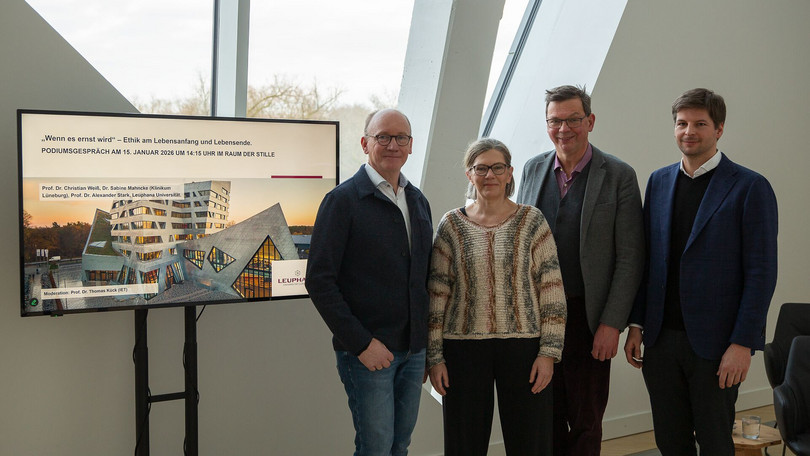
Dr. Sabine Mahncke, a senior consultant in pediatrics and adolescent medicine, and her colleague Prof. Dr. Christian Weiß, chief physician of cardiology and intensive care medicine, provided the audience with representative insights into their demanding professional practice. Both members of the Ethics Committee at Klinikum Lüneburg, an interdisciplinary advisory body that supports clinical decision-making in complex therapeutic contexts.
“At the heart of every decision lies the well-being of the patient,” explained chief physician Dr. Weiß. “What is medically feasible? And what is medically appropriate in light of the patient’s perspective?” Moderator Thomas Kück followed up with a critical question: “In situations of acute crisis, is there sufficient time to properly determine what constitutes the patient’s well-being?” “Yes,” Christian Weiß responded. “Even in time-critical cases, there is room for consultation with relatives. The decisive questions generally arise after the immediate emergency, when decisions about longer-term treatment strategies must be made.”
Life Preservation or Alleviation
“What kinds of decisions does this involve?” the moderator asked. “Primarily decisions about shifts in therapeutic goals,” Dr. Sabine Mahncke explained. “In such cases, the focus may shift away from life-preserving measures toward the alleviation of suffering in a terminal phase.” She cited another example: “In the case of an extremely premature birth, should intensive care treatment be initiated at all?”
Professor Weiß summarized the situation concisely: “We intervene when ethical tensions arise—particularly when the assessment of the medical and nursing staff regarding further treatment differs from the wishes expressed by the patient’s relatives.” In such cases, advance directives may serve as an important point of orientation for medical care, particularly when patients are no longer able to communicate or respond.
At this stage of the discussion, legal expertise was introduced by Prof. Dr. Alexander Stark. The Junior Professor of Public Law and Legal Philosophy at Leuphana Law School emphasized the constitutional relevance of human dignity and individual self-determination, from which a fundamental right to a self-determined death may be derived. The decisive criterion for both scope and limits of this right, he argued, is the voluntariness and personal responsibility underlying the decision. This marks a key distinction between the beginning and the end of life, as newborns are not capable of articulating a freely responsible will.
Assisted Dying?
The closely related issue of assisted dying raises complex legal questions. While passive and indirect forms of assisted dying are not subject to criminal liability when they correspond to the patient’s expressed wishes, active assisted dying remains a criminal offense under current law. Sabine Mahncke confirmed that, in pediatrics and adolescent medicine, borderline cases typically involve questions of indirect or passive assisted dying: “We are dealing with extremely premature infants with a highly uncertain prognosis, or with children suffering from the most severe multiple underlying conditions. In such cases, the question of quality of life inevitably arises.” At the same time, she emphasized that in these situations the affected individuals are not themselves in a position to decide about their own lives. Physicians and nursing staff therefore carefully consider the child’s responses and signals and support parents in their decision-making process, guided by the paramount principle of the child’s best interests.
Turning again to the issue of self-determination, Thomas Kück addressed the prohibition of killing upon request as codified in Section 216 of the German Criminal Code. Professor Stark argued for a constitutionally consistent revision of this provision and the adoption of an assisted-dying statute. The theologian and church historian reaffirmed his fundamental opposition to active assisted dying, stating: “The Basic Law, in every one of its articles, reflects a profound commitment to resisting National Socialism and its crimes. Section 216 of the Criminal Code must be understood against this historical backdrop.” Professor Stark countered that the primary focus should instead lie on the freely responsible will and the individual, private decision of the patient: “That position is, in fact, the very opposite of National Socialist euthanasia policy,” he argued, “which entirely disregarded any form of self-determined, freely responsible intent on the part of those affected.”