
Lower Saxony is funding a new center for empirical educational research with 5.8 million euros
Research that makes a difference
2026-02-06 How can we create teaching that empowers children and young people? How can the education system remain adaptable when societal demands are changing rapidly? With the establishment of the Center for Empirical Educational Research (ZEB), Lower Saxony aims to provide scientifically sound answers to these and many other questions. The ZEB addresses current challenges in the field of education and sees itself as a bridge between educational science, educational policy, and educational administration. It pools expertise, promotes exchange among key stakeholders, and provides evidence-based foundations for educational policy decisions.
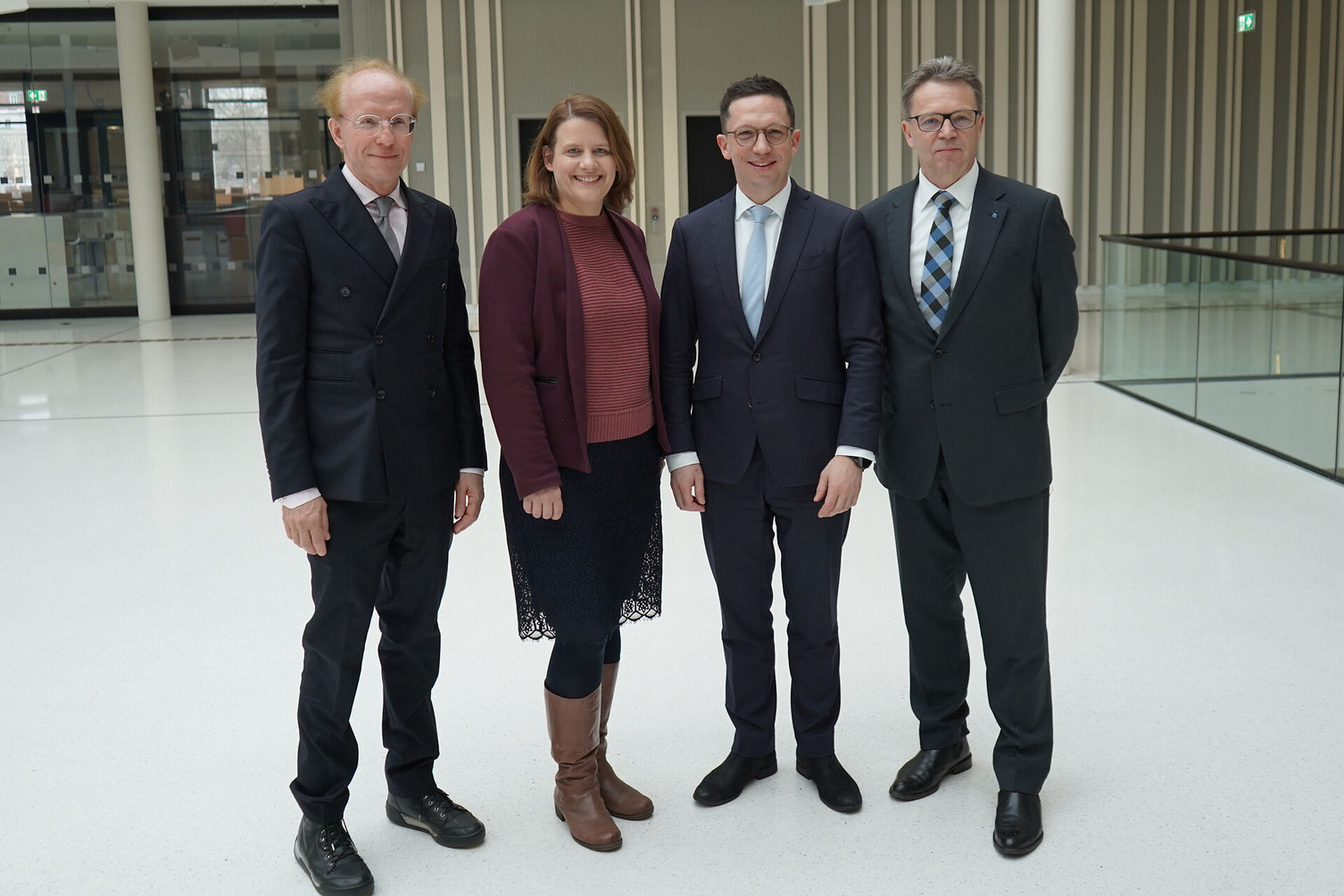
The new center will be funded with approximately €5.8 million over six years from the joint funding program zukunft.niedersachsen of the Lower Saxony Ministry of Science and Culture and the Volkswagen Foundation. In parallel, zukunft.niedersachsen is funding accompanying measures for empirical educational research within the "Research Alliance for Intervention, Implementation, and Transfer Research" with an additional €4.1 million. Participating institutions in this alliance include Leibniz University Hannover, the Technical University of Braunschweig, and the University of Hildesheim.
The ZEB (Center for Educational Research) at the Lüneburg site is jointly operated by Leuphana University Lüneburg and Leibniz University Hannover. Initial research will focus on the competence measurement of learners and teachers, innovative approaches to educational monitoring, and data-driven and evidence-informed school development. Furthermore, close collaboration with other universities and research consortia at the national and international levels is planned to further strengthen the quality and reach of educational research in Lower Saxony. A total of three professorships and up to ten doctoral positions will be funded for this purpose. The universities will ensure the subsequent permanent appointment of these professors and will also create two additional junior professorships for the ZEB (Center for Educational Research). The initiative to establish the center came from the Scientific Commission of Lower Saxony (WKN).
Lower Saxony's Minister of Science, Falko Mohrs, stated: “Good education is the key to tomorrow's prosperity. But what constitutes good education, and how can our education system remain relevant? I am delighted that with the establishment of the ZEB, we are further strengthening empirical educational research in Lower Saxony and that these very questions of the present and future will be answered here – scientifically sound, innovative, and closely aligned with the lives of students.”
Lower Saxony's Minister of Education, Julia Willie Hamburg: "The demands on our schools are immense – and they continue to grow. Dealing with heterogeneity, ensuring basic skills, the shortage of skilled workers, inclusion, integration, and digitalization are all topics that are becoming increasingly relevant. Lower Saxony has already embarked on a path of modernizing learning and schools with a variety of programs and initiatives. However, we cannot leave greater educational equity and quality to chance. We need to know how the programs and the available freedoms are working, under what conditions they are successful, and where they need support. Now is the right time to systematically integrate the initiated innovation processes into expanded educational monitoring – with reliable data, continuous observation, and scientifically sound evaluation. The still-young ZEB (Center for Educational Quality Improvement) demonstrates that politics, science, and practice are not separate worlds, but rather part of a shared responsibility for quality education. Together, we are shaping the future."
Professor Sascha Spoun, President of Leuphana University Lüneburg: “Good education is essential – above all for democracy, the economy, and also personal development. With the new research center, the participating universities aim to support the state of Lower Saxony in specifically improving the education of pupils based on scientific data. As a thematically oriented university, Leuphana focuses its work on current societal developments. Across disciplines and in cooperation with practitioners, we want to make a concrete contribution to solving problems. With the establishment of the new Center for Educational Research, we are consistently pursuing this approach.”
Prof. Volker Epping, President of Leibniz University Hannover: “We thank the state of Lower Saxony for supporting our universities in the field of empirical educational research with a total of three professorships. This allows us to further develop our strengths and potential in this area together and to collaborate at the highest research level. In return, by strengthening our research, we create science-based insights as a basis for decision-making in education, politics, and schools, and can thus provide sound support for the urgently needed transformations in education. At Leibniz University Hannover, the professorship for Educational Innovation & Change focuses on researching the transfer of empirical data into educational practice and thus enabling concrete school development.”
Prof. Jutta Allmendinger, Chair of the Lower Saxony Scientific Commission: “Empirical educational research provides many insights into how our school system, school administration, and the performance of our students can be improved.”
zukunft.niedersachsen
The majority of the funding provided by zukunft.niedersachsen (future.lower-saxony) stems from the equivalent of the annual dividend on the nominal value of 30.2 million VW trust shares held by the State of Lower Saxony, which are subject to the profit transfer claim to the Volkswagen Foundation. According to its statutes, the funding is to be awarded to scientific institutions in the State of Lower Saxony. The state government submits proposals for the allocation of these funds to the foundation's board of trustees, usually in the summer and autumn. In the 2024 reporting year, a total of €618.7 million was available to zukunft.niedersachsen due to special income.