
15 years of the Faculty of Sustainability: What does science think of fireworks?
2025-12-17 For 15 years, the Faculty of Sustainability at Leuphana University Lüneburg has stood for innovative research and teaching on the major issues of our time. As a faculty of sustainability sciences that is unique in Europe, it has been combining ecological, social, and economic perspectives since 2010 and working on interdisciplinary and transdisciplinary solutions for social transformation. At the end of the anniversary year, researchers are taking an interdisciplinary look at the topic of “fireworks.” And a sweet and sustainable alternative for New Year's Eve awaits.
![[Translate to Englisch:] Prof. Dr. Jacob Hörisch](/fileadmin/_processed_/2/0/csm_Crowdfunding_Nachhaltige_Entwicklung_001_0314b57de9.jpg)
![[Translate to Englisch:] Prof. Dr. Maureen Schulze](/fileadmin/_processed_/b/0/csm_Frau_Dr._Maureen_Schulze_Ernennung_cc2269311f.jpg)
![[Translate to Englisch:] Maria del Carmen Sunen-Bernal](/fileadmin/_processed_/5/e/csm_sunen_bernal_maria_del_carmen_795-82702_88d99fdc5e.jpg)
![[Translate to Englisch:] Prof. Dr. Astrid Kause](/fileadmin/_processed_/f/5/csm_Portraet_von_Astrid_Kause_8cbc7f0ca1.jpg)
The fascination of fireworks – a chemical perspective
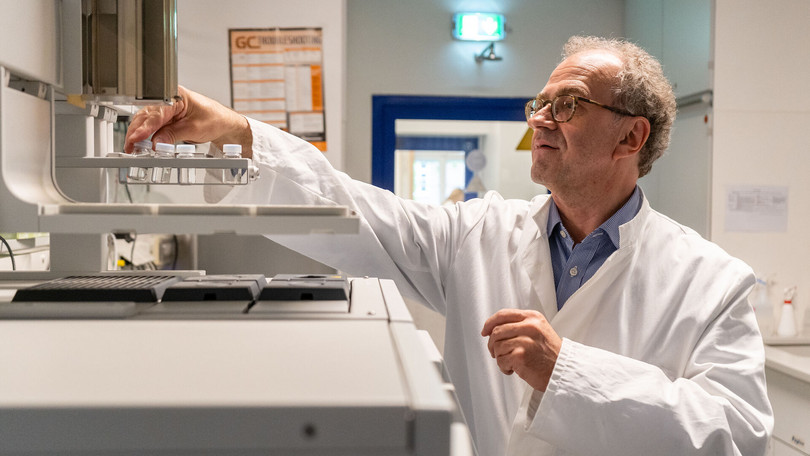
Prof. Dr. Klaus Kümmerer, Professor of Sustainable Chemistry and Material Resources
Professor Kümmerer, do you like fireworks?
As a chemist, I can't possibly be against fireworks. The chemistry behind them is fascinating. In the past, kings and princes used them to demonstrate their power and emphasize their splendor. Fireworks and the chemistry behind them had a mystical and mysterious effect. Part of this fascination still resonates today.
How are the colors in fireworks created?
The colors of fireworks are created by heated metal salts—such as strontium for red, copper for green or blue, sodium for yellow, and magnesium or aluminum for white light—whose excited electrons emit characteristic colored light when they fall back. The art lies in controlling the sequence so that not all effects happen at once. Different capsules, delays, and ignition mechanisms create successive effects. It is an interplay of chemistry, physics, and engineering that has been developed over centuries.
It's all very colorful, but are there any sustainability issues?
Fireworks affect animals primarily through their noise. A study by the Max Planck Institute has shown that wild geese, for example, fly for miles to escape the noise. Fireworks also pose risks to humans: they can cause serious injuries such as blast trauma or the loss of fingers or more, and people who have experienced war, such as refugees, are particularly sensitive to the noise. In addition, fireworks cause a massive short-term deterioration in air quality; in the hour they are set off, particulate matter levels can rise to 1,000 to 10,000 times normal concentrations, which can be dangerous for people with respiratory problems. The consumption of resources is also considerable, as fireworks contain valuable and hard-won metals such as strontium or even rare earths in some cases, and also leave behind large amounts of waste that has to be disposed of. The fire hazard should not be underestimated, especially in historic neighborhoods, but not only there.
What do you think are the alternatives?
People are optimistic on New Year's Eve and want to celebrate. That's a good thing. Why don't local authorities organize an artistic, musically accompanied aerial fireworks display instead of individual fireworks, safely implemented by professionals with less impact on spectators and the environment? This could be financed by tax revenue or donations from citizens who refrain from setting off private fireworks. There are already examples of this.
There is another, slightly smaller alternative: sparklers. How do they work?
We have perchlorate, iron, and starch. The perchlorate serves as an oxidizing agent, while the iron and starch form a kind of dough that holds everything together. The gray color comes from the iron: when heated, it glows white and small iron particles jump off due to thermal tension—hence the typical sparkle.
Thank you very much for talking to us!
Fireworks from an economic perspective – why bans sometimes make economic sense
Prof. Dr. Jacob Hörisch, Professor of Sustainability Economics & Management
First, a confession: I think fireworks are beautiful – especially when there's a festival on the Lüneburg Sülzwiesen and I can watch it from my study. At the same time, I know that fireworks cause damage for which those responsible do not pay. People suffer from enormous particulate matter pollution and overcrowded hospitals on New Year's Eve, nature suffers from CO₂ emissions and waste, and small children and animals are disturbed by the noise. In sustainability economics, such uncompensated damage is called externalities. However, traditional taxation would be virtually impossible to implement in this case, as there are many individual perpetrators and different externalities. That is why solutions that are normally unpopular from an economic perspective can also make sense: bans or temporal and spatial restrictions, or centralized fireworks displays, such as on the Sülzwiesen. Perhaps in the future we will experience city-wide communal fireworks displays – and I will be able to watch one of the central fireworks displays in Lüneburg on New Year's Eve without worrying about sleeping children or feeling guilty about the environment. Sometimes, even from an economic point of view, uneconomical solutions are the best. And sparklers will still be allowed.
Why we set off fireworks despite our good intentions
Prof. Dr. Maureen Schulze, junior professor for sustainable purchasing and consumption decisions at the Centre for Sustainability Management
Environmental awareness among the population is growing, but when it comes to fireworks, there is a clear contradiction: although the negative consequences such as fine dust, waste, noise, and stress for animals are increasingly becoming the focus of social attention, sales of fireworks are rising. This behavior can be explained primarily by the so-called attitude-behavior gap: many people want to act more sustainably, but sometimes find it difficult to put their good intentions into practice. In the case of fireworks, several factors reinforce this gap: from their deep cultural roots to the often imperceptible damage they cause to the perceived ineffectiveness of personal abstinence. However, it is important to note that the responsibility does not lie solely with consumers. A change in supply, but also clear political regulations, are just as important in closing the gap between sustainable attitudes and actual behavior. Sustainable consumption is promoted when politics, business, and society act together. And, as is so often the case with sustainable behavior, it takes time, repetition, and targeted support to establish new habits—similar to New Year's resolutions.
Twelve grapes for good luck: a sweet New Year's Eve tradition without fireworks
Maria del Carmen Sunen-Bernal, International Center
In Spain, New Year's Eve is traditionally celebrated less with private fireworks, but instead there are often large, official fireworks displays and organized events in the cities. The most popular places for communal fireworks are the main squares such as Puerta del Sol in Madrid or Plaça Catalunya in Barcelona.
On New Year's Eve in Spain, it is traditional to eat a grape for each of the twelve chimes of midnight. This is called “Las Doce Uvas de la Suerte” (the twelve lucky grapes). Those who manage to eat all the grapes in time are said to be blessed with good luck and prosperity in the new year, with each grape representing a month or a wish.
The tradition dates back to 1909, allegedly because of an unusually large grape harvest that year. This custom is not associated with fireworks, but both customs are often celebrated together.
Fireworks, risk, and perception: How dangerous is New Year's Eve really?
Prof. Dr. Astrid Kause, Assistant Professor of Sustainability Science and Psychology
Should we be concerned about the impact of fireworks on people and the environment and take a clear stand for (or against) them, for example by calling for a ban on firecrackers? People must weigh this up for themselves, but as scientists we can help them to better assess the risks. As a psychologist, I am particularly interested in how people perceive risks – all the more so when these are hotly debated and potentially polarize people.
First of all, I am interested in how high the risk actually is. In addition to dirt, noise, and damage to buildings, especially in large cities such as Berlin or Hamburg, hundreds of injuries, and negative effects on animals, according to media reports, five people died from fireworks on New Year's Eve 2024/25 – and that is five deaths too many.
Then I want to know how a risk compares to other risks: Am I worried about what really threatens me? Here are a few examples for comparison: There were 45 deaths due to drunk driving on Saturdays in 2021 in Germany. In Berlin alone, around 5,000 people died in 2024 due to particulate matter and nitrogen oxide pollution. Which of these are attributable to fireworks, and which to traffic, industry, and heating?
To better assess risks overall, it is worth taking a look at the risk street, which tells me how many residents on average are affected by different risks—per 100,000. That's about 514 cases of minor assault, 269 victims of violence, and two traffic fatalities. Or: 11,800 people made a claim on their home insurance. If I look only at the number of people who do not survive New Year's Eve (and disregard other effects for the moment), this corresponds to 0.00625 deaths per 100,000 inhabitants – so in comparison, this is actually rather unlikely.
The risk street shows that in order to assess what threatens us, we need comparable populations (e.g., per 100,000 inhabitants) and a good description of costs and benefits. It also helps to know what we don't yet know for sure: What are the long-term health effects of fireworks – for example, on hearing or the respiratory tract?
Risks that affect many people in a short period of time often receive a lot of attention, including media attention, even if the number of people affected by such “dread risks” is relatively small compared to the population as a whole. For various reasons, these risks are sometimes heatedly debated: perhaps they are an important part of a culture. Or their consequences are particularly visible, such as those on New Year's Eve. On the other hand, we may neglect other, more dangerous risks because we think we can control them well or because they cause less visible damage, such as multi-resistant germs in hospitals.
Ultimately, the question for me is: Is the effort involved in banning fireworks justified? Or should we instead campaign against the construction of a motorway, for example, given the impact it will have on particulate matter, noise, health, and the ecosystem for decades to come? Comparable data is the way to make an informed decision here.