
MBA Sustainability Management: Founding nature-positive supply chains
2025-12-14 For years, Leuphana alumnae Regina Kallfelz and Miriam Farsi have been committed to sustainable supply chains in the textile and beauty industry. Now, with the EXIST start-up grant for scientific start-ups, they are going one step further together with the Centre for Sustainability Management: The Soil Sisters Group is raising awareness of regenerative management and nature-based solutions in the textile and beauty industry. For those interested in part-time studies and continuing education, the Professional School at Leuphana University of Lüneburg is offering an online information day on January 7 and 8, 2026.
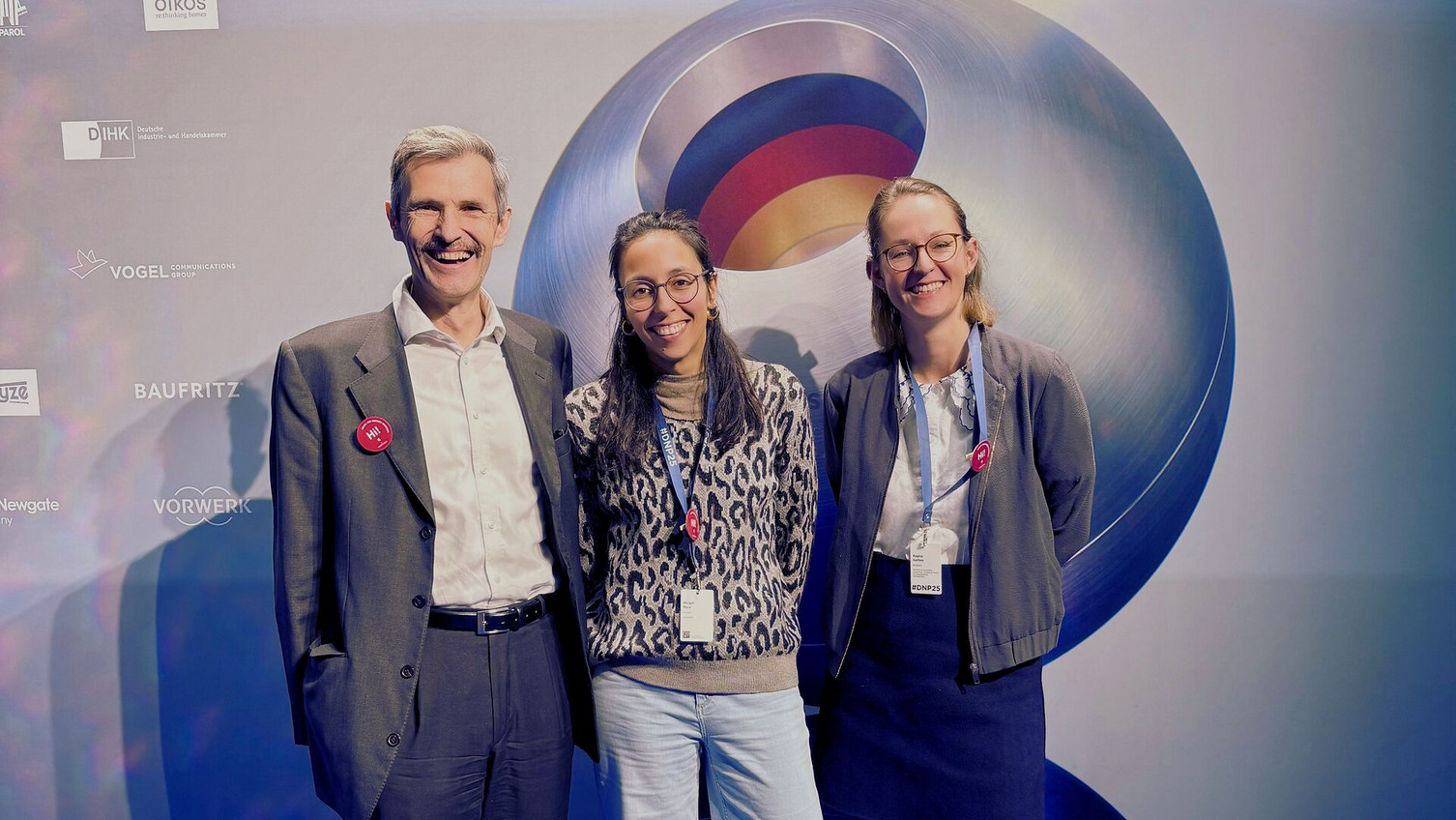
Million-dollar marketing budgets often contrast with practices that are not very sustainable: Regina Kallfelz and Miriam Farsi know the fashion industry. Both have worked there successfully for a long time: "I started my career in quality management in 2009. The end product had to be free of harmful substances. What happened before that was irrelevant for sales," reports Regina Kallfelz. The textile manager became thoughtful. "I looked for training opportunities that would explain to me how business and management can function sustainably," recalls the Hamburg resident.
The part-time MBA program in Sustainability Management at Leuphana's Centre for Sustainability Management (CSM) gave her the necessary tools to think about sustainability holistically. After graduating in 2016, she often traveled to manufacturing countries such as China, Myanmar, and Bangladesh, where she saw the reality of textile production with her own eyes: "It's not enough to avoid harmful substances in the finished product—the entire supply chain must become cleaner, starting with the raw materials," she summarizes.
Her friendship with Miriam Farsi marked the beginning of something new. The two women met at Generation Restoration. The aim of the association is not only to make refugee camps more sustainable through regenerative agriculture, but also to offer the people there career prospects and a source of income.
Miriam Farsi, an alumna since 2021, previously worked in the luxury fashion industry. After the birth of her two children, she made a clear decision to pursue sustainability: "I want to be part of the solution." She completed her part-time MBA in Sustainability Management with a master's thesis on agroforestry in Morocco: "Seventy percent of the people there live from agriculture, but it only accounts for a small part of the economy," she explains. She sees regenerative agriculture as the key to generating income, protecting soil, and opening up prospects in crisis regions. Through her studies at the Leuphana Professional School befor , Miriam Farsi learned above all how to convince people with technical arguments: "That's one of the most important levers for initiating change," she says.
The two founders want to make the textile industry more sustainable and fairer. "The textile and beauty industries are under pressure: resource waste, species extinction, and exploitation characterize the picture. But through soil-building cultivation methods, smart technologies, systemic cooperation, and regional solutions, natural fiber cultivation can become part of the solution," says Regina Kallfelz.
One example: organic waste—such as cotton plant stems—can be used to produce biochar. This is created when organic waste is burned in the absence of air. Biochar acts like a sponge, increasing soil fertility while also storing CO₂. So-called CO₂ credits can be sold as certificates – and be another source of income for farmers. "Climate-related extreme weather events are causing significantly poorer harvests," explains Miriam Farsi. "To ensure that investments flow specifically into regenerative farming practices on farms, we enable companies to purchase these CO₂ certificates." This creates a long-term connection between companies and farmers. A key feature of the Soil Sisters startup: "It's not about just any offset certificate. Companies support the farmers who grow natural fibers for them. This turns offsetting into insetting, because the measures are implemented in their own supply chain."
This creates a kind of solidarity-based agriculture for the textile industry. Both explain that this benefits farmers, who generate additional income, and companies, which make their supply chains more resilient and nature-positive.
Both are currently preparing for their science-based start-up in a one-year support program, backed by Leuphana's start-up service. Prior to this, they completed the Scale F program at Leuphana and successfully applied for an EXIST start-up grant in June 2025. The project is being scientifically supported by Prof. Dr. Jacob Hörisch, Professor of Sustainability Economics and Management at CSM.
Miriam Farsi and Regina Kallfelz share a conviction: "We must act regeneratively. Seven of the nine planetary boundaries have been exceeded. Now it's time to actively restore nature. With our innovative tools, we increase visibility and acceptance and create connections and commitment to nature-based solutions," says Regina Kallfelz. "Together, the raw material-dependent beauty and textile industries have enormous potential to accelerate change, because cotton is grown on 15% of the world's arable land and the beauty and wellness industry is now just as economically significant as the global oil and gas industry," adds Miriam Farsi.
The MBA Sustainability Management program prepared both of them for this major challenge and continues to support them: "Even after all these years, we still have close ties to Leuphana and the CSM. The community supports us, and the exchange of ideas always helps us move forward."
Information day on part-time studies at the Professional School
For those interested in part-time studies and continuing education, the Professional School at Leuphana University Lüneburg is offering an online information day on January 7 and 8, 2026. Participants will gain concise insights into bachelor's, master's, and certificate programs and will have the opportunity to speak directly with program directors and students. Registration for the information day is available online.
The program starts at 4 p.m. on both days. After general presentations, the program directors will present their study programs in digital lectures and discussions and will be available to answer questions. In addition to study programs and certificates, the Professional School itself, financing options for studying, the organization of e-learning, and the various participation options for part-time continuing education will also be presented in more detail.